

Key Takeaways
Our Verdict
Both philosophies can produce genuinely functional homes, but they suit different households and lifestyles. Minimalist organisation rewards those who are comfortable reducing possessions and living lean; the everything-has-a-home approach shines in busy, multi-person households where items need to be found quickly and returned consistently. For most households, a thoughtful blend of both principles will outlast rigid adherence to either extreme.
| Best for | Recommended |
|---|---|
| Singles or couples who prefer low-maintenance, clutter-free living | Minimalist Organisation |
| Families, shared homes, or anyone managing a wide range of everyday items | Everything-Has-a-Home Approach |
| Those wanting sustainable long-term habits without extreme decluttering | Hybrid of Both |
What Each Philosophy Actually Means
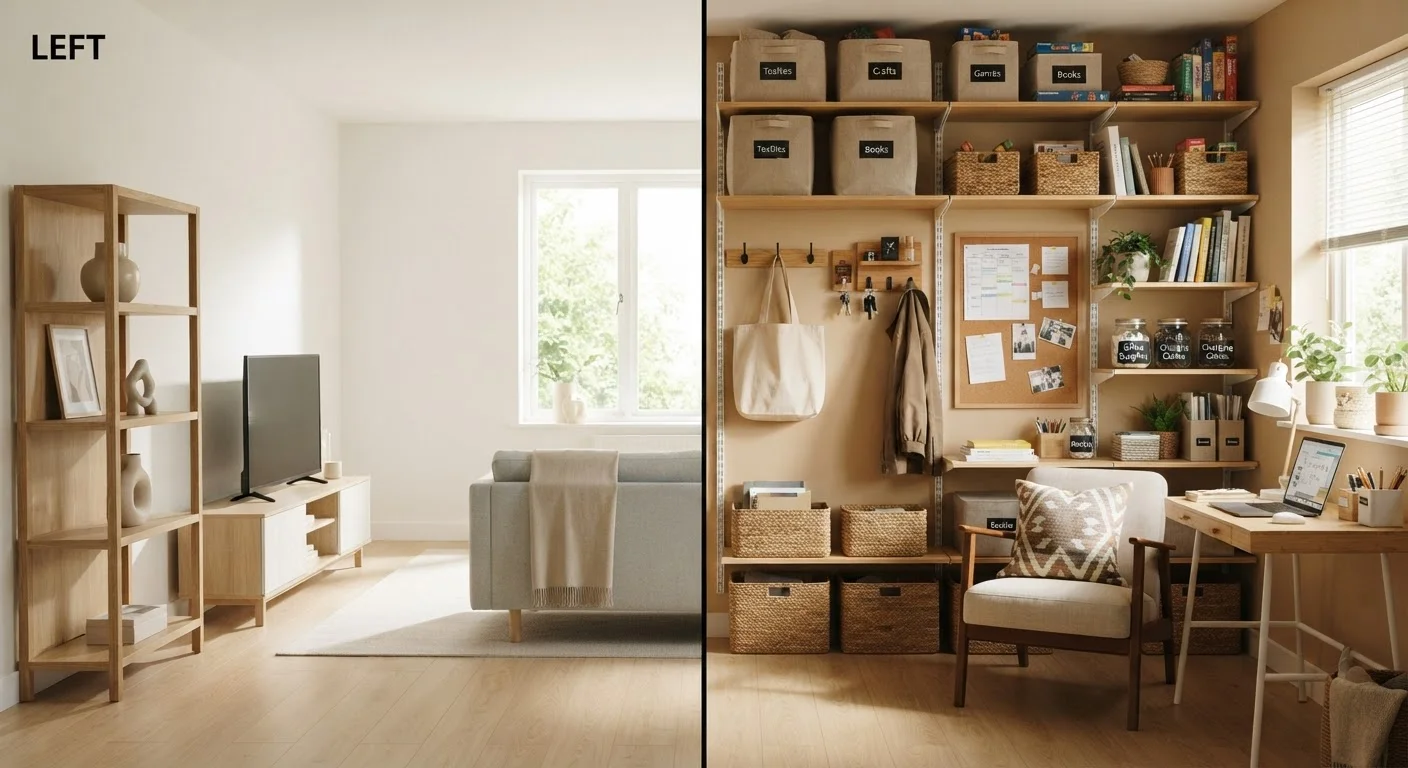
Minimalist organisation starts with reduction. The guiding idea is that the fewer objects you own, the less infrastructure you need to manage them. Surfaces stay clear not because every item has a designated spot, but because non-essential items have been removed entirely. The system practically maintains itself — there simply isn't much to put away.
The everything-has-a-home approach takes a different angle. It doesn't necessarily demand fewer possessions; instead, it insists that every item you keep has a specific, intentional location. Scissors go in one drawer, chargers in a designated basket, spare keys on a particular hook. The discipline is in the placement, not the quantity.
These two philosophies are often conflated, but they solve different problems. Understanding which problem your household actually has is the starting point. See our introduction to building your first organisation system if you're not sure where to begin.
Comparing the Two Approaches
Both methods have genuine strengths and real limitations. The comparison below looks at how each performs across the criteria that matter most day-to-day.
| Minimalist Organisation | Everything-Has-a-Home | |
|---|---|---|
| Initial effort required | High — significant decluttering upfront | Moderate — categorise and assign locations |
| Ongoing maintenance | Low — fewer items to manage | Medium — relies on consistent habit |
| Works for multiple users | Challenging — requires shared values on ownership | Strong — clear rules work well for shared use |
| Suits high-possession households | Poor fit — requires reducing items substantially | Good fit — accommodates what you choose to keep |
| Visual calm achieved | Very high — surfaces stay clear naturally | High — when system is followed consistently |
| Recovery after disruption | Quick — little to reset | Requires re-engagement from all household members |
| Flexibility for new items | Low — acquiring new items conflicts with ethos | Moderate — new items simply need a designated home |
One pattern stands out: minimalism front-loads the work (the initial declutter) and reduces ongoing effort, while the everything-has-a-home system distributes effort more evenly — easier to start, but requiring consistent follow-through from everyone in the household. For shared homes, that consistency can be the hardest part. Our article on organising a shared home when tolerance for mess differs covers that challenge in depth.
Where Each Approach Works Best
Minimalist organisation tends to suit people who live alone or with one other person, work from home, or find visual clutter genuinely disruptive to focus. It pairs well with a mindful living approach and can support clearer thinking in a workspace. However, it can feel restrictive for households with children, hobbyists, or anyone whose meaningful possessions span multiple categories.
The everything-has-a-home approach shines in households with kids, in shared rentals, and anywhere multiple people need to find and return the same items independently. It's also more forgiving of sentimental attachment — you don't have to get rid of things, just place them thoughtfully. The tradeoff is that the system only works if everyone in the home participates. An item that regularly ends up in the wrong spot undermines the whole model.
Start With One Zone, Not the Whole House
Testing either philosophy in a single area — a bathroom cabinet, an entryway, or a kitchen drawer — lets you gauge what's sustainable before committing household-wide. Most people find they naturally prefer one approach in certain rooms and the other elsewhere. That's a workable outcome, not a compromise.
If you've tried either approach and found it unsustainable, you may be running into a common misconception about how organisation systems work. The article Organisation Myths That Are Quietly Making Your Home More Chaotic is worth a read before you start over.
Building a Hybrid That Actually Sticks
Most functional homes are neither purely minimalist nor exhaustively labelled. A practical hybrid takes the minimalist principle of intentional ownership — keeping only what earns its place — and combines it with the everything-has-a-home discipline of consistent placement. You don't need to own fewer than 100 items, but you do need a reason for each item and a place for it to live.
A useful entry point: apply minimalist thinking to categories where clutter accumulates easily (junk drawers, bathroom counters, digital cables), and apply the everything-has-a-home method to high-traffic items that multiple people need daily (keys, school bags, chargers, medications).
Principles like the one-in, one-out rule help maintain balance over time — our overview of widely used organisation principles explains this and other useful methods plainly. For homes with limited floor space, pairing either approach with smart storage choices can multiply the effect — see small-space organisation strategies for practical options that don't require renovation.
Ultimately, the method you can maintain on a tired Tuesday evening is the right one for your household.