

Key Takeaways
Start here
Why Most First Attempts at Organisation Fail
Understand the basics
The Core Concepts You Need to Understand First
Take action
How to Choose Your Starting Point
Make it last
Building a System That Actually Sticks
Set expectations
What to Expect in the First Few Weeks
Why Most First Attempts at Organisation Fail
Most people approach home organisation the same way: they spend a whole weekend sorting, labelling, and rearranging — and within a month, things look exactly as they did before. The problem isn't a lack of effort. It's treating organisation as a one-time event rather than an ongoing system.
Clutter tends to return because the underlying habits haven't changed. Items drift back to surfaces because they still don't have a consistent, designated place. Without a repeatable routine to fall back on, even the most ambitious overhaul slowly unravels.
Understanding this distinction — event versus system — is the single most important shift a beginner can make. It changes what you aim for and how you measure success.
The Core Concepts You Need to Understand First
Before you move a single item, it helps to know the vocabulary and logic behind effective organisation. These aren't abstract ideas — they're practical principles that explain why certain approaches work and others don't.
Organisation system
A set of repeatable routines and designated places for your belongings that keeps your space functional without constant effort.
Decluttering
The process of removing items you no longer use, need, or want so that what remains is easier to manage and find.
Zone
A defined area of your home — such as a kitchen counter or bedroom closet — treated as a distinct unit when building organisation habits.
Maintenance reset
A brief daily or weekly routine of returning items to their proper places to prevent disorder from building up over time.
One-in, one-out rule
A guideline where every new item brought into the home is matched by removing an existing item, keeping overall volume steady.
For a deeper look at principles like the one-in, one-out rule and how they apply day-to-day, see our overview of core organisation principles.
How to Choose Your Starting Point
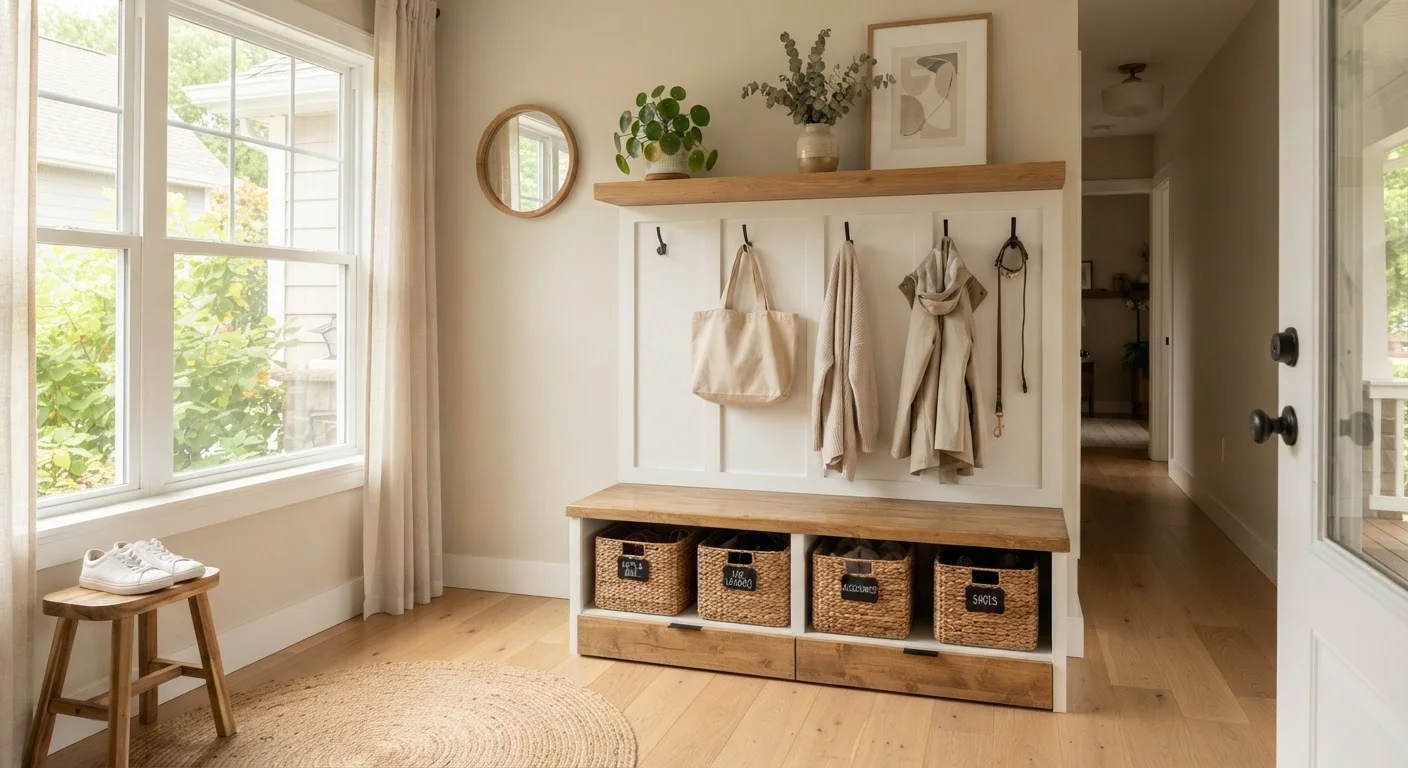
The biggest mistake beginners make is trying to organise everything at once. Instead, choose a single zone — ideally one you interact with multiple times a day, like a kitchen counter, entryway table, or bathroom shelf.
Start with a Five-Minute Sort
Before buying a single bin or label, spend five minutes sorting one small area — a junk drawer, a bathroom shelf, or a coat hook. This reveals what you actually own and what you genuinely need to store. It also gives you an immediate, low-stakes win.
Ask yourself two questions about your chosen zone: What comes into this space? and What should leave it? These questions clarify purpose and make decisions faster. Once a zone is functioning well, that same logic scales naturally to the next area.
Avoid the Storage-Shopping Trap
Buying matching bins and baskets before you've decluttered almost always results in beautifully organised clutter. Containers should follow the decluttering process, not precede it. Wait until you know exactly what needs a home before spending money on storage products.
If the sheer volume of stuff feels paralyzing, it may help to read about approaching your space with a more intentional mindset before diving into the physical work.
Building a System That Actually Sticks
A durable system has two components: designated homes for every item you keep, and a maintenance reset you can realistically perform. The reset doesn't need to be elaborate — five to ten minutes each evening returning things to their places is enough to prevent disorder from compounding.
Match your system to your real routines, not an idealised version. If you know you always drop your bag by the front door, put a hook there. Fighting your natural tendencies wastes energy; designing around them makes the system nearly invisible.
Organisation Looks Different for Everyone
There is no single correct system. A method that works perfectly for one household may feel restrictive or impractical in another. Your goal is a system that fits your actual life — your routines, your space, and the people sharing it — not one copied from a magazine or social media feed.
Organisation also benefits from the same consistency principles that underpin any new habit. For guidance on building routines that last, the first 30 days of habit-building guide offers a practical framework that applies directly here.
What to Expect in the First Few Weeks
In the first week, expect friction. New systems require conscious effort before they become automatic, and it's normal for things to slip back temporarily. This doesn't mean the system is failing — it means habits are still forming.
By the second and third weeks, your designated zones should start feeling intuitive. You'll notice yourself automatically returning items rather than leaving them out. Small wins — finding something immediately because it has a proper home — reinforce the behaviour.
Perfection is not the goal. A system that's followed imperfectly 80% of the time is vastly more effective than a perfect system you abandon after two weeks. Adjust as you learn what works in your specific space, and consider pairing your organisation efforts with broader lifestyle intentions — the mindful living hub offers useful perspectives on building intentional everyday environments.