

| Origin of the One-In, One-Out Rule | Consumer behavior and wardrobe management communities |
| FIFO Stands For | First In, First Out (Standard inventory management terminology) |
| KonMari Sorting Order | Clothing → Books → Papers → Komono (miscellaneous) → Sentimental items (Marie Kondo, The Life-Changing Magic of Tidying Up) |
| Most Common Clutter Hotspot | Flat horizontal surfaces (counters, tables, entry areas) |
| Zone Organization Best For | Households with multiple users or mixed-activity spaces |
| Capsule Wardrobe Typical Size | 30–40 core items (varies by practitioner) |
Why Principles Matter More Than Products
Walk into any home organization aisle and you'll find bins, dividers, and label makers promising a tidier life. But experienced organizers will tell you the same thing: systems fail when people don't understand the reasoning behind them. Principles give you a mental framework that works regardless of your square footage, budget, or lifestyle — and they travel with you when you move, downsize, or share a space.
This glossary covers the most widely used organization principles and methods. Bookmark it as a reference, or use it as a starting point if you're building your first real organization system from scratch.
One-In, One-Out Rule
A habit-based principle where every new item brought into the home is matched by removing one comparable item. It prevents gradual accumulation without requiring drastic decluttering sessions.
Zone Organization
Dividing a home into activity-based areas so that storage and supplies are located where they're actually used. Zones are defined by behavior, not by room labels.
Decluttering
The process of removing items from a space that are unused, duplicated, broken, or no longer serving a purpose. Decluttering is typically the first step before building any storage system.
FIFO
"First In, First Out" — a rotation method where older stock is placed at the front and newer items at the back. Most commonly applied in pantries and medicine cabinets to reduce waste.
Capsule Wardrobe
A deliberately small, curated clothing collection built around versatile, coordinating pieces. The goal is to reduce decision fatigue while ensuring everything owned is actually worn.
Decision Fatigue
The mental drain that comes from making too many choices. In home organization, clutter and poorly structured storage increase decision fatigue by forcing small choices repeatedly throughout the day.
KonMari Method
An organization approach that involves sorting possessions by category rather than room, and keeping only items that are functional or feel personally meaningful. Developed by organizing consultant Marie Kondo.
Designated Home
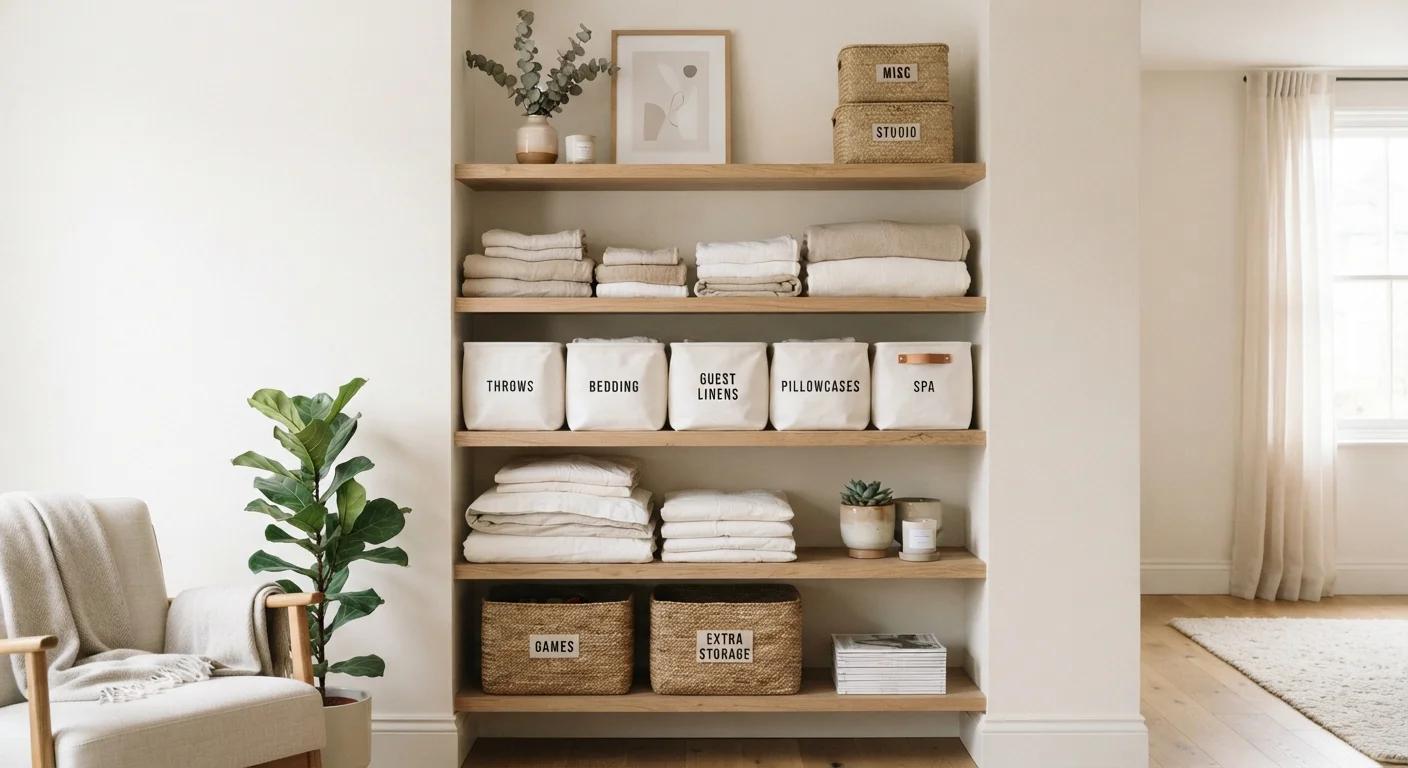
A fixed, consistent location for a specific item. The principle holds that items without a designated home drift and cause clutter, while items with a clear place are easier to put away and find.
Touch-It-Once Principle
The idea that when you pick something up, you handle it completely rather than setting it down to deal with later. Applied consistently, it prevents the buildup of items in transitional spots like counters and chairs.
Flat Surface Rule
A maintenance guideline that treats horizontal surfaces — countertops, tables, dressers — as intentionally kept clear except for a few permanent items. Flat surfaces tend to attract clutter quickly if left unmanaged.
Key Methods Explained
Beyond individual principles, several named methods have become popular frameworks in their own right. Understanding what each actually involves — and what it doesn't — helps you pick the approach that fits your household.
| Origin of the One-In, One-Out Rule | Consumer behavior and wardrobe management communities |
| FIFO Stands For | First In, First Out (Standard inventory management terminology) |
| KonMari Sorting Order | Clothing → Books → Papers → Komono (miscellaneous) → Sentimental items (Marie Kondo, The Life-Changing Magic of Tidying Up) |
| Most Common Clutter Hotspot | Flat horizontal surfaces (counters, tables, entry areas) |
| Zone Organization Best For | Households with multiple users or mixed-activity spaces |
| Capsule Wardrobe Typical Size | 30–40 core items (varies by practitioner) |
The One-In, One-Out Rule is perhaps the simplest habit that keeps clutter from creeping back. For every new item that enters your home, one comparable item leaves. It works best with categories that tend to multiply: clothing, kitchen gadgets, books, and hobby supplies. The rule doesn't require minimalism — it just creates a ceiling on accumulation.
Zone organization divides your home into areas based on activity rather than room label. A mudroom zone near the front door handles outerwear and bags whether or not you have a dedicated mudroom. A charging zone lives wherever people actually use devices. Zones match storage to behavior, which is why they tend to stick. This approach pairs well with strategies for organizing a shared home where different household members have different habits.
The KonMari method, developed by organizing consultant Marie Kondo, involves sorting by category (not room) and keeping only items that feel meaningful or functional. Its "does this spark joy" question is often misquoted as trivial, but the underlying intent is to make intentional, values-based decisions about possessions rather than defaulting to "I might need it someday."
FIFO (First In, First Out) is borrowed from inventory management and applied most usefully in pantries and medicine cabinets: newer items go to the back, older items come forward. It reduces waste without requiring extra systems.
It's worth reading about common organization myths before committing to any method — some popular advice actually works against sustainable tidiness.
Choosing What Fits Your Home
No single method suits every household. A family of five with young children needs different structures than a single professional in a studio apartment. The principles in the glossary above can be mixed and matched — you might use zone organization throughout your home while applying the One-In, One-Out rule strictly only to clothing.
The clearest dividing line is usually between minimalist approaches, which prioritize fewer possessions overall, and systems that focus on giving every item a designated place regardless of quantity. Both can produce genuinely organized homes. Our comparison of minimalist organization versus the everything-has-a-home approach walks through the tradeoffs in detail.
The most durable organization habits tend to be the ones that require the least willpower to maintain. If a system depends on everyone in the household performing multiple steps perfectly each time, it will erode. Start with principles that lower friction, and layer in additional structure only once the basics feel automatic.