

Key Takeaways
Why Common Organization Wisdom Often Backfires
Home organization advice is everywhere — social media feeds, TV makeover shows, lifestyle blogs — and much of it looks convincing. Matching bins, color-coded labels, ruthless decluttering sessions: they photograph beautifully. The problem is that aesthetics and function are not the same thing, and advice built for one often undermines the other.
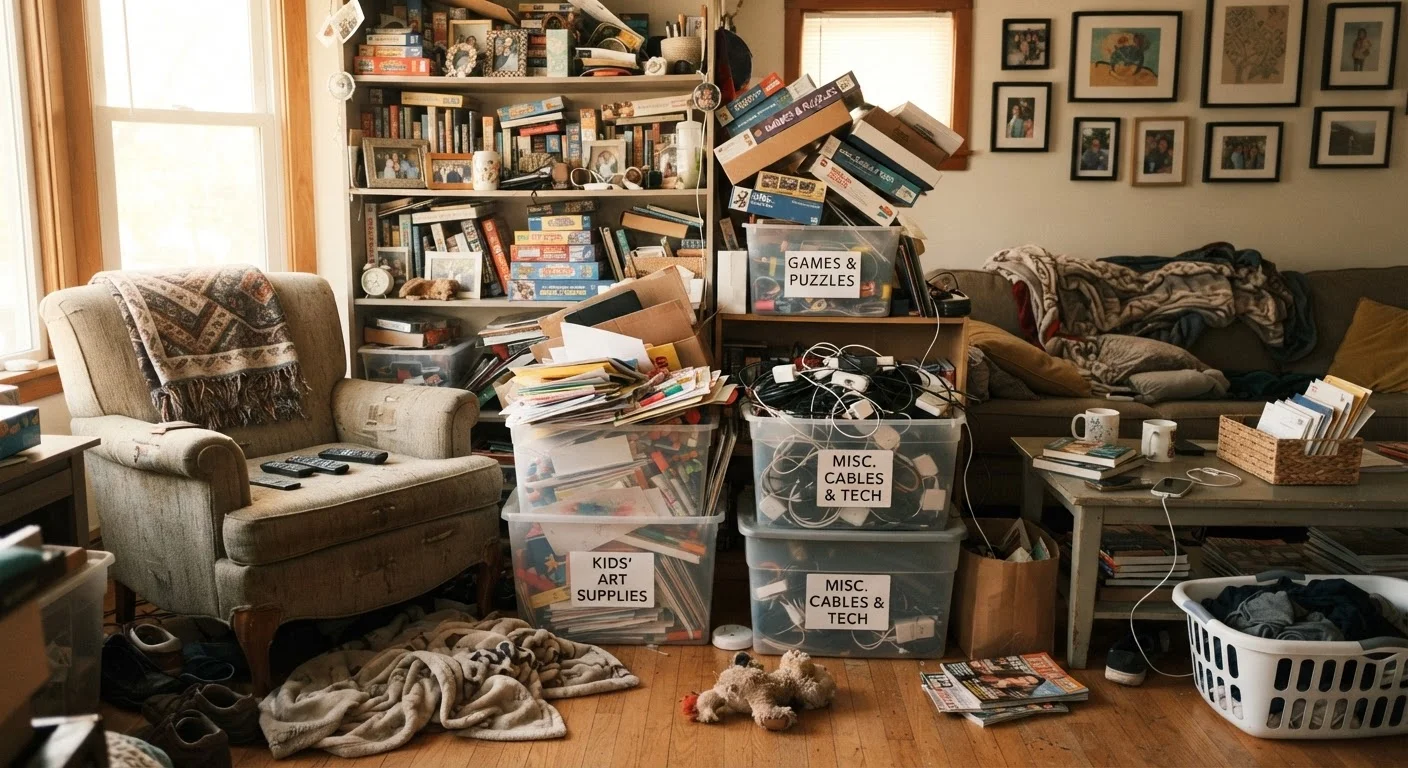
Many popular organization myths persist because they contain a grain of truth wrapped in a flawed assumption. A label can help you find things faster — but only under the right conditions. Buying fewer containers can reduce visual noise — but it can also leave your household without a place to put things, which is how clutter piles up on every flat surface. Understanding where these ideas go wrong is the first step toward building a home that actually stays organized.
See how minimalist and 'everything-has-a-home' philosophies compare to find the approach that genuinely fits your household.
Myth
Everything needs a label to be organized. The more labels, the better the system.
Fact
Labels help only when a category is genuinely ambiguous — over-labeling adds maintenance burden and rarely improves day-to-day function.
Labels are a tool, not a goal. When every container, shelf, and drawer gets a label, you create a system that requires constant upkeep: items get reclassified, categories shift, and the label stops matching reality within weeks. Worse, rigid labeling can discourage household members from putting things away if they're not sure something belongs in a given spot.
Reserve labels for shared storage areas where multiple people need to find the same things quickly — the pantry, kids' craft supplies, the garage. For personal spaces you navigate daily, your memory is the label. For a deeper look at where labeled storage systems go wrong, see why perfectly labelled bins still lead to chaos.
Myth
A big declutter session will solve your organization problem once and for all.
Fact
A one-time declutter addresses existing clutter but does nothing to stop new clutter from forming without a supporting daily habit.
The appeal of the grand declutter is real — filling donation bags and clearing surfaces feels transformative. But clutter is not a one-time event; it's an ongoing output of daily life. Without a system that intercepts incoming items (mail, purchases, hand-me-downs), the cleared spaces refill, often within a few months.
Lasting organization comes from small, repeatable habits: a nightly ten-minute reset, a rule about where new items enter the home, a regular review of what's being stored. These routines are unglamorous but durable. The one-in, one-out rule is one simple principle that helps manage incoming items without requiring another major overhaul.
Myth
More storage containers will fix a clutter problem.
Fact
Adding containers without reducing volume simply relocates clutter — and often makes it harder to find things.
Buying bins is one of the most common responses to a messy home, and it almost always comes before the harder work: deciding what to keep. When you containerize clutter without editing it first, you end up with organized-looking chaos — every bin is full, nothing is easy to retrieve, and you've spent money on the problem.
The correct sequence is: sort and reduce first, then measure your actual storage needs, then purchase containers sized to fit. A half-empty container is a sign your system is working. A stuffed-to-the-lid container is a sign the editing step was skipped.
Myth
If your home looks tidy, it is organized.
Fact
Visual tidiness and genuine organization are different — hidden clutter in drawers and closets creates real daily friction even when surfaces are clear.
Surface tidiness is easy to achieve by moving items out of sight. But if those items land in overstuffed drawers, crammed closets, or a catch-all room, you haven't organized — you've deferred the problem. The friction shows up later when you can't find your passport, run out of a household item you didn't know you'd already bought three of, or dread opening the linen closet.
A genuinely organized home is one where any member of the household can locate any item within a reasonable amount of time. That standard — retrieval speed — is a more useful measure than whether the living room looks camera-ready. Understanding why we hold on to clutter can help unpack the habits that drive the hide-and-ignore cycle.
Myth
Organization systems that work for one household will work for yours.
Fact
Effective organization is highly individual — systems must match the specific habits, schedules, and cognitive styles of the people using them.
The popularity of certain organization methods can make them feel universal, but no system works for everyone. A household with young children, shift workers, or members with different tolerance for tidiness has fundamentally different needs than the household a given method was designed around. Adopting someone else's system wholesale — without adapting it — is a common reason people feel like they've failed at organization when the method simply wasn't suited to them.
Before choosing a system, observe your household for a week: where does mess collect? Which areas stay tidy naturally? Those patterns tell you more about what will work than any trending method. For shared living situations, strategies for households with different tidiness standards can help you find workable common ground.
Building Systems That Actually Stick
Recognizing these myths matters because they quietly set you up to fail. You reorganize, feel proud of the result, and then watch the clutter creep back — which can feel like a personal failing rather than a system problem. It isn't. If a system doesn't match how your household moves through the day, it will collapse no matter how good it looks on day one.
80%
Of clutter is from delayed decisions
Professional organizers commonly estimate that the majority of household clutter results from postponed choices about where items belong, not from having too little storage.
~30 min
Time lost daily searching for misplaced items
Workplace productivity research has estimated people lose significant time each day to searching for things — a finding that translates readily to the home environment.
Sustainable organization is less about perfection and more about friction reduction. Ask yourself: where does mess actually land in your home? That's where storage needs to be. How do the people in your household naturally put things down? Design around that behavior, not against it. A hook by the front door that everyone actually uses beats an elaborate entryway system no one touches.
Long-term decluttering habits matter more than any single tidying session. And if paper chaos is your primary pain point, understanding why paper clutter accumulates can help you put a realistic system in place rather than one that collapses by week two. Your physical environment also shapes how calm or stressed you feel day to day — explore what the evidence says about space and mental calm to put organization in its proper context.
Systems Fail People, Not the Other Way Around
If an organization system isn't working in your home, the most likely explanation is that the system doesn't fit your household's actual behavior — not that your household is uniquely disorganized. Effective organization is designed around real patterns, not idealized ones. Adjust the system before concluding the effort is hopeless.