

Key Takeaways
Why Small Spaces Demand Smarter Systems
Limited square footage punishes disorganisation quickly. A few items left without a home can make a compact apartment feel chaotic overnight. The good news: most small-space organisation problems aren't structural — they're system problems that thoughtful habits and low-cost interventions can fix without touching a single wall.
Before diving into specific strategies, it helps to understand your organisation philosophy. If you're unsure whether a minimalist approach or an "everything has a home" method suits your household better, the comparison of both approaches is worth reading first. Once you have a framework, the following strategies become much easier to apply consistently.
Audit and reduce before you organise
No storage system can compensate for excess belongings. Before buying a single bin or shelf, spend time evaluating what you own. Go category by category — clothing, kitchen tools, paperwork, hobby supplies — and remove anything broken, duplicated, or genuinely unused in the past year.
A useful test: if you moved tomorrow, would this item earn space in the moving truck? If not, it's a candidate to donate, sell, or discard. Reducing volume first means your storage solutions actually work rather than simply containing more clutter. For wardrobe-specific guidance, the capsule wardrobe organisation guide walks through a practical audit process.
Reducing volume first means your storage solutions actually work rather than simply containing more clutter.
Claim vertical space with freestanding shelves and wall hooks
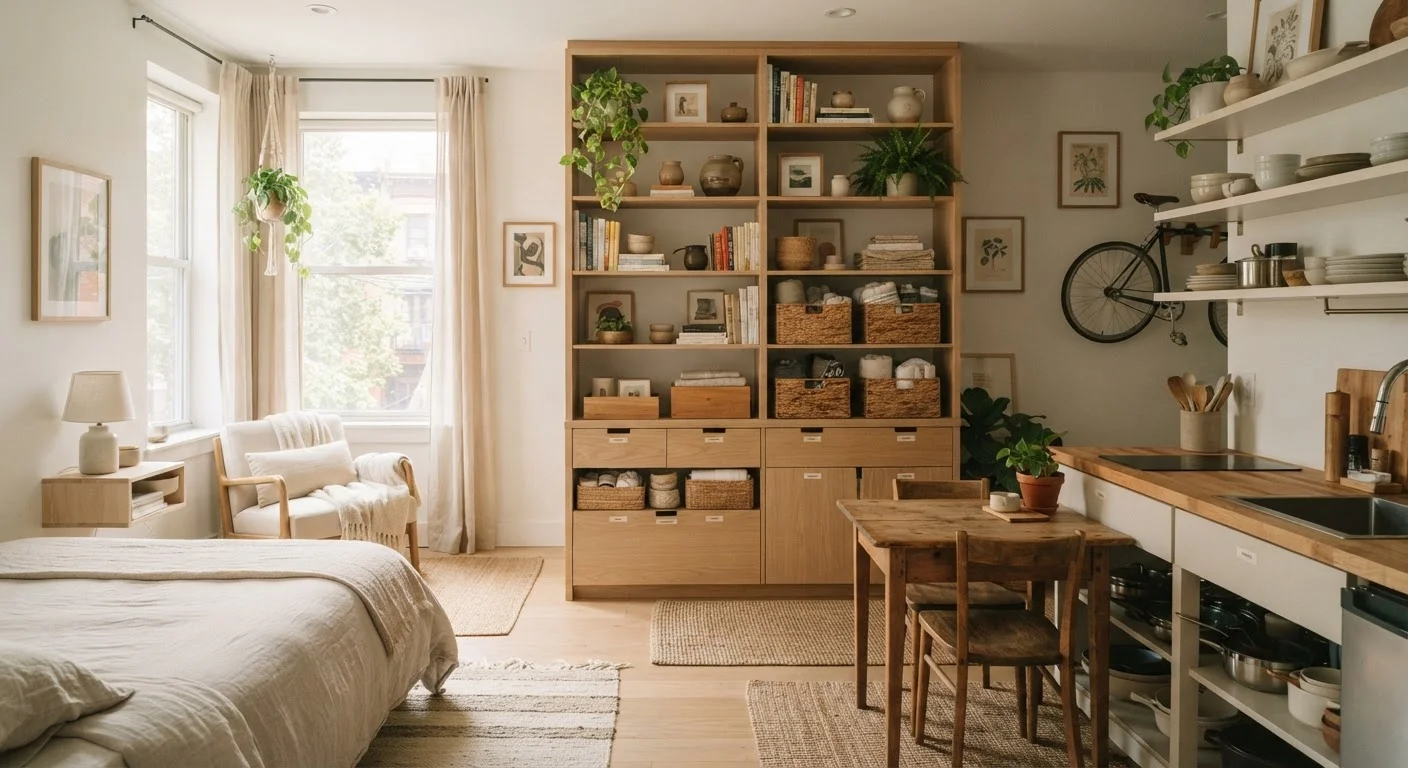
Floor space is finite; wall and vertical space is frequently wasted. Freestanding bookcases, ladder shelves, and over-door organisers add substantial storage capacity without requiring a single nail in a load-bearing wall. For renters, removable adhesive hooks rated for appropriate weights can hold bags, coats, and frequently used tools near doorways without landlord approval.
Stack storage vertically inside cabinets and closets too — shelf risers double the usable surface inside most cupboards for minimal cost. For a more detailed breakdown of how vertical and horizontal strategies compare in different room layouts, see vertical vs. horizontal storage.
Floor space is finite; wall and vertical space is frequently wasted in most small homes.
Use furniture that earns its keep twice
In a small space, every piece of furniture should justify itself with more than one function. An ottoman with interior storage serves as a coffee table, extra seating, and a concealed linen or media cabinet simultaneously. A bed frame with built-in drawers replaces a separate dresser. A narrow console table behind a sofa doubles as a desk or homework station.
When evaluating a furniture purchase, ask: does this piece store, display, and seat — or does it only do one of those things? Single-purpose furniture is a luxury small spaces rarely afford.
Every piece of furniture in a small space should justify itself with more than one function.
Assign a home to every category, not every item
A common organisation mistake is trying to assign a specific location to each individual object — which creates a system too rigid to maintain. Instead, assign zones by category: all charging cables live in one drawer, all cleaning supplies in one caddy, all craft materials in one tote. Within the zone, individual items can shift without breaking the system.
Label these zones clearly, especially in shared households. When everyone knows where the "batteries zone" is, items get returned without thinking. This category-based approach also makes it obvious when a zone is overloaded — a signal to declutter rather than expand storage.
Assign zones by category, not individual items — the system stays flexible and easier to maintain.
Rotate seasonal items rather than storing everything at once
Not everything you own needs to be accessible year-round. Bedding for a different season, bulky winter coats in July, or holiday decorations can move to under-bed storage bags, high-shelf bins, or a storage unit between uses. This rotation frees significant active storage space for items you actually reach for daily.
There are real trade-offs to rotating possessions, including the effort of swapping out and the risk of forgetting what's stored where. The seasonal storage guide weighs the case honestly so you can decide how much rotation is worth it for your lifestyle.
Not everything you own needs to be accessible year-round — rotation frees significant active storage.
Keep surfaces intentionally clear
Surfaces — counters, tables, nightstands — act as clutter magnets. The more clear space you start with, the longer it stays manageable. Adopt a rule for key surfaces: only items used daily earn a permanent spot. Everything else gets a drawer, cabinet, or dedicated tray.
A single decorative tray on a counter corrals the items that do belong there and creates a visual boundary. When the tray is full, nothing new goes on it — that constraint forces a decision about what actually belongs versus what was set down out of habit.
A simple tray on a counter creates a visual boundary that constrains clutter before it spreads.
Use consistent containers and labels
Mismatched bins, bags, and boxes create visual noise that makes even an organised space feel chaotic. Choosing a consistent container style — whether that's uniform wicker baskets, matching canvas cubes, or identical clear bins — brings visual calm to shelves and cabinets. You don't need an expensive matching set; uniform shapes and colors do most of the work.
Labels matter most in shared households and in high-turnover areas like pantries and utility closets. A labelled system is one that other people can use and return items to without asking. That simple shift dramatically reduces the maintenance burden of keeping a small space functional.
Consistent containers and clear labels mean others can use and return to your system without asking.
Building Habits That Keep Small Spaces Functional
Organisation strategies only stick when they're backed by daily habits. A ten-minute evening reset — returning items to their designated spots, clearing surfaces, and quickly scanning the floor — prevents the slow accumulation that makes small spaces feel unmanageable. For broader strategies on building routines that reduce everyday stress, explore the daily habits hub.
Start with one zone, not the whole home
Attempting to reorganise an entire apartment in a single weekend often leads to half-finished projects and exhaustion. Instead, pick one high-impact zone — the entryway, the kitchen counter, or the bathroom cabinet — and fully implement a system there before moving on. Success in one area builds motivation and clarifies what works before you scale it.
If your home is shared, the challenge multiplies. Different tolerance levels for tidiness among housemates can undermine even the best organisation system — the guide to organising a shared home addresses this directly. Ultimately, the most effective small-space setup is one every person in the home can realistically maintain.