

Key Takeaways
Option A
Calorie Counting
The established, quantitative approach to food energy.
Best for: Tracking overall energy intake when managing weight or monitoring a specific dietary target.
Option B
Nutrient Density
The qualitative lens that asks what your food actually delivers.
Best for: Evaluating whether foods are providing meaningful vitamins, minerals, fiber, and protein relative to their calorie load.
If you are trying to understand your overall energy balance
Calorie Counting
Tracking total calorie intake provides a measurable baseline for understanding how much energy you are consuming relative to your expenditure.
If you want your food choices to support long-term health and satiety
Nutrient Density
Prioritizing nutrient-dense foods ensures you get essential vitamins, minerals, fiber, and protein — not just energy — making meals more filling and nutritionally complete.
If you want the most complete picture of your diet quality
Calorie Counting
Using calorie awareness alongside nutrient density evaluation gives you both the quantity and quality dimensions of what you eat — a balanced approach most nutrition professionals support.
What a Calorie Actually Measures
A calorie is a unit of heat energy — specifically, the amount of energy needed to raise one kilogram of water by one degree Celsius. In nutrition, calories tell us how much energy a food can release when metabolized. That is a genuinely useful number, but it is only one dimension of food.
The limitation becomes clear quickly: 100 calories of soda and 100 calories of lentils both provide the same energy load, but they deliver entirely different biological effects. One supplies little beyond sugar and water; the other offers protein, fiber, folate, and iron. Calorie counts, by themselves, are blind to that distinction.
This is why relying on calorie totals alone — without considering what accompanies those calories — can lead to nutritional gaps even when total intake looks fine on paper. For a deeper look at how food labels present this information, see our guide to reading a nutrition label.
Nutrient Density: A Better Quality Filter
Nutrient density refers to the concentration of beneficial nutrients — vitamins, minerals, fiber, lean protein, healthy fats — relative to a food's calorie content. A food is considered nutrient-dense when it delivers substantial nutritional value without an outsized calorie cost. Dark leafy greens, legumes, eggs, berries, and fatty fish consistently rank high by this measure.
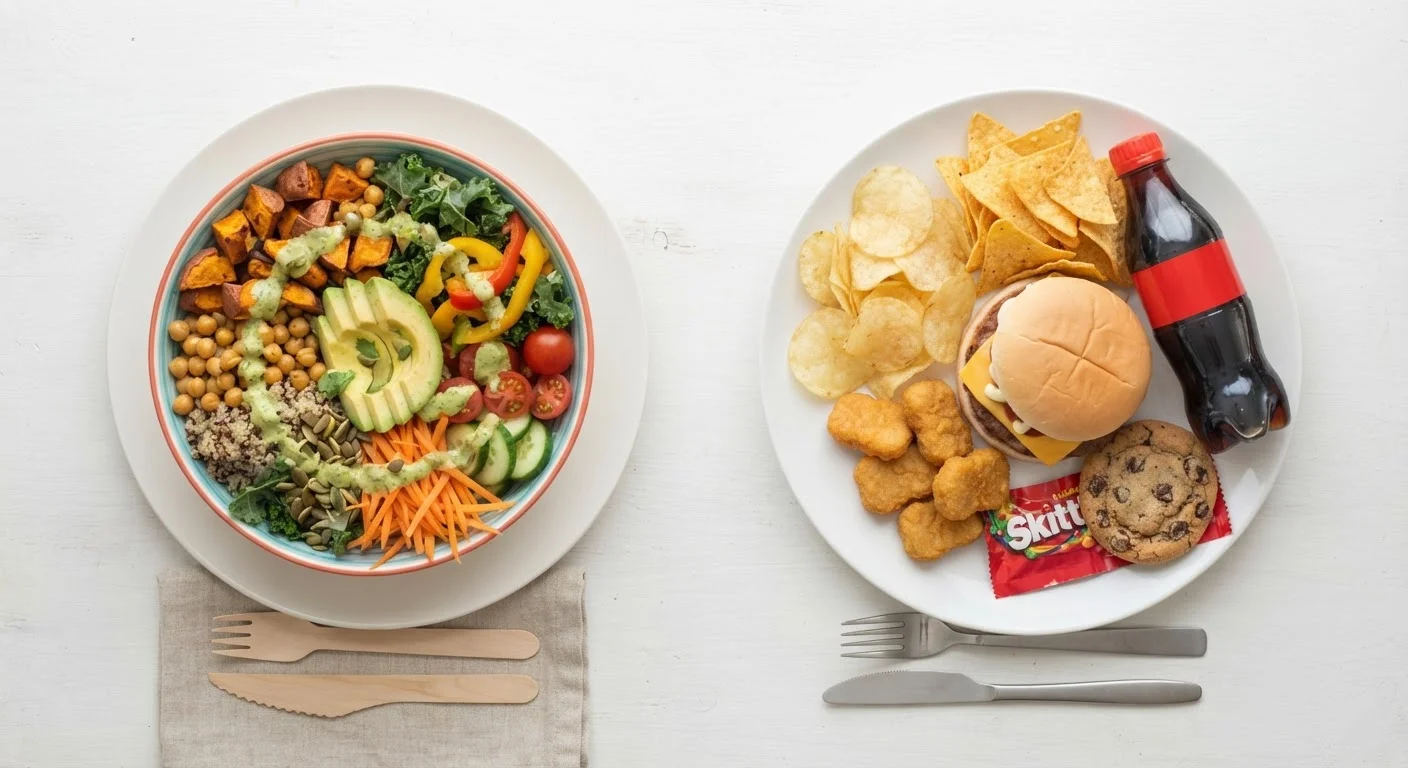
By contrast, foods described as energy-dense but nutrient-poor — often called "empty calories" — provide plenty of fuel but little else. Heavily refined snack foods, sugar-sweetened beverages, and some ultra-processed products fall into this category.
| Criterion | Calorie Counting | Nutrient Density |
|---|---|---|
| What it measures | Energy content of food | Nutritional value per calorie |
| Primary focus | Quantity of intake | Quality of intake |
| Accounts for vitamins & minerals | No | Yes |
| Accounts for fiber & protein | Partially (as energy sources) | Yes, as quality markers |
| Useful for weight management | Yes, directly | Indirectly, via satiety |
| Distinguishes whole vs. processed foods | No | Yes |
| Ease of tracking | Straightforward with labels or apps | Requires more food knowledge |
Understanding nutrient density also helps explain hunger patterns. Foods rich in protein and fiber tend to slow digestion and promote satiety — meaning you stay fuller longer — while calorie-equivalent foods lacking those components may leave you hungry again quickly. Our article on dietary fiber and why it matters explores one of the most impactful nutrient-density factors in detail.
Using Both Frameworks Together
Calories and nutrient density are not competing philosophies — they are complementary lenses. Awareness of calorie intake helps with understanding energy balance, which is relevant to weight management and overall diet planning. Nutrient density helps ensure that the calories you do consume are doing meaningful work.
~57%
Share of U.S. calories from ultra-processed foods
Research published in BMJ Open estimated that ultra-processed foods account for roughly 57% of total calorie intake among U.S. adults — foods that are typically low in nutrient density.
3x
More fiber in whole grains vs. refined grains
Whole grains can contain three times the dietary fiber of their refined counterparts, illustrating how processing affects nutrient density even at similar calorie levels.
In practice, a useful rule of thumb is to ask two questions about any food: How much energy does this provide? and What does that energy come packaged with? If a food delivers substantial energy but little nutritional return, it may be worth pairing with or partially replacing by something more nutrient-rich.
For everyday eaters, shifting attention toward nutrient density often naturally improves calorie quality without requiring meticulous tracking. You can explore how this plays out in specific eating scenarios — including snack choices — in our piece on what separates a useful snack from an empty one. And if you're curious how this compares to structured calorie-focused dietary philosophies, our overview of calorie counting vs. intuitive eating provides helpful context.
This article is for general informational purposes only and is not a substitute for professional medical or nutritional advice. Consult a qualified healthcare provider or registered dietitian for guidance specific to your health needs.