

Key Takeaways
Why the Nutrition Label Exists and How It's Structured
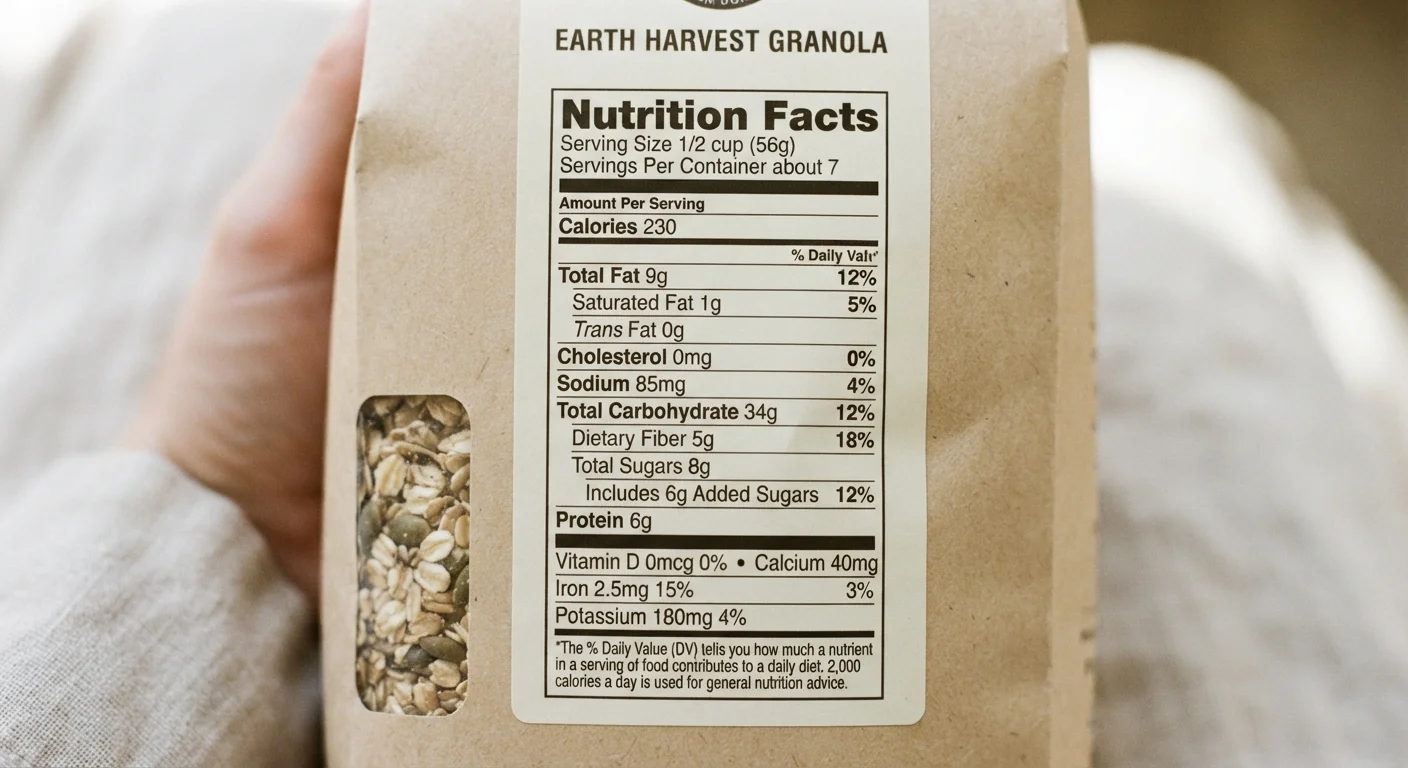
The Nutrition Facts label is a standardized format required by the U.S. Food and Drug Administration (FDA) on most packaged foods. Its purpose is straightforward: give consumers a consistent, comparable snapshot of what's in a product. The label was significantly updated in 2016 to reflect current nutrition science and eating patterns, including a mandatory line for added sugars.
Every label follows the same top-to-bottom hierarchy: serving information, then calories, then nutrients to limit, then nutrients to encourage, and finally the % Daily Value column on the right. Understanding that structure turns label-reading from guesswork into a reliable skill. For a broader grounding in how nutrition concepts fit together, see our complete guide to nutrition fundamentals.
A packaged food item with a Nutrition Facts panel
The primary object you'll be reading and interpreting throughout this guide.
Magnifying glass or phone camera zoom
Helpful for reading small-print labels clearly, especially for vitamins and minerals.
Step-by-Step: How to Read Any Nutrition Label
Follow these steps in order each time you pick up a packaged product. They're designed to build on one another so you walk away with a complete picture of what you're eating — not just a single number out of context.
Start With Serving Size — Every Time
The very first field on any Nutrition Facts label is the serving size, expressed in a common household measure (e.g., 1 cup, 3 crackers) alongside a gram weight. Every single number that follows — calories, fat, sodium, everything — applies to that one serving, not the whole package.
Before reading anything else, check how many servings are in the container. A bag labeled as two servings means you double every number if you eat the whole thing. This single step prevents the most common misreading of nutrition labels.
Note the Calorie Count in Context
The calorie figure (calories per serving) appears prominently just below the serving size. Calories measure energy — how much fuel a food provides. However, calories alone don't indicate nutritional quality. A 200-calorie serving of mixed nuts and a 200-calorie serving of a sugary snack are very different foods despite an identical calorie count.
Use the calorie number as one data point, not the primary verdict. For a deeper look at why, see calories vs. nutrient density.
Scan the Nutrients to Limit
The next section lists nutrients that many Americans consume in excess, and which are associated with increased health risks when eaten in large amounts over time. These include:
- Saturated fat — linked to cardiovascular risk when consumed in excess
- Trans fat — largely phased out but still worth checking; aim for 0g
- Sodium — major contributor to high blood pressure risk at high intake levels
- Added sugars — calories with minimal nutritional benefit beyond energy
The goal isn't to avoid these entirely, but to be aware of how much a single serving contributes relative to your overall day.
Look for the Nutrients to Prioritize
Below the nutrients-to-limit section, labels list nutrients that many people don't get enough of and that support health in meaningful ways:
- Dietary fiber — supports digestive health and sustained energy
- Vitamin D, calcium, iron, and potassium — nutrients identified by public health guidance as commonly under-consumed
- Protein — essential for muscle maintenance, satiety, and cellular function
A food contributing a meaningful %DV for these nutrients offers more nutritional return for its calories. For a plain-language breakdown of what vitamins and minerals do in the body, see our micronutrients reference guide.
Interpret the % Daily Value Column
The right-hand column shows the % Daily Value (%DV) for each nutrient. This figure represents what percentage of the recommended daily intake — based on a 2,000-calorie reference diet — one serving provides or contributes.
%DV is most useful for quick comparison: it lets you see at a glance whether a food is high or low in a given nutrient without needing to know the specific gram targets. Use it to compare similar products side by side, or to gauge how one food fits into a day's overall intake.
Labels Inform — They Don't Replace Professional Guidance
Nutrition labels are a general educational tool, not a medical or dietary prescription. If you have a health condition, allergy, or are managing a specific diet under clinical guidance, always consult a registered dietitian or your healthcare provider before making significant dietary changes based on label information alone.
The Ingredients List: What It Tells You Beyond the Numbers
Just below the Nutrition Facts panel, you'll find the ingredients list. This section deserves its own attention. Ingredients are listed in descending order by weight — meaning the first ingredient makes up the largest proportion of the product by mass, and the last makes up the least.
A few practical things to look for: if sugar (or one of its many aliases — corn syrup, dextrose, maltose, cane juice) appears in the first two or three positions, the product is likely high in added sugars. Similarly, seeing whole grains as the first ingredient on a bread or cereal is a positive signal. To understand how the degree of processing shapes these lists, our guide to the whole foods vs. processed foods spectrum offers useful context.
Use the 5% and 20% Rule as a Quick Guide
A simple shortcut: a %DV of 5% or less per serving is generally considered low for a nutrient, while 20% or more is considered high. Use this rule to quickly spot whether a food is a significant source of something you want more of — or less of — without doing mental math.
Putting It All Together: Labels in a Broader Diet Context
A nutrition label is a tool, not a verdict. A food with a high sodium count might still fit well into an otherwise low-sodium day. A snack with some saturated fat might also deliver meaningful fiber, protein, and micronutrients. The label gives you data; you supply the context.
For most people, the most useful habit is checking the serving size first, scanning sodium and added sugars for awareness, and looking for fiber and protein as markers of satiety and nutrient density. If you want to go deeper on why calorie counts alone don't tell the whole story, our piece on calories vs. nutrient density explains the distinction clearly. And if you're just starting to think about food choices more intentionally, Healthy Eating From Scratch is a practical starting point.
This article is for general informational and educational purposes only and is not a substitute for professional medical or dietary advice. Always consult a qualified healthcare provider or registered dietitian for guidance specific to your health needs.