

Key Takeaways
Option A
Whole Foods
The unaltered, nutrient-dense foundation of a healthy diet.
Best for: People seeking maximum nutrient density with minimal additives in their daily meals.
Option B
Processed Foods
A broad category spanning from lightly altered staples to heavily engineered products.
Best for: Understanding which processed options are harmless conveniences versus which warrant closer scrutiny.
If you want to maximize nutrient density at every meal
Whole Foods
Whole foods deliver vitamins, minerals, fiber, and phytonutrients in their most intact form, with no additives diluting their nutritional value.
If you rely on convenient, time-saving pantry staples
Processed Foods
Minimally processed options like canned legumes, frozen vegetables, and whole-grain breads offer genuine nutritional value with practical ease.
If you're concerned about added sugars, sodium, and artificial additives
Whole Foods
Choosing whole or minimally processed foods is the most reliable way to limit added sugars, excess sodium, and hard-to-pronounce additives.
If you want a realistic, sustainable everyday diet
Processed Foods
A diet that thoughtfully includes minimally processed foods alongside whole foods is more achievable long-term than strict avoidance of all processing.
What Makes a Food 'Whole' or 'Processed'?
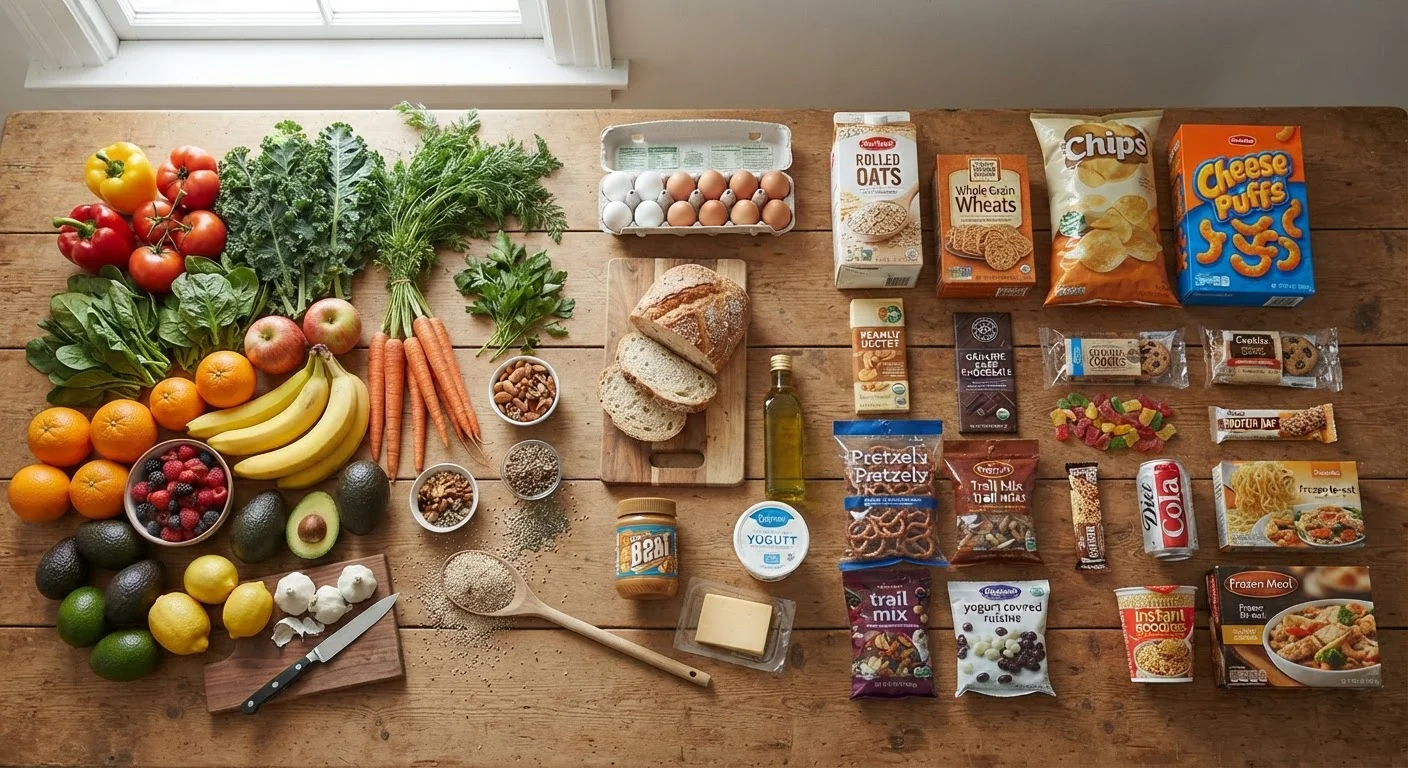
The terms whole food and processed food get used constantly, but they're rarely defined with enough precision to be useful. A whole food is one that remains close to its natural state — a raw apple, a dry lentil, a plain cut of meat. It has undergone little to no alteration from what existed at harvest or slaughter. The nutrients are intact, and the ingredient list, if one existed, would contain a single item.
Processed foods, by contrast, have been deliberately changed from their original form. But here's where the conversation gets complicated: that definition encompasses everything from washed and bagged spinach to fluorescent orange cheese puffs. Treating all processed foods as equivalent is one of the most common misconceptions in everyday nutrition. For a deeper look at how these categories intersect with popular diet labels, see how whole food, clean eating, and real food labels differ in practice.
The Processing Spectrum Explained
Nutrition researchers often use a framework called NOVA — developed by Brazilian epidemiologists — to classify foods by the extent and purpose of their processing. It groups foods into four categories that are far more informative than a simple whole-versus-processed binary.
- Unprocessed or minimally processed foods: Fresh, dried, ground, or chilled foods with no added substances. Examples include fresh fruit, plain oats, eggs, and unsalted nuts.
- Processed culinary ingredients: Substances extracted from foods and used in cooking — flour, oils, butter, and salt. These aren't eaten alone but transform whole foods into meals.
- Processed foods: Products made by adding salt, sugar, oil, or other culinary ingredients to whole foods, typically to extend shelf life or enhance flavor. Think canned tomatoes, cheese, cured fish, and whole-grain bread.
- Ultra-processed foods (UPF): Industrially formulated products that contain little to no whole food. They typically include additives — emulsifiers, artificial flavors, color stabilizers — not found in home cooking. Examples: packaged snack cakes, flavored instant noodles, and many carbonated soft drinks.
| Criterion | Whole Foods | Ultra-Processed Foods |
|---|---|---|
| Ingredient complexity | Single ingredient or very few | Long list, many additives |
| Nutrient retention | High — close to natural state | Often low — nutrients stripped or added back |
| Added sugars and sodium | Naturally absent or very low | Frequently high |
| Fiber content | Generally intact | Often reduced or removed |
| Shelf stability | Lower — spoils more quickly | High — engineered for long shelf life |
| Preparation required | Usually requires cooking or prep | Ready-to-eat or minimal preparation |
| Associated health outcomes | Positive in research literature | Negative associations at high intake |
The distinction between processed and ultra-processed is where the health research becomes most significant.
What the Research Actually Shows
Observational research has consistently associated higher ultra-processed food consumption with increased risks of obesity, type 2 diabetes, cardiovascular disease, and certain digestive conditions. A landmark 2019 study in The BMJ found that a 10% increase in the proportion of ultra-processed foods in the diet was associated with a 12% higher risk of cancer — though associations in observational research do not prove direct causation.
Minimally processed foods tell a very different story. Frozen vegetables, canned beans, and plain yogurt retain most of their nutritional value and consistently appear in the dietary patterns linked to positive long-term health outcomes, such as the Mediterranean and DASH approaches.
57%
Share of US calories from ultra-processed foods
Research published in BMJ Open estimated that ultra-processed foods account for roughly 57% of energy intake in the average American diet.
12%
Associated cancer risk increase per 10% more UPFs
A 2019 study in The BMJ found a 12% higher overall cancer risk associated with a 10-percentage-point increase in ultra-processed food consumption.
4x
Sodium difference between whole and processed equivalents
Comparing plain dried beans to canned beans with added salt illustrates how processing can multiply sodium content several times over.
The key nutritional red flags in ultra-processed foods are added sugars, refined carbohydrates, sodium, and saturated or trans fats — often in combination. Understanding how added sugars differ from naturally occurring ones can sharpen your ability to evaluate any packaged food.
Practical Ways to Navigate the Spectrum
Applying this knowledge doesn't require eliminating every packaged food from your kitchen. Instead, the goal is to tilt the balance — more whole and minimally processed foods, fewer ultra-processed ones. Some practical starting points:
- Check the ingredient list first, not just the nutrition panel. A short list of recognizable ingredients typically signals lower processing. Learning to read a nutrition label effectively helps you decode both at a glance.
- Treat convenience foods as a spectrum, not a category. Canned chickpeas, frozen edamame, and pre-washed salad greens are processed but nutritionally sound. They're not the same as artificially flavored chips or ready-made pastries.
- Use whole foods as anchors for each meal. Building meals around a whole food — a grain, a legume, a vegetable, a plain protein — then adding minimally processed components keeps the overall profile strong.
- Be thoughtful about snacking choices. This is where ultra-processed foods most easily accumulate. Understanding what separates a nutritionally worthwhile snack from an empty one can help close the gap.
This article is for general informational and educational purposes only and is not a substitute for professional medical or dietary advice. Consult a registered dietitian or qualified healthcare provider for guidance tailored to your individual health needs.