

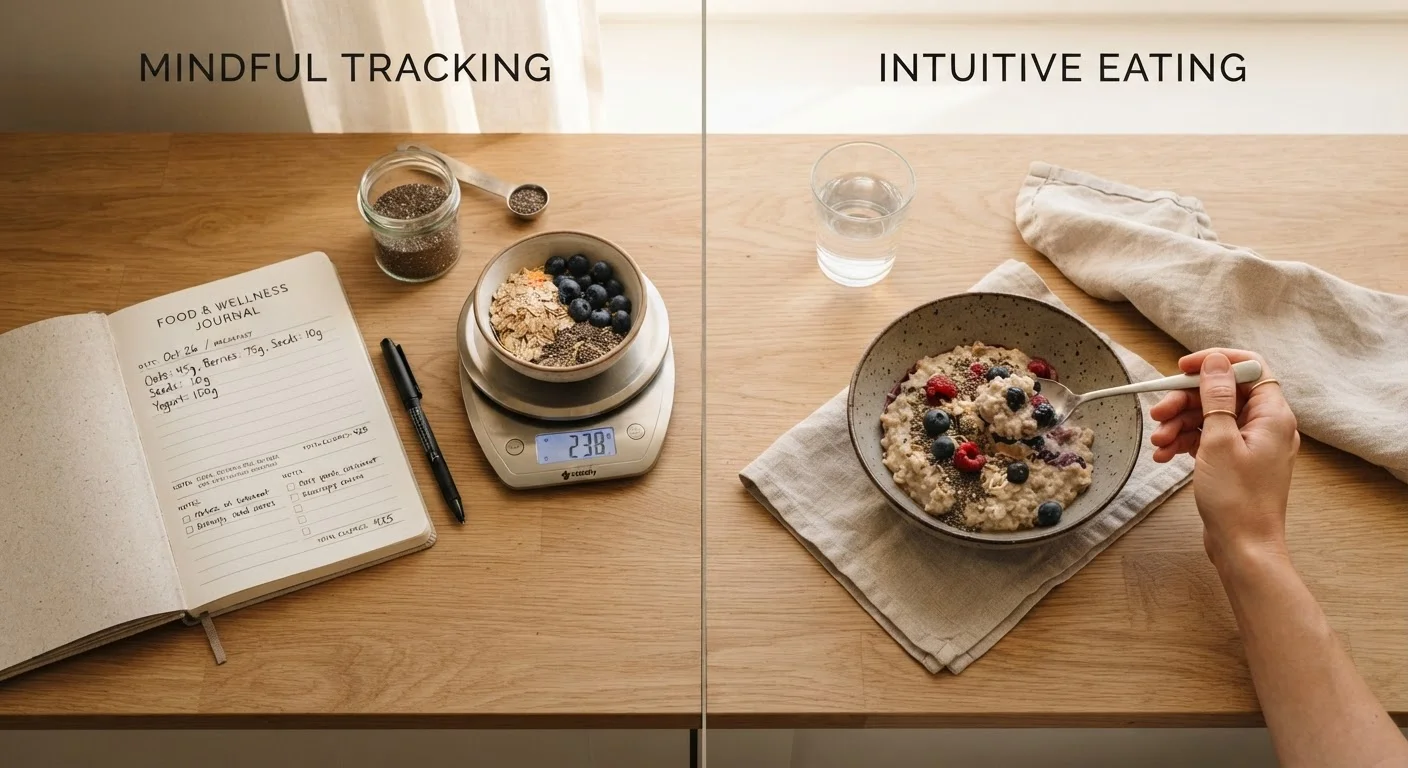
Key Takeaways
Option A
Calorie Counting
The structured, data-driven approach to managing food intake.
Best for: People who prefer clear external guidelines, measurable feedback, and systematic tracking to guide their food choices.
Option B
Intuitive Eating
The internal, body-trust framework that rejects diet rules.
Best for: People looking to rebuild a healthy relationship with food by tuning into hunger, fullness, and satisfaction cues.
If you're motivated by data and enjoy structured systems
Calorie Counting
Tracking provides measurable, tangible feedback that many people find motivating and easy to follow consistently.
If you have a history of stress or anxiety around food rules
Intuitive Eating
Intuitive eating's non-diet framework has been associated with reduced disordered-eating behaviors and better emotional relationship with food.
If you're trying to understand your general eating patterns
Calorie Counting
Short-term tracking can build genuine awareness of portion sizes and nutritional content, even if not maintained long-term.
If long-term sustainability and food enjoyment are your priority
Intuitive Eating
Research suggests intuitive eating is associated with more durable, psychologically healthy eating habits over time.
If you're managing a specific clinical nutrition goal
Calorie Counting
Structured tracking can support clinical goals under professional guidance, though it should always be supervised by a qualified dietitian or clinician.
The Core Philosophy Behind Each Approach
At their roots, calorie counting and intuitive eating represent opposing theories about how humans should relate to food. Calorie counting treats food primarily as measurable energy. It assumes that understanding and managing energy intake — typically through logs, apps, or nutrition labels — gives people control over their dietary outcomes. The method is external: numbers drive decisions.
Intuitive eating, developed by dietitians Evelyn Tribole and Elyse Resch in the 1990s, takes an entirely different stance. It frames chronic dieting and external food rules as the problem, not the solution. Instead, it encourages people to reconnect with hunger and fullness signals, reject the diet mentality, and find satisfaction in eating without moral judgments about food. The method is internal: the body is the guide.
Understanding where each philosophy starts helps explain why they produce such different experiences in practice. As our editorial team notes in our piece on common healthy eating mistakes, well-intentioned frameworks can backfire when they don't fit a person's psychological makeup or lifestyle context.
| Criterion | Calorie Counting | Intuitive Eating |
|---|---|---|
| Core mechanism | External tracking of energy intake | Internal body cues and signals |
| Tools required | Apps, journals, food scales | Self-awareness and reflection |
| Food rules | Structured daily targets | No rigid rules or restrictions |
| Learning curve | Technical; requires consistent logging | Gradual; relearning body attunement |
| Psychological impact | Can increase stress for some | Linked to improved body image |
| Evidence base | Short-term effectiveness supported | Growing long-term wellbeing evidence |
| Flexibility | Low to moderate | High |
How Each Method Works Day-to-Day
In practice, calorie counting requires logging meals — either with a smartphone app, written journal, or database tool. Users track grams, servings, or portions and compare totals against a daily target. This creates a feedback loop: eat within the target, and the system signals success. It rewards consistency with data and offers a concrete sense of progress.
Intuitive eating's day-to-day practice looks quite different. Practitioners work through a set of principles — including honoring hunger, making peace with food, and challenging the inner food police — rather than rules or targets. Eating decisions are made by checking in with how hungry or full you feel, what sounds genuinely satisfying, and how certain foods make your body feel afterward. It takes time to rebuild this attunement, especially after years of external rule-following.
72%
Adults who underestimate calorie intake
Research published in nutrition journals consistently shows most people underestimate their calorie consumption, limiting tracking accuracy.
10 principles
Core principles in intuitive eating framework
The intuitive eating model developed by Tribole and Resch is structured around ten evidence-informed principles guiding a non-diet relationship with food.
97%
Long-term diet failure rate (traditional diets)
Studies on weight cycling suggest the vast majority of conventional calorie-restricting diets do not produce sustained results over multi-year periods.
For a closer look at how food satisfaction and mindfulness intersect with eating behavior, the research on mindful eating offers a useful companion read.
What the Evidence Shows
Research on calorie counting is mixed. Studies show it can raise awareness of food intake and support short-term dietary changes. However, evidence also links prolonged rigid tracking with increased dietary restraint, heightened food preoccupation, and in some people, elevated risk of disordered eating behaviors. Tracking accuracy also poses challenges — research consistently shows that people tend to underestimate calorie intake, sometimes significantly, limiting the method's precision.
The evidence base for intuitive eating has grown substantially. A 2021 review in the journal Eating Behaviors found associations between intuitive eating and lower rates of disordered eating, better body image, and improved psychological wellbeing. It's worth noting, however, that much of the research is observational, and intuitive eating's effects on specific clinical nutrition outcomes remain an active area of study.
It's also important to flag that calories alone don't tell the full story of what makes a diet health-supporting — a consideration that matters in both frameworks.
This article provides general nutrition education and is not a substitute for personalized medical or dietary advice. Always consult a qualified healthcare provider or registered dietitian before making significant changes to your diet, especially if you have a health condition or history of disordered eating.