

Key Takeaways
Cuts daily cooking time significantly
Consolidating prep into one session means weeknight meals take minutes to assemble rather than requiring a full cook from scratch.
Reduces decision fatigue around food
Having prepared components ready removes the daily mental load of planning and cooking, especially useful during high-stress periods.
Supports more consistent nutritional quality
When healthy food is immediately accessible, it's more likely to be chosen over processed or takeout options in moments of low energy.
Minimizes food waste through intentional buying
Shopping specifically for a batch session means ingredients are fully used rather than left to spoil at the back of the refrigerator.
Scales well for dietary goals
Batch cooking allows precise control over ingredients, which supports people managing specific nutritional needs like reduced sodium or higher protein intake.
Significant upfront time commitment
A thorough batch cooking session typically requires two to three hours, making it difficult to sustain for people with consistently packed weekends.
Variety fatigue over the week
Eating from the same set of base ingredients across multiple days can feel repetitive, particularly for people who value culinary variety.
Requires food safety discipline
Cooked food remains safe in the refrigerator for roughly three to four days; anything beyond that should be frozen, requiring careful planning and labeling.
Not suited to all household dynamics
Families with different dietary preferences or restrictions may find it difficult to create a single batch that satisfies everyone effectively.
Demands adequate kitchen and storage space
Batch cooking at volume requires sufficient oven capacity, containers, and refrigerator space — constraints that can make it impractical in smaller kitchens.
Our Verdict
Batch cooking is a genuinely effective strategy for reducing daily food stress and supporting consistent nutrition — but it demands a realistic time commitment and suits those comfortable with some repetition in their meals. It is not a universal solution, and its benefits depend on consistent follow-through, sound storage habits, and a kitchen stocked for scale.
Ideal for busy individuals or households who want to eat well during hectic weeks and are willing to invest a few hours on a weekend or free evening to make that happen.
What Batch Cooking Actually Involves
Batch cooking means preparing large quantities of food in a single, dedicated session — then portioning and storing it for use across multiple meals throughout the week. It is not the same as cooking a big dinner and hoping for leftovers. It is an intentional system: choosing components that store well, cooking them in volume, and building meals from those components as the week unfolds.
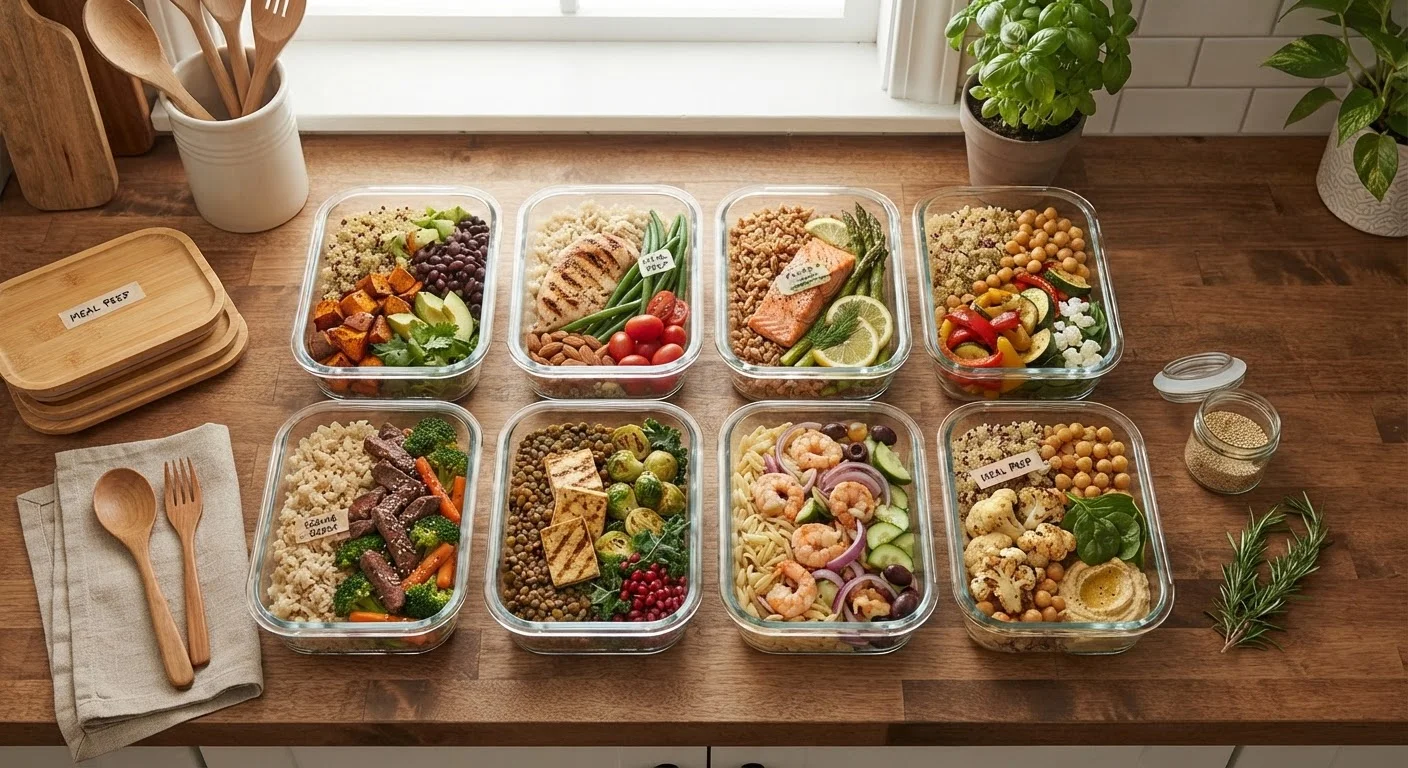
A typical session might involve roasting two sheet pans of vegetables, cooking a large pot of grains, and preparing one or two protein sources. These become the building blocks for lunches, dinners, and quick breakfasts — assembled in minutes rather than built from scratch each night. The protein-grain-vegetable meal formula pairs particularly well with this approach, making variety achievable without extra effort.
How you stock your kitchen matters, too. A well-organized pantry makes batch cooking more efficient and less wasteful — a point explored further in our guide to balancing pantry staples with fresh ingredients.
The Genuine Advantages
The strongest case for batch cooking is its ability to reduce daily decision fatigue around food. When ingredients are already prepared, the question shifts from "what do I make?" to "how do I assemble this?" — a much smaller cognitive lift after a long day.
Cuts daily cooking time significantly
Consolidating prep into one session means weeknight meals take minutes to assemble rather than requiring a full cook from scratch.
Reduces decision fatigue around food
Having prepared components ready removes the daily mental load of planning and cooking, especially useful during high-stress periods.
Supports more consistent nutritional quality
When healthy food is immediately accessible, it's more likely to be chosen over processed or takeout options in moments of low energy.
Minimizes food waste through intentional buying
Shopping specifically for a batch session means ingredients are fully used rather than left to spoil at the back of the refrigerator.
Scales well for dietary goals
Batch cooking allows precise control over ingredients, which supports people managing specific nutritional needs like reduced sodium or higher protein intake.
Consistent availability of ready-to-eat food also tends to support better overall eating patterns. Research in nutrition science consistently shows that dietary quality is shaped more by habitual access and convenience than by knowledge alone. When a nourishing option is already in the fridge, it competes more effectively with takeout or processed alternatives. This aligns with the broader case that eating patterns over time matter more than any single meal.
Batch cooking also tends to reduce food waste. Buying ingredients with a specific plan in mind — and using them fully in a single session — leaves less room for unused produce to spoil. For households managing grocery budgets carefully, this can be a meaningful advantage.
The Real Limitations
Batch cooking is not without friction. Its most cited drawback is the upfront time cost: a well-executed session can take two to three hours, which is a real barrier for people whose weekends are already stretched.
Significant upfront time commitment
A thorough batch cooking session typically requires two to three hours, making it difficult to sustain for people with consistently packed weekends.
Variety fatigue over the week
Eating from the same set of base ingredients across multiple days can feel repetitive, particularly for people who value culinary variety.
Requires food safety discipline
Cooked food remains safe in the refrigerator for roughly three to four days; anything beyond that should be frozen, requiring careful planning and labeling.
Not suited to all household dynamics
Families with different dietary preferences or restrictions may find it difficult to create a single batch that satisfies everyone effectively.
Demands adequate kitchen and storage space
Batch cooking at volume requires sufficient oven capacity, containers, and refrigerator space — constraints that can make it impractical in smaller kitchens.
Variety fatigue is another legitimate concern. Eating from the same base ingredients across four or five days works well for some people and feels monotonous to others. Households with varied preferences — especially those with children — may find it harder to satisfy everyone from a shared batch. For those who prefer less rigid repetition, intentional leftovers may offer a lighter-touch alternative.
Food safety also deserves attention. Cooked food stored in the refrigerator is generally safe for three to four days; anything beyond that typically requires freezing. Improperly stored batch-cooked food poses real spoilage risks. Portion sizing also requires thought — cooking too much of a perishable item can result in waste that offsets the efficiency gains.
Who It Suits — and Who It Doesn't
Batch cooking is well matched to people with predictable weekly schedules, moderate comfort in the kitchen, and a preference for efficiency over spontaneity. It also tends to work better for individuals and couples than for large families with diverse dietary needs.
Batch Cooking Is a Tool, Not a Rule
No single food strategy works for every lifestyle. Batch cooking is most effective when it solves a genuine friction point — like weeknight time pressure — rather than being adopted as an obligation. Starting with just one or two batch-prepped components, rather than an entire week's food supply, is a practical way to test whether the approach fits your routine before committing to a full system.
It is a poor fit for people who genuinely enjoy daily cooking as a creative or decompressive practice — for them, front-loading all kitchen time into one session may remove something valuable from their routine. Similarly, anyone living in a small kitchen with limited refrigerator and container space will run into practical constraints before the strategy can deliver its benefits.
The principle underlying batch cooking — grouping similar tasks together to reduce switching costs — is not unique to food. It mirrors productivity strategies used in other domains. Our overview of task batching in work contexts explains why consolidating similar tasks tends to reduce mental overhead, regardless of the domain.
This article is for general informational purposes only and does not constitute medical or nutritional advice. For personalized dietary guidance, consult a registered dietitian or qualified healthcare professional.