

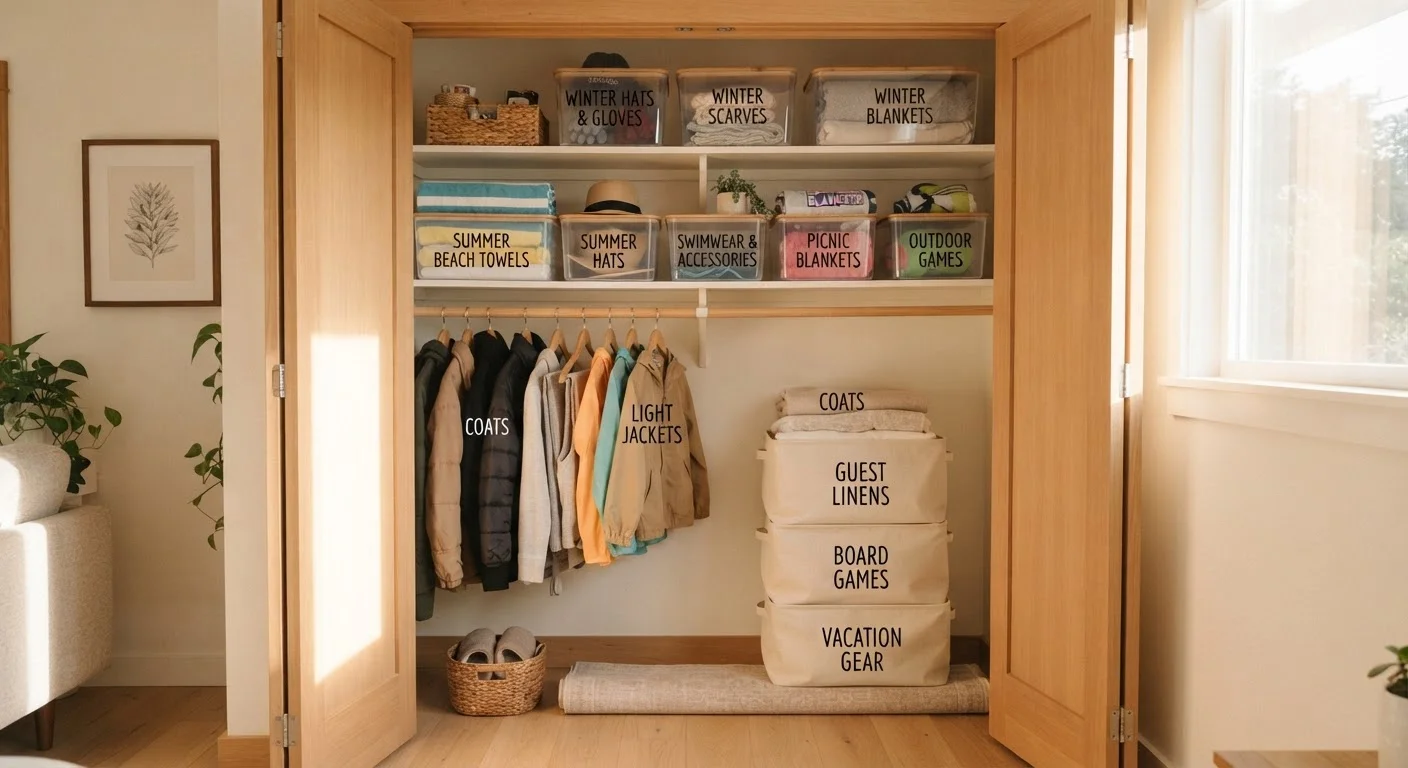
Key Takeaways
Frees up primary living and storage space
Removing out-of-season items creates room for the things you actually use now, making closets, garages, and utility areas more functional day to day.
Reduces visual clutter and mental load
Living among only currently relevant items creates a calmer environment; research in environmental psychology suggests visual clutter is linked to elevated perceived stress.
Creates built-in decluttering checkpoints
Each seasonal swap prompts a natural review of possessions — items that sat unused for an entire season become easy candidates for donation or disposal.
Protects seasonal items from everyday wear
Proper off-season storage — away from foot traffic and daily use — can extend the lifespan of items like outerwear, sports gear, and holiday decorations.
Requires consistent time and effort twice yearly
Rotating storage isn't passive — it demands planned packing, thoughtful labeling, and retrieval time each season, which many households underestimate.
Depends on having suitable secondary storage
Damp, unventilated, or pest-prone storage areas can damage clothing, bedding, and soft furnishings, turning a space-saving strategy into a costly mistake.
System collapses without reliable labeling
Bins without clear, specific labels quickly become mystery boxes, requiring full unpacking to locate a single item and eroding any efficiency gained.
Doesn't suit households without clear seasonal patterns
In mild climates or for people with variable schedules, the seasonal divide that makes rotation logical may not exist, leading to constant retrievals from "stored" bins.
Can create friction in shared households
If only one person maintains the rotation system, it becomes a burden rather than a shared benefit — and disagreements about what counts as "off-season" are common.
Our Verdict
Seasonal storage rotation is a genuinely effective strategy for reclaiming space and reducing clutter — but only when it's executed with discipline and a clear system. The benefits are most tangible for households in climates with distinct seasons and limited square footage. For those who struggle to commit to the upkeep, it can create disorganization rather than cure it.
Seasonal rotation is best suited to homeowners or renters in smaller spaces who live in regions with distinct seasonal changes and are willing to invest a few hours twice a year in proper packing, labeling, and storing.
What Seasonal Storage Rotation Actually Means
Seasonal storage rotation means deliberately moving items you won't use for the next few months — think heavy winter coats, holiday decorations, or patio furniture cushions — out of your primary living space and into longer-term storage. Items relevant to the coming season take their place. The goal is to keep only what you currently need within easy reach, reducing clutter and freeing up daily-use space.
The practice is common in households dealing with limited closet space, small apartments, or garages that double as seasonal equipment storage. It pairs naturally with other organization strategies — see our small-space organization guide for complementary approaches that don't require structural changes.
Done well, rotating storage is a twice-yearly project. Done poorly, it becomes a recurring source of frustration. Understanding both sides helps you decide whether it fits your household.
The Case For Rotating Your Belongings
Frees up primary living and storage space
Removing out-of-season items creates room for the things you actually use now, making closets, garages, and utility areas more functional day to day.
Reduces visual clutter and mental load
Living among only currently relevant items creates a calmer environment; research in environmental psychology suggests visual clutter is linked to elevated perceived stress.
Creates built-in decluttering checkpoints
Each seasonal swap prompts a natural review of possessions — items that sat unused for an entire season become easy candidates for donation or disposal.
Protects seasonal items from everyday wear
Proper off-season storage — away from foot traffic and daily use — can extend the lifespan of items like outerwear, sports gear, and holiday decorations.
The most immediate benefit is reclaimed space. When bulky winter gear isn't competing with summer equipment for the same closet, both are easier to access and organize. This is especially meaningful in homes under 1,200 square feet, where every shelf and drawer counts.
There's also a psychological benefit: living among only seasonally relevant items tends to feel less overwhelming. A coat rack with three lightweight jackets rather than eight is visually calmer and functionally easier. This aligns with findings in environmental psychology suggesting that visual clutter contributes to perceived stress — though individual responses vary.
Seasonal transitions also create natural audit points. Each time you rotate, you're prompted to evaluate what you actually used. Items that never left the bin for an entire season become obvious candidates for donation or disposal, supporting a more intentional approach to possessions.
The Case Against Rotating Your Belongings
Requires consistent time and effort twice yearly
Rotating storage isn't passive — it demands planned packing, thoughtful labeling, and retrieval time each season, which many households underestimate.
Depends on having suitable secondary storage
Damp, unventilated, or pest-prone storage areas can damage clothing, bedding, and soft furnishings, turning a space-saving strategy into a costly mistake.
System collapses without reliable labeling
Bins without clear, specific labels quickly become mystery boxes, requiring full unpacking to locate a single item and eroding any efficiency gained.
Doesn't suit households without clear seasonal patterns
In mild climates or for people with variable schedules, the seasonal divide that makes rotation logical may not exist, leading to constant retrievals from "stored" bins.
Can create friction in shared households
If only one person maintains the rotation system, it becomes a burden rather than a shared benefit — and disagreements about what counts as "off-season" are common.
The most common objection is the upkeep. Rotating storage isn't a one-time fix — it requires a meaningful time investment at least twice a year, plus a reliable labeling system to avoid retrieving every bin to find a single item. Our article on why labeling systems still lead to chaos outlines exactly how well-intentioned organization often breaks down in practice.
There's also the question of accessible storage. Seasonal rotation only works if you have somewhere suitable to put the off-season items — a dry basement, climate-controlled garage, or large attic. Damp or poorly ventilated storage can damage clothing, electronics, and soft furnishings, potentially costing more than the organizational gain is worth.
Finally, not every household has clearly defined seasonal patterns. In mixed climates, or for people who work irregular schedules or travel frequently, the neat seasonal divide that makes rotation logical simply doesn't exist. Forcing the system can result in repeatedly retrieving "stored" items, negating the efficiency entirely.
Climate Control Matters for Storage
Items stored in spaces with high humidity, temperature swings, or pest exposure are at real risk of damage. Natural fibers like wool and down are especially vulnerable to moisture and moths. If your only available storage is a damp basement or hot attic, use sealed, airtight containers and consider moisture-absorbing products. When in doubt, prioritize the condition of what you're storing over the organizational benefit.
How to Decide If It's Right for Your Home
Start by asking three practical questions: Do you live somewhere with genuinely distinct seasons? Do you have appropriate off-site or secondary storage? And can you commit to a structured transition — realistic packing, clear labeling, and a consistent schedule?
If you answer yes to all three, seasonal rotation is likely worth trying. If your storage options are limited, consider vertical storage strategies as an alternative that keeps everything accessible without rotating anything out entirely.
1 in 10
US households renting off-site storage
According to the Self Storage Association, roughly one in ten American households rents a self-storage unit, reflecting widespread demand for overflow storage solutions.
~2 hrs
Typical time per seasonal rotation
Organization experts generally estimate a thorough seasonal clothing rotation for a household of two to four people takes between one and three hours when done properly.
For shared households, it's worth discussing the system with everyone involved before committing. Differing tolerances for effort and organization can make a well-planned system fall apart if only one person maintains it. The shared home organization guide covers how to align expectations across a household.
Seasonal storage rotation is a tool, not a rule. Used selectively and maintained consistently, it can meaningfully improve how a home functions — but it's not the right fit for every household or every space.