

Key Takeaways
Why Skid Type Matters
Most drivers have experienced that unsettling moment when the car stops responding as expected — the steering goes vague, the back end feels loose, or the vehicle seems to have its own idea of where it's heading. These are skids, and not all of them work the same way. Understanding the distinction is critical, because the corrective action for one type can actively worsen another.
Skids happen when one or more tyres exceed their available grip — usually because of speed, road surface, driver inputs, or some combination of all three. Modern vehicles equipped with Electronic Stability Control (ESC) can catch many incipient skids automatically, but the system has limits, particularly on very slippery surfaces or during extreme manoeuvres. See our guide to driver assistance technologies for a clear explanation of what ESC can and cannot do.
The two primary skid types — understeer and oversteer — feel distinct, originate differently, and require different responses. A third category, a four-wheel skid (or total loss of grip), is typically caused by excessive speed or severe ice and demands its own approach.
ESC Is a Safety Net, Not a Safety Guarantee
Electronic Stability Control (ESC) is standard on all new US passenger vehicles sold after 2012. It can detect and partially correct both understeer and oversteer by selectively applying brakes to individual wheels. However, it cannot generate grip that isn't there — on ice or at extreme speeds, it will reach its limits. Understanding skids manually gives you a foundation that technology alone cannot replace.
Understeer: When the Front Pushes Wide
What it feels like: You turn the steering wheel but the car continues travelling in a straighter line than intended, drifting toward the outside of the corner. The front end feels unresponsive, almost detached.
Why it happens: The front tyres have exceeded their grip limit. Common causes include entering a corner too fast, braking while turning, or an overloaded front axle. Front-wheel-drive (FWD) vehicles are more naturally prone to understeer because the front wheels must steer and deliver engine power simultaneously.
How to respond:
Ease off the throttle gradually
Lift your foot from the accelerator smoothly. This transfers some weight back to the front wheels, restoring grip. Avoid sharp braking, which can lock the front wheels and remove any remaining steering ability.
Reduce steering angle slightly
Counter-intuitively, adding more lock often makes understeer worse. Straightening the wheel a few degrees reduces the lateral load on the front tyres, giving them a chance to regain grip.
Steer out of oversteer with opposite lock
If you experience oversteer, steer in the direction the rear is sliding — commonly called "opposite lock" or "counter-steering." If the rear slides right, steer right to catch it. The goal is to align the front wheels with the direction of travel.
Modulate throttle gently during oversteer recovery
Reduce power smoothly — snapping the throttle shut can cause a "snap oversteer" reversal where the car swings back the other way. Ease off gradually while maintaining steering correction.
Straighten up and reassess
Once the car is tracking straight, take a breath and check your surroundings. Reduce speed before continuing. If your vehicle has ESC and the warning light illuminated during the event, it was actively intervening — consider whether your speed was appropriate for the conditions.
Wet and slippery roads significantly reduce the speed at which understeer sets in. Our article on driving in heavy rain explains how surface conditions change grip thresholds.
Oversteer: When the Rear Steps Out
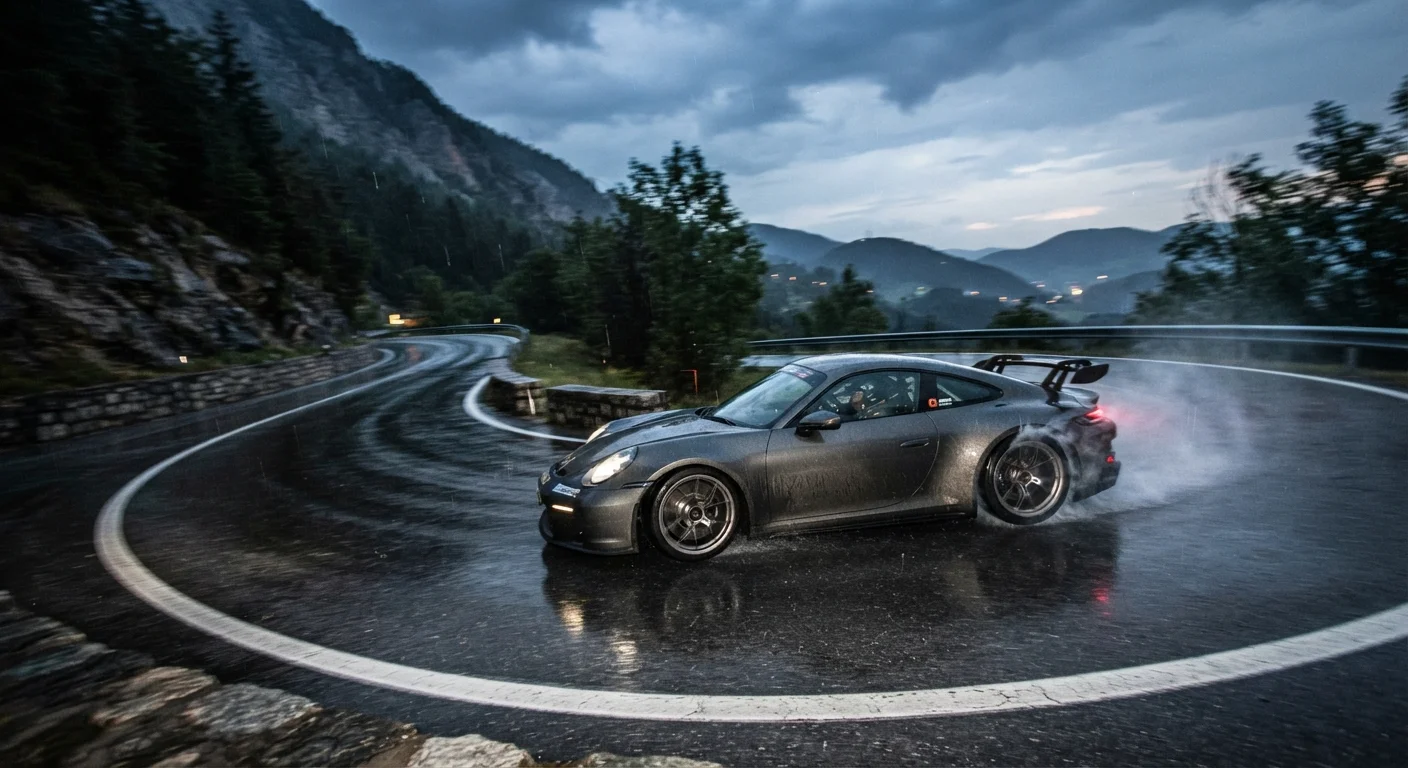
What it feels like: The rear of the car swings outward — toward the outside of the corner — while the nose points inward more sharply than intended. In a rear-wheel-drive (RWD) vehicle, this can happen under heavy throttle. In any vehicle, it can be triggered by abrupt steering or trail braking.
Why it happens: The rear tyres lose traction before the fronts. Rear-wheel-drive vehicles are more susceptible, particularly when power is applied mid-corner. However, oversteer can also occur in front- and all-wheel-drive vehicles due to sudden weight transfer or very slippery conditions.
How to respond:
Overcorrecting Oversteer Can Flip the Skid
The most common mistake during oversteer is applying too much opposite lock too quickly, then failing to unwind the steering as the car straightens. This causes the vehicle to snap into a skid in the opposite direction — sometimes more severe than the original. Practice smooth, measured corrections and be ready to straighten the wheel as grip returns.
Being able to recognise these situations early — before a skid fully develops — is a hallmark of defensive rather than reactive driving.
Preventing Skids Before They Start
Skid recovery is a valuable skill, but prevention is more reliable than correction. The vast majority of skids are caused by entering a corner or hazard too fast, poorly maintained tyres with insufficient tread depth, or abrupt inputs — hard braking, sharp steering — that shift weight faster than the tyres can adapt.
Check tyre tread depth and inflation pressure regularly. Worn tyres dramatically reduce the grip available, lowering the threshold at which any skid can occur. Your vehicle's tyre pressure monitoring system (TPMS) light is an early signal — our dashboard warning lights guide explains what that and other indicators mean in practice.
Approach corners at a speed that allows you to accelerate gently out — a principle sometimes called the "slow in, fast out" method. Smooth, progressive inputs to the steering, throttle, and brakes keep weight transfer gradual and tyres within their grip limits. In adverse conditions, increasing following distance and reducing speed before corners — not during — is the most effective skid prevention strategy available to any driver.