

Key Takeaways
Start here
What Makes Motorways Different
Next
Joining the Motorway
Core skill
Lane Discipline and Overtaking
Stay safe
Speed, Following Distance, and Fatigue
Exiting
Leaving the Motorway
Emergency prep
Breakdowns and Emergencies
What Makes Motorways Different
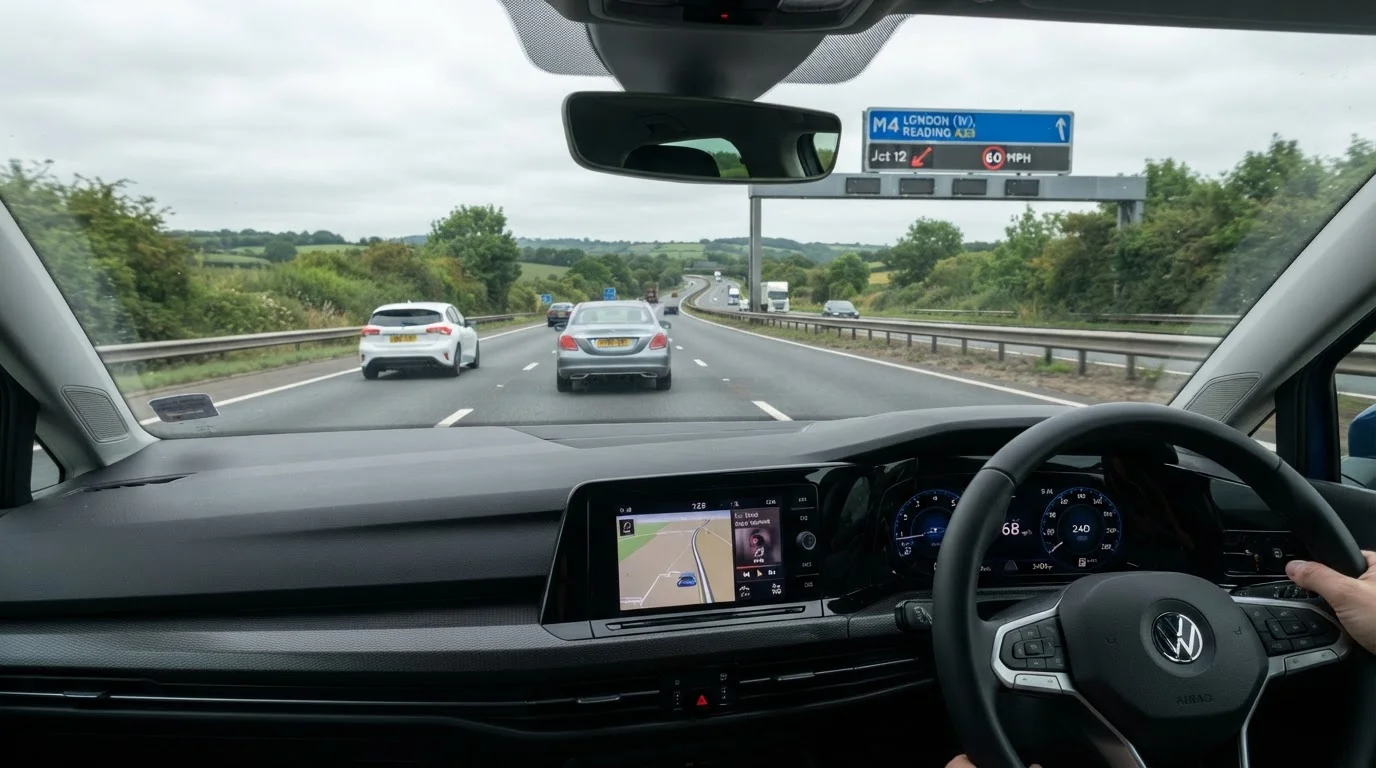
Motorways and interstate highways share characteristics that set them apart from every other road type: no junctions at grade level, controlled entry and exit points, higher sustained speeds, and multiple lanes of traffic all moving in the same direction. These features reduce certain hazards — pedestrians, cyclists, and cross-traffic are absent — but introduce others that demand a higher level of planning and awareness.
The biggest mental shift for new drivers is speed management. At 65–70 mph, events unfold faster and stopping distances are dramatically longer than on a 30 mph urban road. Understanding this before you join is more valuable than any amount of in-car experience on slower roads.
Slip road
The short joining or exiting lane that connects local roads to a motorway, giving drivers space to accelerate or decelerate without disrupting through traffic.
Hard shoulder
The paved strip running along the left edge of a motorway, reserved for genuine emergencies and breakdowns — not for driving or stopping unless unavoidable.
Lane discipline
The practice of staying in the left (or rightmost in the US) lane by default and only moving to an outer lane to overtake, then returning promptly.
Two-second rule
A simple method for maintaining a safe following distance: count two seconds between the vehicle ahead passing a fixed point and your vehicle reaching the same point.
Countdown markers
Blue signs with diagonal stripes placed 300, 200, and 100 yards before a motorway exit, warning drivers to begin moving into the left lane.
Before your first motorway trip, make sure your vehicle is ready. A thorough pre-journey check of tyres, fluids, and lights is especially important when sustained high-speed travel is involved.
Joining the Motorway
Joining happens via a slip road (on-ramp). This is your acceleration zone — use all of it. Your goal is to reach a speed that matches traffic in the left-hand (or right-hand in the US) lane before you reach the merge point. Stopping at the end of the slip road is one of the most dangerous mistakes new motorway drivers make.
As you accelerate, check your mirrors and blind spot for a suitable gap. Indicate clearly before merging. Traffic already on the motorway has priority, so time your entry around available gaps rather than forcing your way in. Once merged, cancel your signal and position yourself fully within the lane.
Practice Your First Merge at a Quiet Time
If possible, plan your first motorway trip during off-peak hours — mid-morning on a weekday is generally less pressured than rush hour. A quieter road gives you more time to find a gap and build confidence with the merge before experiencing heavier traffic conditions.
Lane Discipline and Overtaking
The left lane (right lane in the US) is the normal driving lane. The middle and outer lanes exist for overtaking only — not for cruising. Keep left unless overtaking is the core rule, and most jurisdictions enforce it.
When overtaking, check your mirrors, signal, move to the next lane, pass the vehicle, check it is clear in your mirror, signal, and return to your original lane. Do not linger alongside another vehicle. Undertaking — passing on the inside — is illegal in the UK and dangerous everywhere.
If your car is equipped with driver assistance technology such as lane-keep assist or adaptive cruise control, understand what it does and does not do before relying on it. These systems have real limitations that drivers must account for themselves.
Speed, Following Distance, and Fatigue
Observe posted speed limits at all times. On a motorway, the minimum safe following distance in dry conditions is the two-second rule: pick a fixed point ahead, and ensure two full seconds pass between the vehicle in front passing it and you reaching it. In wet conditions, double this gap to four seconds. In fog or ice, increase it further.
Fatigue is a leading cause of motorway collisions. Plan rest stops every two hours and use service areas rather than pushing through tiredness. Opening a window or turning up the radio does not meaningfully combat drowsiness — only rest does.
Leaving the Motorway
Exit signs and countdown markers — blue boards with diagonal lines at 300, 200, and 100 yards — provide advance warning of your junction. Begin moving to the left lane well before the 300-yard marker, then signal as you approach the slip road exit.
Once on the slip road, reduce speed gradually. After sustained motorway speeds, 40 mph can feel deceptively slow — always check your speedometer rather than relying on feel. At the end of the slip road you will typically meet a roundabout or junction. Refreshing your knowledge of give-way rules before your trip pays off here.
If you are planning a longer road trip that includes motorway driving, there are several logistical and safety checks most first-timers overlook that are worth reviewing in advance.
Breakdowns and Emergencies
If your vehicle develops a problem, act promptly. Move to the hard shoulder or designated emergency refuge area, switch on your hazard lights, exit via the left-hand door (away from traffic), and wait behind the barrier or on the bank — not in the vehicle. Call for roadside assistance from a safe distance.
Never attempt a repair on the hard shoulder itself. If you cannot reach safety before stopping, stay in the vehicle with your seatbelt fastened and hazard lights on, and call emergency services.
Never Stop or Reverse on a Motorway
Reversing on a motorway or highway is illegal and extremely dangerous — do not attempt it even if you miss your exit or feel unsure. If you stop on the hard shoulder for any reason other than a genuine emergency, you are also at serious risk. Always continue to the next exit if in doubt.
Being well-prepared as a first-time car owner goes beyond motorway skills alone. Everything from insurance to maintenance schedules forms part of the confidence you need to drive safely on any road.