

Key Takeaways
Hair Porosity, Density, and Texture
Porosity describes how well your hair absorbs and retains moisture. Density refers to how many individual strands grow on your scalp. Texture describes the diameter of each strand — fine, medium, or coarse. Together, these three characteristics determine how your hair responds to products, heat, and styling far more accurately than curl pattern alone.
Porosity is largely determined by the condition of the hair's cuticle layer — the outermost, scale-like cells that open or close to regulate moisture exchange.
Why Curl Pattern Alone Isn't Enough
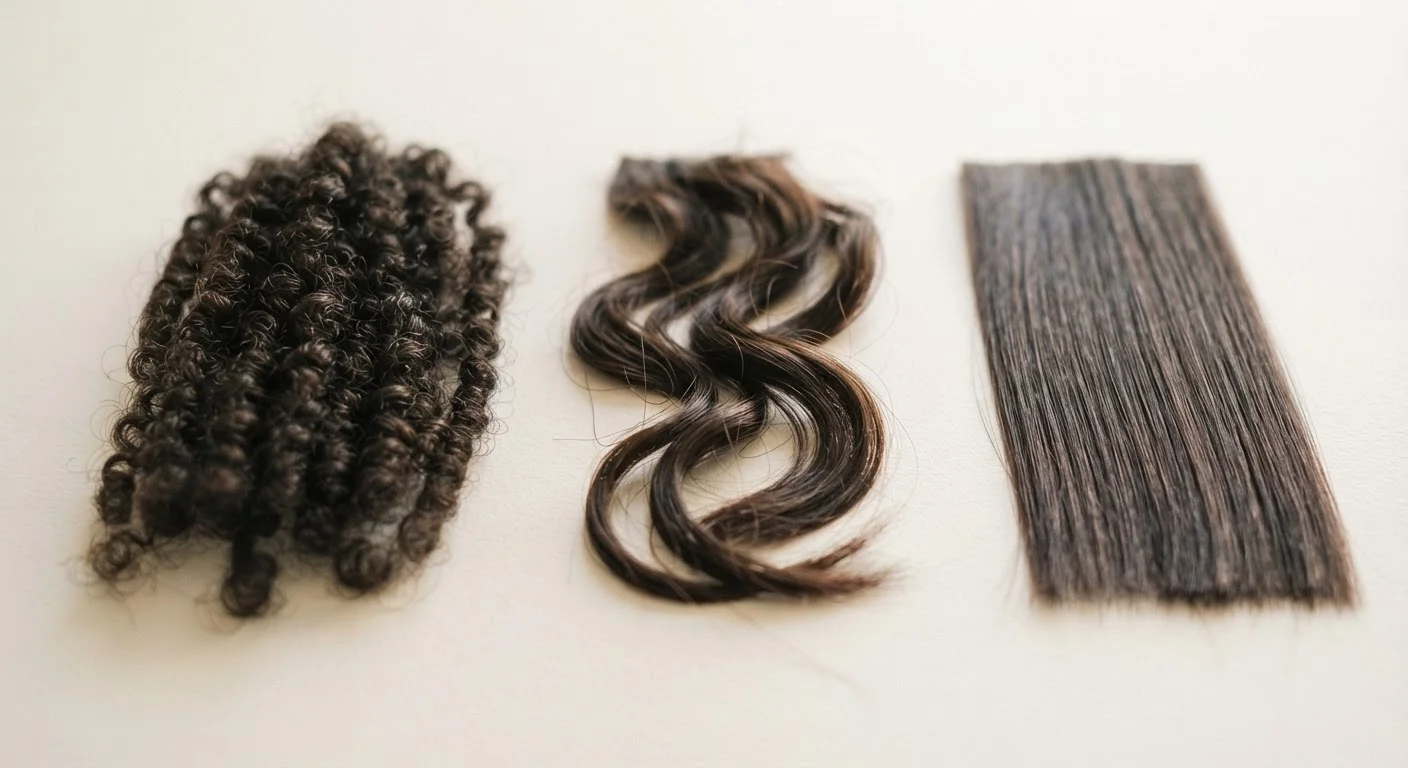
The popular curl-typing systems — which classify hair from straight through loose waves to tight coils — gave many people a useful starting vocabulary for their hair. But curl pattern describes only one dimension of hair structure: its shape. It tells you very little about how your hair actually behaves with moisture, products, or heat.
Two people with the same curl classification can have wildly different results with the same routine. One may find their hair soaks up conditioner easily; the other may find product sits on top of their strands no matter how much they apply. The missing variables are almost always porosity, density, and texture. Understanding all three gives you a genuinely useful picture of your hair — and why it does what it does.
Just as skin type shapes which ingredients work for you, hair characteristics shape which products and techniques are actually compatible with your strands.
Porosity: How Your Hair Handles Moisture
Porosity describes the hair cuticle's ability to absorb and hold onto moisture. The cuticle is the outermost layer of each strand — a series of overlapping, scale-like cells that open and close to regulate what enters and exits the hair shaft.
~100,000
Average number of hair follicles on a human scalp
Estimates from trichology research suggest the average adult scalp has between 80,000 and 120,000 hair follicles, with natural variation across individuals.
3 layers
Structural layers in each hair strand
Each hair strand is composed of the medulla (inner core), cortex (middle layer providing strength and color), and cuticle (outer protective layer governing porosity).
Low porosity means the cuticle lies very flat and tightly closed. Water and products bead up on the surface and take longer to absorb, but once moisture gets in, it tends to stay. People with low-porosity hair often find that products feel heavy or waxy and that deep conditioning works better with gentle heat (which helps lift the cuticle slightly).
High porosity means the cuticle has more gaps or damage — either from genetics or from chemical processing, heat styling, or environmental wear. Hair absorbs moisture quickly but also loses it fast, leading to frequent dryness, frizz, and breakage. If you want to understand more about what damages the cuticle structurally, see why heat damage looks the way it does.
Medium (normal) porosity sits in between: the cuticle is slightly raised, allowing moisture to enter and exit at a relatively balanced rate. This is often the easiest porosity to maintain.
Density and Texture: Two More Pieces of the Puzzle
Density refers to how many hair strands grow from your scalp — not the thickness of each strand, but the total count. High-density hair looks and feels full and thick even when individual strands are fine. Low-density hair may look sparse even if each strand is coarse. Density matters when choosing styling products: heavy creams and butters can weigh down low-density hair, while lightweight serums may disappear into high-density hair without much effect.
Texture (sometimes called strand width or coarseness) describes the diameter of each individual hair strand — fine, medium, or coarse. Fine strands are more vulnerable to breakage and product overload. Coarse strands are structurally stronger but may resist moisture penetration and can feel rough if the cuticle isn't well-conditioned. Medium texture tends to be the most versatile.
These properties also interact with each other. High-porosity, fine-textured hair is particularly prone to damage and dryness. Low-porosity, coarse hair may need specific application techniques to allow conditioning ingredients to actually work. How different oils function in hair care is a good example of this: penetrating oils suit low-density or fine hair, while heavier sealants may serve high-porosity or coarse strands better.
Putting It Into Practice
Once you have a reasonable sense of your hair's porosity, density, and texture, product and routine decisions become far more logical. Rather than following a one-size approach, you can ask: Does this product weight suit my density? Will this formula actually penetrate my cuticle, or just coat it? Is my hair losing moisture because of high porosity, or am I over-applying to low-porosity strands?
Test Products on a Small Section First
When trying a new product, apply it to a small, less visible section of hair and observe how your hair responds over 24 to 48 hours. This gives you useful information about absorption, weight, and feel before committing your entire head. It's especially helpful if you're still learning your hair's porosity and density profile.
These characteristics aren't fixed forever. Chemical services, heat tools, medications, nutritional shifts, and even your local water supply can shift your hair's behavior over time. Everything that affects hair health — from diet to environment — is worth revisiting periodically as your hair and routine evolve.
When in doubt, a professional stylist familiar with diverse hair types can assess your hair's characteristics more reliably than any at-home test. Think of this knowledge not as a rigid system, but as a flexible framework for understanding your hair on its own terms.