

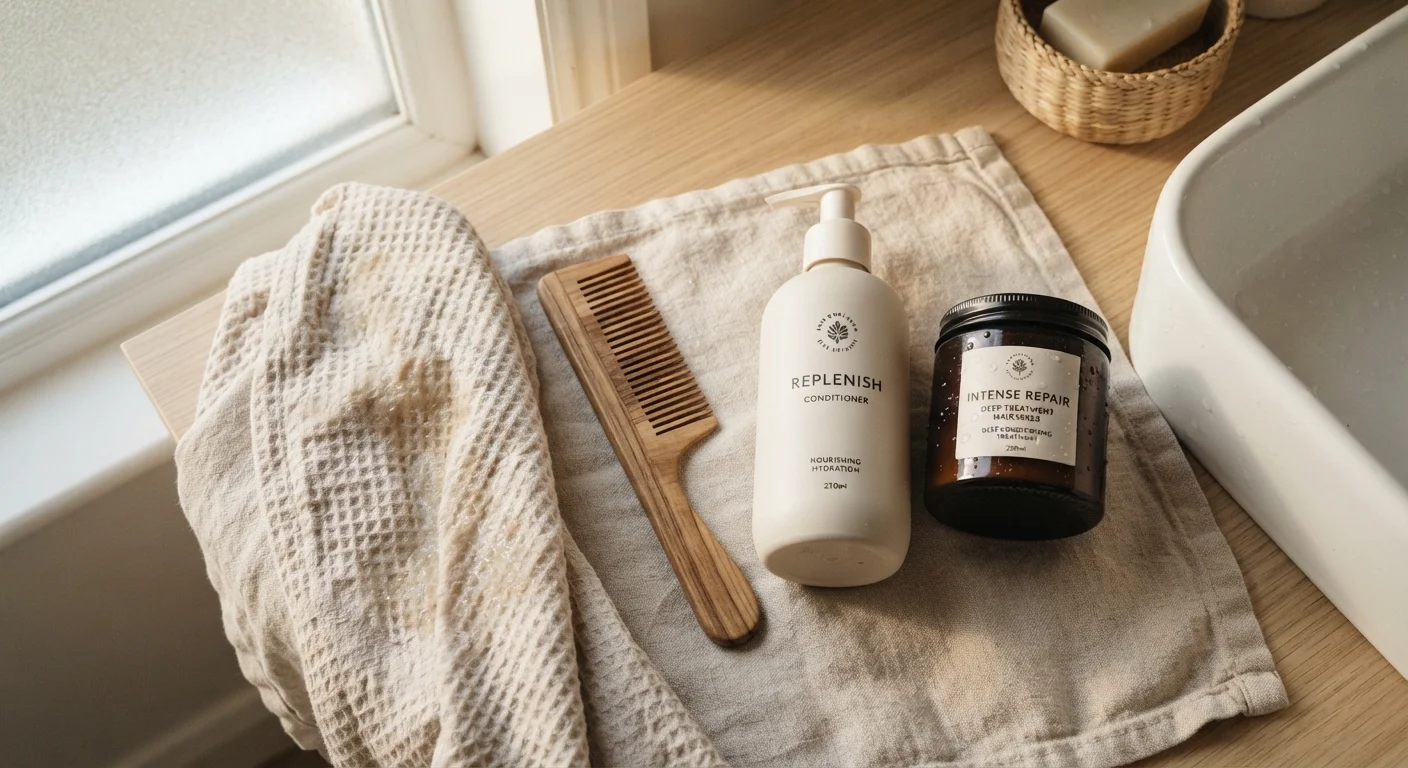
Key Takeaways
Option A
Conditioner
The everyday maintenance staple for post-shampoo softness.
Best for: Detangling, sealing the cuticle, and maintaining moisture after every wash.
Option B
Hair Mask
The targeted, periodic treatment for deeper restoration.
Best for: Replenishing severely dry, damaged, or chemically treated hair with concentrated ingredients.
If you wash your hair regularly and want everyday manageability
Conditioner
A rinse-out conditioner is fast, effective, and designed for consistent use after every shampoo session without weighing hair down.
If your hair feels brittle, straw-like, or has been chemically treated
Hair Mask
A mask's higher concentration of humectants and emollients can provide the intensive repair that a standard conditioner can't deliver in a 2-minute rinse.
If you have fine or low-porosity hair prone to product buildup
Conditioner
Lighter conditioner formulas are easier to control and less likely to cause the limpness or heaviness that over-masking can produce in finer hair types.
If you heat style frequently or have high-porosity, coarse, or coily hair
Hair Mask
Porous hair absorbs and loses moisture rapidly; the denser formula of a mask gives it more to hold onto between washes.
What Each Product Is Actually Designed to Do
The confusion between conditioners and hair masks is understandable — both soften hair and both claim to moisturise. But they're built differently, for different timescales and different levels of need.
A rinse-out conditioner is formulated for speed and regularity. It typically contains a blend of cationic (positively charged) surfactants that temporarily bond to the negatively charged surface of the hair shaft, smoothing the cuticle and reducing friction. This is what makes wet hair easier to detangle and why hair feels softer after rinsing. Most conditioners are designed to be left on for one to three minutes — long enough to coat the cuticle, not long enough to penetrate deeply.
A hair mask, by contrast, is a treatment product with a denser, often more emollient formula containing higher concentrations of conditioning agents, proteins, humectants (ingredients that draw in water), and sometimes lipids. The point of the longer contact time — typically five to thirty minutes — is to allow these ingredients more opportunity to interact with the hair's outer layers. Think of it less as daily upkeep and more as periodic restoration.
Importantly, neither product can reverse internal structural damage to the cortex (the hair's inner layer). Once the disulfide bonds within the hair shaft are broken by bleach or excessive heat, topical treatments can only help the surface behave better — not rebuild what's been lost at a molecular level.
How Porosity and Hair Type Affect Which You Need
Understanding your hair's porosity — how readily the cuticle opens to absorb and release moisture — goes a long way toward choosing the right product at the right frequency.
High-porosity hair (common in chemically processed, heat-damaged, or naturally coily strands) has gaps or lifts in the cuticle that absorb moisture quickly but lose it just as fast. These hair types often benefit most from regular masking because the richer formulas help compensate for that rapid moisture loss. A structured weekly audit of your routine can help you identify whether your hair is genuinely high-porosity or simply needs better daily conditioning.
Low-porosity hair has a tightly closed cuticle that resists absorption. Ironically, heavy masks can sit on the surface and cause buildup without doing much inside. Lightweight conditioners applied to damp hair — where gentle warmth has nudged the cuticle slightly open — often perform better for this type.
Fine hair of any porosity is particularly susceptible to over-conditioning. Too much product, applied too frequently, can make strands limp and dull. A lighter rinse-out conditioner focused on the mid-lengths and ends — avoiding the roots — is usually the right rhythm.
| Criterion | Conditioner | Hair Mask |
|---|---|---|
| Primary purpose | Daily maintenance and detangling | Intensive periodic restoration |
| Typical contact time | 1–3 minutes | 5–30 minutes |
| Formula concentration | Lighter, lower active concentration | Denser, higher active concentration |
| Recommended frequency | Every wash session | Weekly to monthly |
| Best hair type fit | All types, especially fine/low-porosity | Dry, damaged, or high-porosity hair |
| Risk of overuse | Low with correct application | Buildup or limpness if used too often |
| Replaces shampoo? | No | No |
Frequency, Timing, and How to Use Both Effectively
The most practical way to think about this: conditioner belongs in your regular wash-day routine, every time you shampoo. A hair mask belongs in your routine periodically — weekly for very dry or damaged hair, every two to four weeks for hair in reasonably good condition.
When applying a mask, a few practices improve results. Apply to freshly shampooed, damp (not dripping wet) hair so the formula isn't immediately diluted. Distribute evenly with a wide-tooth comb. Covering hair with a shower cap traps body heat, which can help the cuticle relax slightly and allow better ingredient interaction — though the evidence for dramatically improved penetration from heat caps is modest at best.
Rinse thoroughly either way. Residue from a heavy mask left on the hair can attract dirt and cause scalp irritation over time.
If you're wondering how your drying method affects the results of these treatments, the air drying vs. blow drying comparison offers useful context on preserving moisture after your wash routine. And if you use oils alongside conditioners or masks, it's worth knowing that oils work differently depending on their molecular size — some coat the surface, some penetrate the shaft, and layering them incorrectly can block conditioner absorption.
Protein vs. Moisture: Read the Formula
Many hair masks are protein-based (containing hydrolyzed keratin or silk proteins) while others focus on moisture (using shea butter, aloe, or glycerin). Using a protein mask too frequently on already protein-sensitive hair can cause stiffness and increased breakage. If your hair feels hard or snaps easily after masking, the formula may have too much protein for your current hair state. Alternate between protein and moisture-focused treatments based on what your hair is actually responding to.
This article is for informational purposes only. If you are experiencing significant hair loss, scalp conditions, or other concerns, consult a licensed dermatologist or trichologist for personalised guidance.