

Key Takeaways
Our Verdict
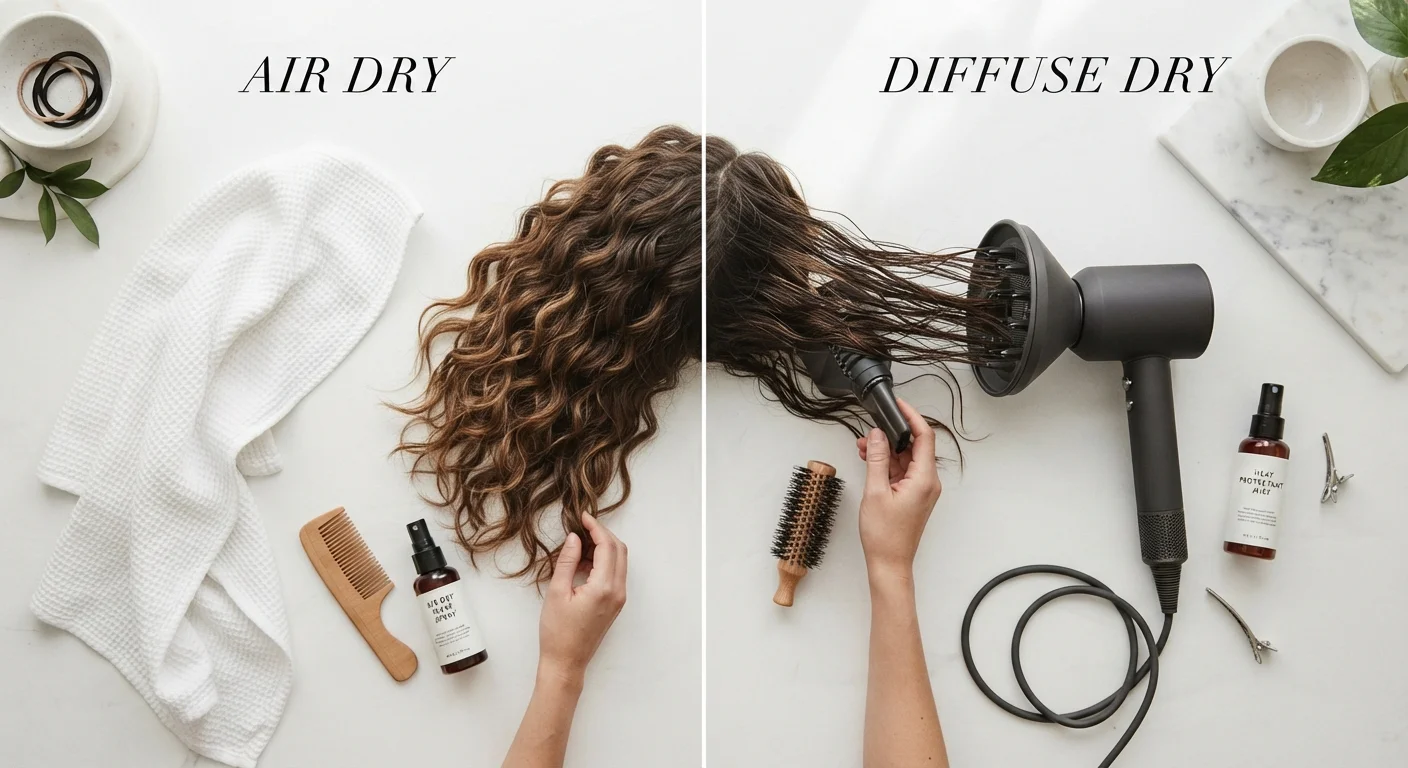
Air drying suits those with lower-porosity hair who can minimize manipulation while wet and aren't pressed for time. Blow drying, when done with appropriate heat settings and a protectant, is a reasonable and sometimes healthier-in-practice option for people who detangle or style wet hair aggressively. Most people benefit from alternating between the two based on circumstances rather than committing rigidly to one approach.
| Best for | Recommended |
|---|---|
| Those with low-porosity or fine hair who can let hair dry undisturbed | Air Drying |
| Those with high-porosity, coily, or thick hair prone to hygral fatigue | Blow Drying (low heat with diffuser) |
| Anyone with limited time or who styles hair while wet | Blow Drying |
| Those building a lower-manipulation, heat-free routine | Air Drying |
What Actually Happens to Hair During Each Method
Hair is most vulnerable when wet. The cuticle — the outer protective layer of each strand — swells when it absorbs water, making the shaft temporarily more elastic but also more prone to damage from friction, tension, and environmental stress. Both drying methods interact with this vulnerability differently.
Air drying keeps hair in its swollen, wet state for an extended period. Research has noted a phenomenon called hygral fatigue: repeated swelling and contracting of the hair shaft from prolonged water exposure can degrade the cortex — the inner structural layer — over time. This is particularly relevant for high-porosity hair, which absorbs and releases moisture rapidly, and for coily or curly textures that may take significantly longer to fully dry.
Blow drying uses heat to evaporate water from the shaft quickly, which shortens the window of wet-hair vulnerability. However, heat above approximately 150°C (around 300°F) can degrade the proteins that give hair its structure, particularly if applied repeatedly to dry or near-dry hair. The cuticle can also lift and crack under high heat, leaving hair porous and prone to frizz.
For a fuller picture of what shapes hair health day to day, see our guide to everything that affects hair health.
How Hair Type and Porosity Change the Calculation
There is no single right answer because hair behaves differently based on texture, density, and porosity — how readily the cuticle opens to absorb and release moisture.
| Air Drying | Blow Drying | |
|---|---|---|
| Heat damage risk | None | Moderate to high (technique-dependent) |
| Hygral fatigue risk | Higher (prolonged wetness) | Lower (faster drying time) |
| Time required | 30 min to several hours | 10–25 minutes typically |
| Best for fine/low-porosity hair | Generally well-suited | Use low heat to avoid over-drying |
| Best for coily/high-porosity hair | Risk of hygral fatigue | Diffuser on low heat often preferred |
| Equipment needed | Microfiber towel or t-shirt | Blow dryer, heat protectant, nozzle/diffuser |
| Curl/wave pattern preservation | Natural, undisturbed | Diffuser helps; nozzle can disrupt pattern |
Fine or low-porosity hair tends to air dry relatively quickly and may be more susceptible to heat damage from high blow-dryer temperatures. For this hair type, air drying often works well, especially with minimal manipulation while wet.
Coily, coarse, or high-porosity hair may stay wet for hours when air-drying, increasing hygral fatigue risk. A diffuser attachment on a blow dryer at a low or medium heat setting can reduce overall drying time while distributing airflow gently to preserve curl pattern — often a better outcome than prolonged wetness.
Color-treated or chemically processed hair has a compromised cuticle by default, making it more susceptible to both heat and hygral stress. Careful technique matters more here than which method you choose.
Technique Matters More Than the Method Itself
The damage profile of either approach depends heavily on how it's executed.
Reduce Risk With a Hybrid Approach
You don't have to choose exclusively between air and blow drying. Letting hair air dry to 70–80% before finishing with a blow dryer on a low setting limits both hygral fatigue and total heat exposure. Adding a heat protectant before any heat and a leave-in before air drying gives you additional protection on both ends.
For air drying, the main risks come from manipulation: aggressively towel-drying, combing through soaking-wet strands, or allowing hair to dry in a style that creates tension. Squeezing (not rubbing) hair with a microfiber towel or a soft cotton t-shirt removes excess water without roughing up the cuticle. Applying a leave-in conditioner or lightweight oil before air drying adds slip and helps preserve the cuticle while the strand is in its vulnerable wet state.
For blow drying, keeping the dryer moving rather than hovering over one section, maintaining a reasonable distance (around 6 inches), and using a heat protectant are the most effective ways to limit damage. A nozzle attachment directs airflow in one direction, which smooths the cuticle rather than scattering it. The cooler the setting you can tolerate, the lower the cumulative stress on the hair shaft.
Thinking about drying as part of a broader wash routine? Read how wash frequency affects hair condition — it affects how much stress each drying session puts on your hair overall.
Time, Lifestyle, and Practical Trade-Offs
Beyond hair science, practical realities shape which method is sustainable.
~6 hrs
Typical air-dry time for thick coily hair
Drying time varies significantly by hair density, porosity, and ambient humidity — coily textures can remain damp for hours, increasing hygral fatigue risk.
150°C+
Temperature threshold for protein degradation
Hair science research indicates that repeated heat exposure above approximately 150°C (302°F) can begin to break down structural hair proteins over time.
Air drying works best when you have enough time before needing to be somewhere, when your environment isn't cold or humid (which extends dry time further), and when your styling goals are compatible with how your natural texture dries. If you're sleeping on wet hair, using a satin or silk pillowcase reduces friction significantly.
Blow drying suits busier schedules, colder climates where air drying leaves hair damp for hours, and styling routines that require heat or smoothing. For those who already style wet hair frequently — detangling, twisting, braiding — blow drying may actually reduce total mechanical stress by shortening the window of wet vulnerability.
A balanced approach many people find practical: air dry to about 70–80% dry, then use a blow dryer on a low setting to finish. This limits prolonged wetness while minimizing total heat exposure. Your routine doesn't have to be binary.
For a structured way to assess whether your current drying and moisture habits are working, the weekly hair care audit offers a useful starting framework.
This article is for general informational purposes only and does not constitute medical or dermatological advice. Consult a qualified professional for concerns about scalp health or hair loss.