

| Global voltage: most of the world | 220–240V / 50Hz (Standard across Europe, Asia, Africa, and most of South America) |
| US & Canada voltage | 110–120V / 60Hz (Also used in Mexico and parts of Central America and the Caribbean) |
| Number of distinct time zones | Roughly 38 (Including fractional offsets like UTC+5:30 (India) and UTC+9:30 (central Australia)) |
| Countries with no visa required for US passports | 186 (Henley Passport Index, 2024 — subject to change; verify before travel) |
| Countries offering visa on arrival to US citizens | Varies; currently 40+ (Conditions and eligible nationalities change frequently; confirm with official sources) |
| Common plug types worldwide | 15 recognized types (A through O) (IEC international standard classification) |
Voltage & Plugs: Don't Fry Your Gear
Electrical standards are one of the most overlooked trip-planning details — until a hair dryer sparks or a laptop refuses to charge. The world is divided into two main voltage camps: 110–120V/60Hz (used in the US, Canada, and parts of Central America) and 220–240V/50Hz (used across Europe, most of Asia, Africa, and South America). Plugging a 110V device directly into a 220V outlet without a converter can permanently damage the device.
The good news: most modern travel tech — laptops, phone chargers, camera batteries — is dual-voltage, meaning it handles both standards automatically. Check the small print on the power brick; if it reads something like "Input: 100–240V," you need only a plug adapter (to match the physical socket shape), not a voltage converter.
| Global voltage: most of the world | 220–240V / 50Hz (Standard across Europe, Asia, Africa, and most of South America) |
| US & Canada voltage | 110–120V / 60Hz (Also used in Mexico and parts of Central America and the Caribbean) |
| Number of distinct time zones | Roughly 38 (Including fractional offsets like UTC+5:30 (India) and UTC+9:30 (central Australia)) |
| Countries with no visa required for US passports | 186 (Henley Passport Index, 2024 — subject to change; verify before travel) |
| Countries offering visa on arrival to US citizens | Varies; currently 40+ (Conditions and eligible nationalities change frequently; confirm with official sources) |
| Common plug types worldwide | 15 recognized types (A through O) (IEC international standard classification) |
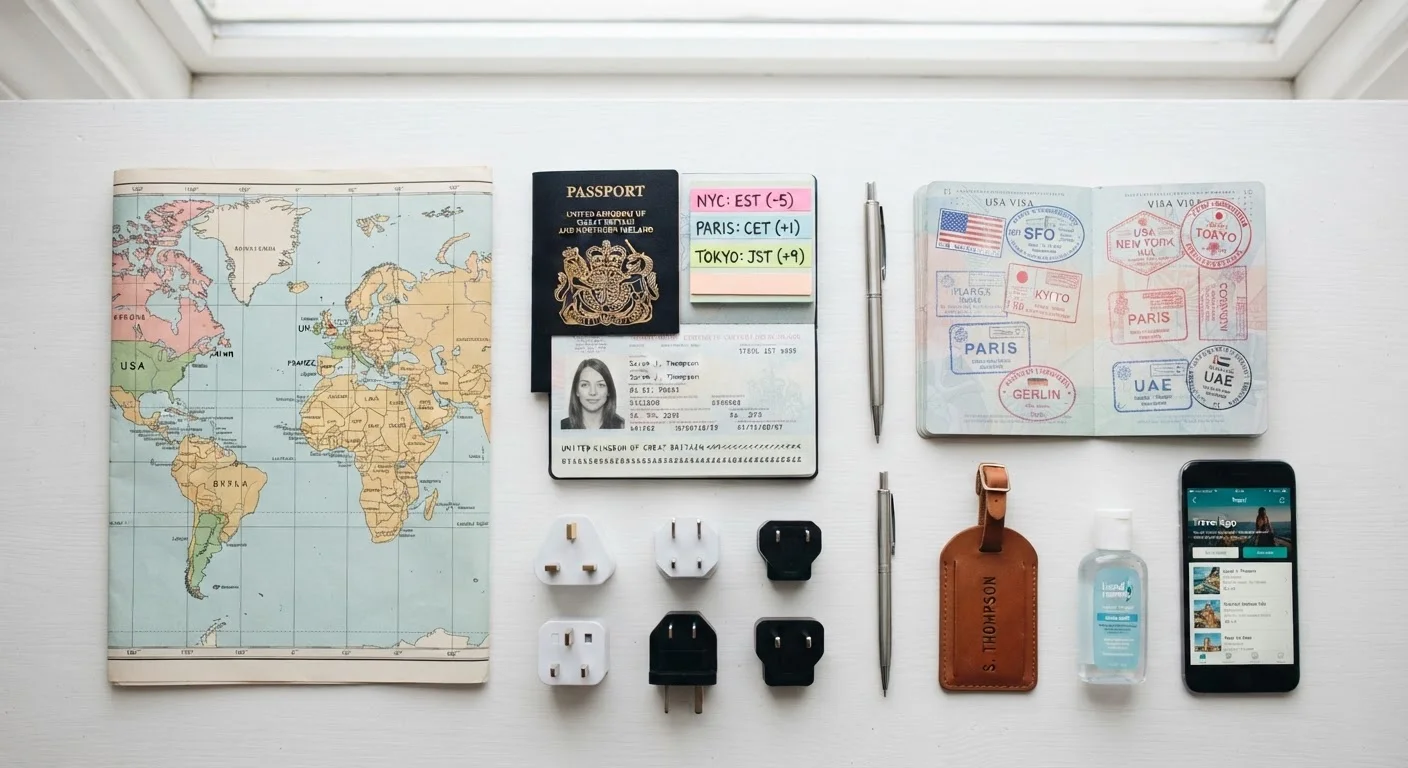
Plug shapes vary by region. Type A and B (flat prongs) dominate North America. Type C (round two-pin) is common across Europe. Type G (three rectangular prongs) is standard in the UK, Ireland, and much of East Africa. Carry a compact multi-plug adapter and always check which type your destination uses before packing. See our international packing checklist for a full tech-gear prep rundown.
Time Zones: How to Convert Without Confusion
Time zone math is deceptively tricky, especially when Daylight Saving Time is in play. The key reference point is UTC (Coordinated Universal Time). Every time zone is expressed as an offset from UTC — for example, US Eastern Standard Time is UTC−5, while Central European Time is UTC+1.
A few offsets that routinely surprise travelers:
- India (IST): UTC+5:30 — a half-hour offset that catches many off guard
- Nepal: UTC+5:45 — the world's only 45-minute offset zone
- Australia: Three time zones including UTC+9:30 (central regions)
- China: A single time zone (UTC+8) despite spanning a geographic width that would normally cover five
When booking connections, always note whether times are listed in local time or UTC — most airline tickets use local time. Use a reliable online time zone converter for any scheduling across more than two zones, and double-check offsets around DST transition dates (which differ between countries).
UTC / GMT
Coordinated Universal Time (UTC) is the global time standard against which all time zones are measured. Greenwich Mean Time (GMT) is effectively equivalent for most practical purposes. When you see 'UTC+5,' it means five hours ahead of that baseline.
Visa on Arrival
A visa issued at the port of entry rather than obtained in advance from an embassy or consulate. Eligibility varies by passport nationality; travelers should verify requirements through official government sources before departure.
eVisa
An electronic visa applied for and approved online before travel. The approval is linked digitally to the passport; no physical sticker or stamp is issued in advance, though some countries print confirmation on arrival.
Voltage & Frequency
Electrical voltage (measured in volts, V) and frequency (measured in hertz, Hz) vary by country. Most of the world runs on 220–240V/50Hz, while the US and Canada use 110–120V/60Hz. Using an incompatible device without a converter can damage it or cause a safety hazard.
Plug Adapter vs. Converter
A plug adapter changes the physical shape of the plug so it fits a foreign outlet but does not change the voltage. A voltage converter (or transformer) actually changes the electrical current. Dual-voltage devices need only an adapter, not a converter.
Transit Visa
A visa required simply to pass through a country's airport or border en route to a final destination. Not all nationalities need one for all airports; always check the specific rules for your layover country.
DST (Daylight Saving Time)
A seasonal practice of advancing clocks by one hour in spring and reverting in fall. Not all countries observe DST, and those that do change on different dates, which can temporarily shift the offset between two destinations.
Visas: A Plain-Language Breakdown
Visa rules depend on two variables: your passport nationality and your destination country's current entry policy. For US passport holders, most popular tourist destinations are either visa-free or offer a visa on arrival — but "most" is not "all," and conditions shift regularly.
Always Verify Entry Requirements Officially
Visa rules, entry conditions, and travel advisories change with little notice. This article provides general orientation only. Before every international trip, check the official government sources for both your home country and your destination — for US travelers, the State Department's travel.state.gov is the authoritative starting point. Vaccination requirements and local laws are equally important to confirm through official channels.
The main categories you'll encounter:
- Visa-free entry
- No advance application needed. Show up with a valid passport and meet the stay limits (often 30–90 days for tourism).
- Visa on arrival (VOA)
- Obtained at the border or airport upon arrival. May require a fee, a return ticket, or proof of accommodation.
- eVisa
- Applied for online before travel, often processed within a few business days. Print or save a digital copy to show at immigration.
- Embassy / consulate visa
- Required for certain countries (China, Russia, India for US travelers, among others). Processing times can be weeks; apply early.
- Transit visa
- Required in some countries just to pass through their airport. Often overlooked and can result in denied boarding.
Our travel terminology reference explains these and related concepts in greater depth. And if you're traveling with prescription medications, don't miss the complete picture of traveling with medications — border rules for medicines can be just as complex as visa rules.
For a broader look at what new travelers get wrong about planning, our piece on travel planning myths is worth a read before your next booking session.