

Key Takeaways
Why Medication Rules Vary So Much by Country
Every country sets its own rules about which medications can legally cross its borders, and those rules are far more varied than most travelers expect. A common antihistamine sold freely in US drugstores may require a prescription in Japan. A pain reliever containing codeine that's routine in the US could be classified as a controlled substance in the UAE, Greece, or Singapore. The legal framework each nation applies reflects its own public health policy, drug scheduling laws, and customs enforcement priorities.
For travelers, this creates a genuinely complex landscape — particularly on multi-country itineraries. A medication that clears customs in one country may flag concern at the next border. That's not a hypothetical: travelers have had medications confiscated or faced delays at entry without proper documentation. Understanding why these differences exist helps frame the preparation you need to do, rather than treating the rules as an arbitrary inconvenience.
OTC Doesn't Always Mean Universally Allowed
Over-the-counter status in the United States does not guarantee that a medication is permitted, unrestricted, or even legal in another country. Pseudoephedrine (found in common decongestants), codeine-containing cough medicines, and certain stimulants are regulated far more strictly in many countries than they are at home. Always verify OTC medications by their active ingredient, not just their US regulatory status.
What to Research Before You Pack
Start your research at least four to six weeks before departure — earlier if you need official letters or import permits. Here's where to focus:
- Embassy and consulate websites for your destination country are the most authoritative sources for current import rules. The US Embassy network also publishes country-specific health and entry information.
- Your destination country's health ministry or customs authority often maintains a dedicated page on controlled substances and pharmaceutical imports.
- Your prescribing physician can write a travel letter — standard practice for international travel — confirming your diagnosis, medication, dosage, and medical necessity.
- Your pharmacist can advise on generic equivalents (since brand names differ internationally) and whether a medication's active ingredients raise flags in specific regions.
Add medication verification to your pre-departure checklist alongside visa and insurance checks. Also review our packing checklist for international travel for a broader look at health essentials to carry.
Ask your pharmacist to print a medication information sheet in the language of your destination country — many pharmacy management systems can generate these automatically.
A translated medication document removes language barriers at customs and with local healthcare providers, reducing the chance of misidentification or unnecessary delay.
Email yourself a scan of your physician's letter, prescription labels, and insurance card before you leave home — cloud access means you're never without documentation even if your bag is lost.
Lost luggage and stolen bags are real travel risks; digital backups ensure you have verifiable proof of your medication's legitimacy regardless of physical circumstances.
How to Pack and Document Your Medications
Proper packing does double duty: it protects your health and signals to customs officers that you're a prepared, legitimate traveler. Follow these practices:
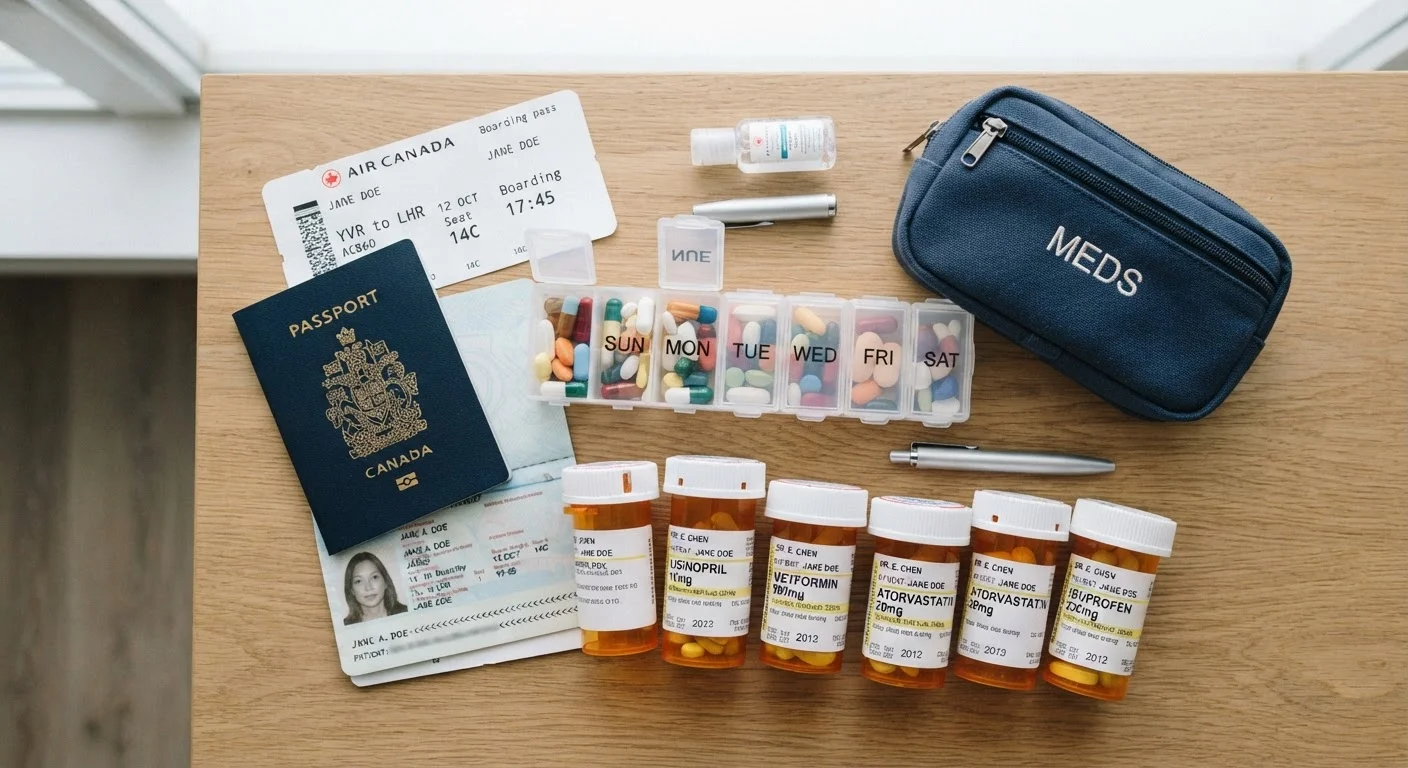
- Keep all medications in their original, pharmacy-labeled containers. Loose pills in unmarked bags or weekly organizers alone can raise questions.
- Bring only the quantity needed for your trip, plus a reasonable buffer (typically a few days' extra). Carrying six months of medication for a two-week trip attracts scrutiny.
- Store a physician's letter in your carry-on, not checked luggage. The letter should include your full name, the medication's generic and brand name, dosage, diagnosis, and your doctor's contact information on official letterhead.
- For liquid medications, include documentation noting medical necessity, especially when quantities exceed standard TSA liquid limits.
- Carry medications in your carry-on bag whenever possible — checked luggage can be lost, delayed, or exposed to temperature extremes that compromise certain drugs.
Navigating Customs and Border Checks
At most international entry points, travelers with properly labeled medications and supporting documentation move through without issue. Being transparent and organized is the single most effective strategy. Declare medications proactively if the customs declaration form asks — failure to declare can create far bigger problems than the medication itself.
If a customs officer asks about your medications, stay calm and hand over your physician's letter and original packaging. Avoid vague answers; a clear explanation of your medical condition and treatment is both appropriate and helpful in these situations.
Land border crossings can differ from airport arrivals in how thoroughly bags are inspected. If you're crossing into Mexico by land, for example, be aware that border agents may inspect vehicles and personal bags more closely than a typical airport customs hall.
Never Mail Medications to Yourself Abroad
Mailing prescription or controlled medications across international borders is subject to the postal and customs laws of both the sending and receiving country — and it is illegal in many situations. Penalties can include seizure, fines, or more serious legal consequences. If you need a medication resupply mid-trip, work through official channels: your travel insurer, a local physician, or your embassy.
Special Situations: Controlled Substances and Injectables
Travelers who rely on controlled substances — ADHD medications, opioid pain relievers, benzodiazepines, or certain sleep aids — face an additional layer of scrutiny in many countries. Some destinations ban these substances outright for visitors; others require advance import permits issued by the destination country's health authority, which can take several weeks to process.
Injectables (insulin, biologics, self-administered immunosuppressants) come with their own logistics: needles, sharps disposal, refrigeration, and documentation. Airlines and airports generally accommodate medical injectables, but you should confirm airline policy in writing before you fly and carry a letter specifying the items are for personal medical use.
For destinations with strict drug laws — Japan, the UAE, and several Southeast Asian countries among them — check requirements rigorously. The consequences of getting it wrong range from medication confiscation to detention. This is exactly where consulting both your physician and the destination's official consulate or embassy well in advance is essential.
This article provides general travel information and is not medical or legal advice. Always consult your healthcare provider and verify current entry requirements with official government sources before traveling.
What to Do If You Run Out or Lose Your Medication Abroad
Even well-prepared travelers occasionally face a medication emergency. Steps to take if you find yourself short:
- Contact your travel insurance provider first — many policies include assistance lines that can help locate pharmacies, arrange international prescription transfers, or coordinate with local physicians.
- Visit a local physician or clinic to obtain a local prescription. Keep your original medication packaging and your physician's letter with you — these dramatically simplify a local doctor's assessment.
- Call the nearest US Embassy or consulate. They won't fill prescriptions, but they can provide a list of local English-speaking physicians and help with emergency contacts.
- Understand that your exact medication may not be available under the same brand name. Your pharmacist at home can give you the generic (International Nonproprietary Name) in advance, which helps local pharmacists identify equivalent options.
Building a medication contingency plan is part of smart trip planning overall. With the right documentation and research in hand before you leave, most medication-related travel complications are manageable — and many are entirely avoidable.