

Key Takeaways
Our Verdict
Synthetic fertilizers excel when plants need a rapid nutrient boost and precision matters most. Organic fertilizers are the stronger long-term investment, gradually improving soil biology and reducing the risk of environmental harm. Many experienced gardeners use both strategically rather than committing to one exclusively.
| Best for | Recommended |
|---|---|
| Gardeners who need fast results for deficient or stressed plants | Synthetic Fertilizer |
| Those building healthy soil over multiple growing seasons | Organic Fertilizer |
| Vegetable growers prioritizing soil biology and reduced chemical inputs | Organic Fertilizer |
| Container gardeners needing precise, controlled nutrient delivery | Synthetic Fertilizer |
How Each Type Works
Understanding the fundamental difference between organic and synthetic fertilizers starts with how each one delivers nutrients to plants.
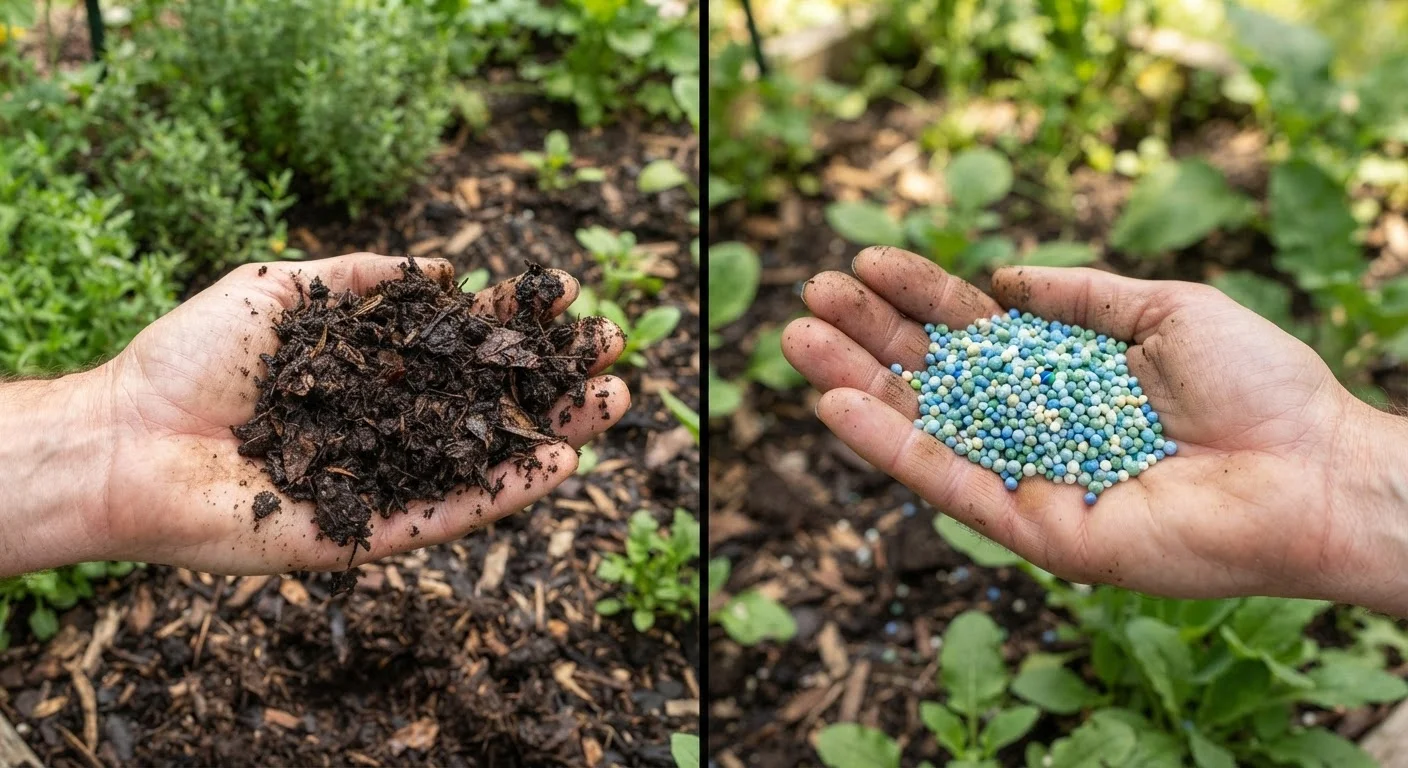
Synthetic fertilizers are manufactured compounds — typically derived from mineral salts or industrial processes — that provide nutrients in a form plants can absorb almost immediately. Nitrogen, phosphorus, and potassium (the primary macronutrients, often labeled as N-P-K) are concentrated and water-soluble, meaning they enter the soil solution quickly after application.
Organic fertilizers come from naturally occurring materials: compost, aged manure, bone meal, kelp meal, and similar sources. These materials must first be broken down by soil microorganisms before nutrients become plant-available. That biological process — called mineralization — takes time, but it also sustains the microbial communities that keep soil healthy over the long term.
Think of it this way: synthetic fertilizers hand nutrients directly to the plant, while organic fertilizers feed the soil ecosystem, which in turn feeds the plant.
Always Start With a Soil Test
Before purchasing any fertilizer, consider having your soil tested through your local cooperative extension service or a certified lab. A soil test tells you which nutrients are actually lacking, so you apply only what's needed. This prevents waste, saves money, and reduces the risk of nutrient imbalances that can harm plants rather than help them.
Nutrient Release and Plant Response
Release rate is one of the most practical differences gardeners encounter.
Synthetic fertilizers typically show visible plant response within days. This makes them useful for correcting a diagnosed deficiency quickly — yellowing leaves from nitrogen shortage, for example, can green up noticeably within a week or two of a targeted application. Some synthetic products are formulated as slow-release coatings, which extend the delivery window, but they still rely on chemical processes rather than biological ones.
Organic fertilizers release nutrients gradually, often over six to twelve weeks or longer depending on soil temperature and microbial activity. Cooler soils slow the process considerably, which is worth keeping in mind for early-spring applications. The upside: a slow, steady nutrient supply rarely overwhelms plant roots and tends to produce more even, resilient growth over a season.
| Organic Fertilizer | Synthetic Fertilizer | |
|---|---|---|
| Nutrient release speed | Slow (weeks to months) | Fast (days to a week) |
| Soil biology impact | Supports microbial life | Neutral to potentially suppressive |
| Soil structure improvement | Yes, over time | No |
| Risk of over-application | Low to moderate | Moderate to high (root burn risk) |
| Environmental runoff risk | Generally lower | Higher with nitrogen types |
| Typical cost | Higher per bag | Lower per nutrient unit |
| Precision of nutrient delivery | Less precise | Highly precise |
Soil Health and Long-Term Impact
This is where organic fertilizers carry a clear structural advantage. Organic matter — the raw material in most organic fertilizers — improves soil texture, water retention, and aeration over time. Compost-based amendments encourage earthworm activity and diverse microbial communities that help plants resist disease and access nutrients more efficiently.
Heavy reliance on synthetic fertilizers, by contrast, can gradually degrade soil biology. Salts in some synthetic formulations may suppress beneficial microbes when applied repeatedly in high concentrations. They also do nothing to improve physical soil structure — a clay-heavy or sandy soil stays that way without organic matter additions.
Environmental considerations are also real. Synthetic fertilizers, particularly nitrogen-based types, can leach through soil into groundwater or run off into nearby waterways after rain, contributing to nutrient pollution. Applying organics more closely mimics natural nutrient cycling and poses a lower runoff risk, though over-application of any fertilizer type can still cause problems.
More Fertilizer Is Not Always Better
Over-fertilizing is one of the most common gardening mistakes. Excess nutrients — particularly nitrogen — don't stay where you put them. They can leach into groundwater, run off into streams, and disrupt local ecosystems. With synthetic fertilizers, too much can also chemically burn plant roots and cause visible leaf scorch. Always follow label rates and adjust based on soil test results rather than guessing.
Practical Considerations for Home Gardeners
Cost, convenience, and application method all factor into your choice.
Synthetic fertilizers are widely available, often less expensive per unit of nutrient, and straightforward to apply at a specific rate. This precision is useful in container gardening, where soil volume is limited and you want to control inputs tightly. However, the margin for over-application is narrower — too much synthetic fertilizer can burn plant roots, a condition known as fertilizer burn.
Organic fertilizers generally cost more per bag, but a single application of a quality compost or aged manure can benefit soil for an entire season. They're also more forgiving — it's difficult to over-apply compost to a garden bed in the way you can over-apply a concentrated synthetic product.
A practical approach many gardeners use: apply organic matter — compost, aged manure — as a baseline each season to build soil health, then use a targeted synthetic application if a specific deficiency is confirmed by a soil test. Starting with a soil test removes guesswork and helps you avoid spending money (and adding chemicals) that your garden doesn't need.
For further reading on how food and diet choices mirror these kinds of input-versus-process trade-offs, see this look at whole vs. processed food spectrums.