

Key Takeaways
Why Your Bedroom Environment Matters
Most people think of sleep problems as internal — a busy mind, stress, or poor habits. But your bedroom itself is an active participant. Temperature, light, and sound are not passive backdrops; they send signals directly to your brain and body that either support or undermine your ability to fall and stay asleep.
Understanding how these three environmental factors work gives you practical levers to pull. If you're new to prioritizing sleep, environmental optimization is one of the most immediately actionable starting points — changes here can take effect the same night you make them.
Individual Variation Is Normal
While research points to general ranges — like 60–67°F for temperature — individual preferences and physiology vary. What matters most is identifying conditions that reduce your personal barriers to falling and staying asleep. Use the general guidance here as a starting framework, then adjust based on what works for you. If sleep difficulties persist despite environmental improvements, speaking with a healthcare provider is a sensible next step.
Temperature: The Coolest Conditions for Deep Sleep
Your core body temperature naturally drops as you approach sleep — a process that signals your brain to initiate deeper sleep stages. A bedroom that's too warm interferes with this process, making it harder to fall asleep and reducing time spent in slow-wave and REM sleep.
Research from sleep science generally supports a sleeping environment in the range of 60–67°F (15–19°C) for most adults, though individual comfort varies. What matters most is that your room isn't too warm — heat is far more disruptive to sleep than mild coolness.
If air conditioning isn't available, lighter bedding materials, a fan for airflow, or a lukewarm shower before bed (which paradoxically accelerates heat loss from the skin) are practical alternatives.
Light: Your Brain's Most Powerful Clock Signal
Light is the primary environmental cue that regulates your circadian rhythm — your internal biological clock. Exposure to light, particularly short-wavelength blue light, suppresses the production of melatonin, the hormone that promotes sleepiness. This is why a bright or unevenly lit bedroom can delay sleep onset even when you feel tired.
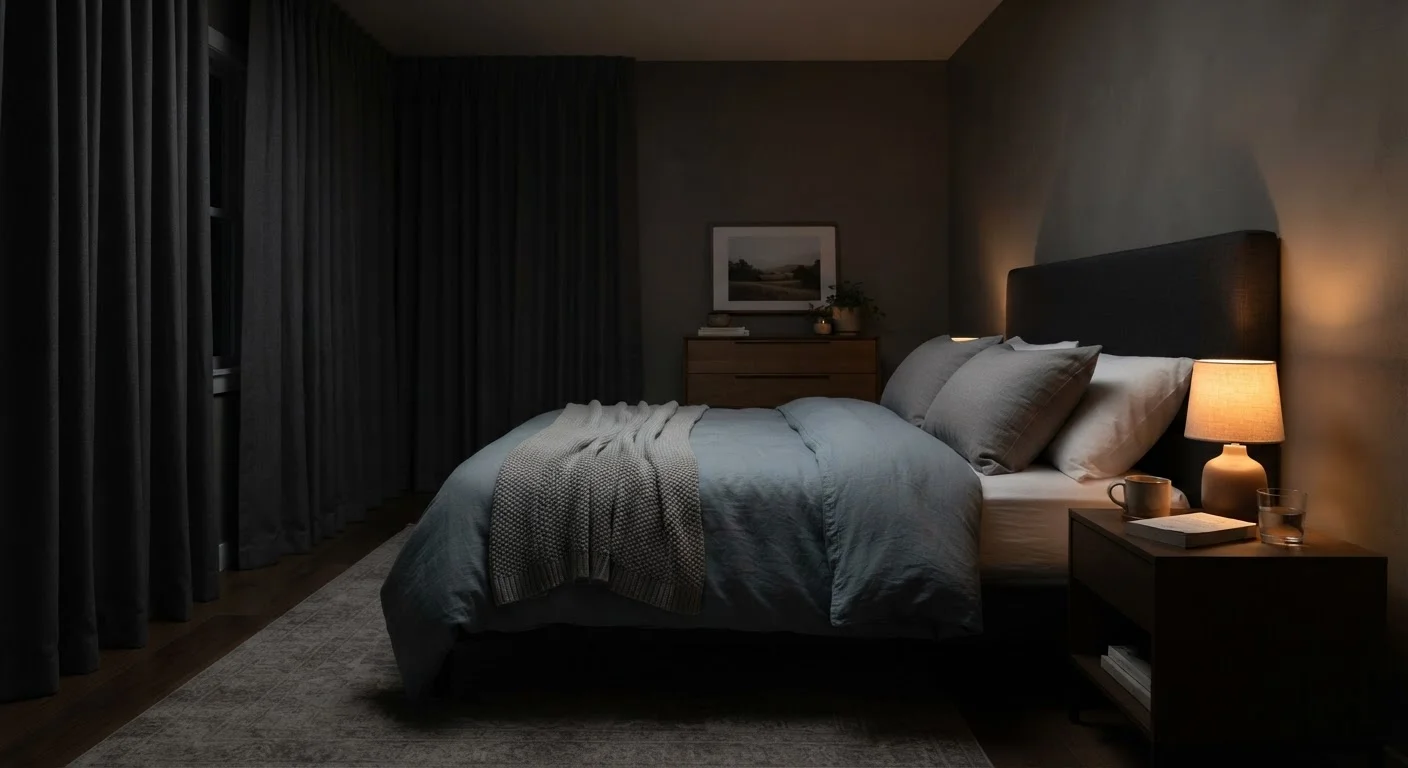
Streetlights, electronics on standby, and early morning sun can all fragment sleep without you being fully aware of the cause. Blackout curtains or a well-fitted sleep mask are among the most cost-effective changes you can make. This issue is compounded by evening screen use — a pattern explored in depth in our look at habits that quietly erode rest.
Morning light exposure matters too: getting natural light shortly after waking helps anchor your circadian rhythm, making it easier to feel sleepy at an appropriate time the following evening.
Sound: The Hidden Disruptor of Sleep Continuity
Sound doesn't have to wake you fully to damage your sleep. Research shows that intermittent or unpredictable noise — traffic, a partner snoring, a nearby TV — can cause brief arousals that pull the brain out of deeper sleep stages, even when you have no conscious memory of waking. Over a full night, this adds up to significantly less restorative rest.
Continuous, predictable sound — such as a white noise machine or a fan — is a well-supported strategy for masking disruptive environmental sounds. The steady auditory backdrop reduces the contrast between silence and sudden noise, which is what typically triggers arousal. Earplugs offer another straightforward option for those who tolerate them.
If you share a sleeping space, soft sound management is often more practical than eliminating the noise source entirely. Your broader evening environment also plays a role; see evening wind-down habits for behavioral strategies that work in tandem with sound management.
“The bedroom environment is one of the most modifiable factors in sleep health, yet it's frequently overlooked in favor of behavioral interventions alone. Addressing temperature, light, and noise together creates the conditions under which behavioral changes can actually take hold.”
— Matthew Walker, Professor of Neuroscience and Psychology, author of research on sleep science
This article is for general informational purposes only and does not constitute medical advice. If you experience persistent sleep difficulties, consult a qualified healthcare professional.