
Chronotypes Explained: Why Night Owls and Early Birds Aren't Just Preferences

Key Takeaways
Chronotype
A chronotype is your body's biologically driven preference for when to sleep and when to be awake. It reflects your internal circadian rhythm — the roughly 24-hour internal clock that governs alertness, hormone release, body temperature, and dozens of other physiological processes. Whether you naturally feel sharpest in the early morning or come alive after dark is largely determined by genetics, not willpower or habit.
Chronotype is influenced by variation in so-called 'clock genes' such as PER3 and CLOCK, which affect the timing and speed of each person's circadian cycle.
More Than a Preference: The Biology Behind Your Sleep Timing
Most of us have been told that waking up early is virtuous and that night owls simply lack discipline. That framing is not supported by science. Your preference for morning or evening wakefulness is governed by your circadian rhythm — an internal biological clock operating on an approximately 24-hour cycle — and that clock runs at a slightly different speed from person to person.
When your circadian clock naturally completes its cycle a little faster than average, you tend to feel sleepy earlier and wake earlier. When it runs a little slower, the reverse is true. These differences are encoded in your DNA. Studies of identical twins show that chronotype is substantially heritable, with genetic factors accounting for roughly half of the variation seen across populations.
This means that if you've always struggled to fall asleep before midnight or found early-morning alertness nearly impossible, your biology — not your character — is largely responsible.
“Chronotype is not a lifestyle choice. It is a biological reality shaped by genetics, age, and light exposure — and treating it as a moral failing does real harm to people whose clocks simply run differently.”
— Till Roenneberg, Professor of Chronobiology, Ludwig Maximilian University of Munich, and author of research on social jetlag
The Chronotype Spectrum: You're Probably Not at Either Extreme
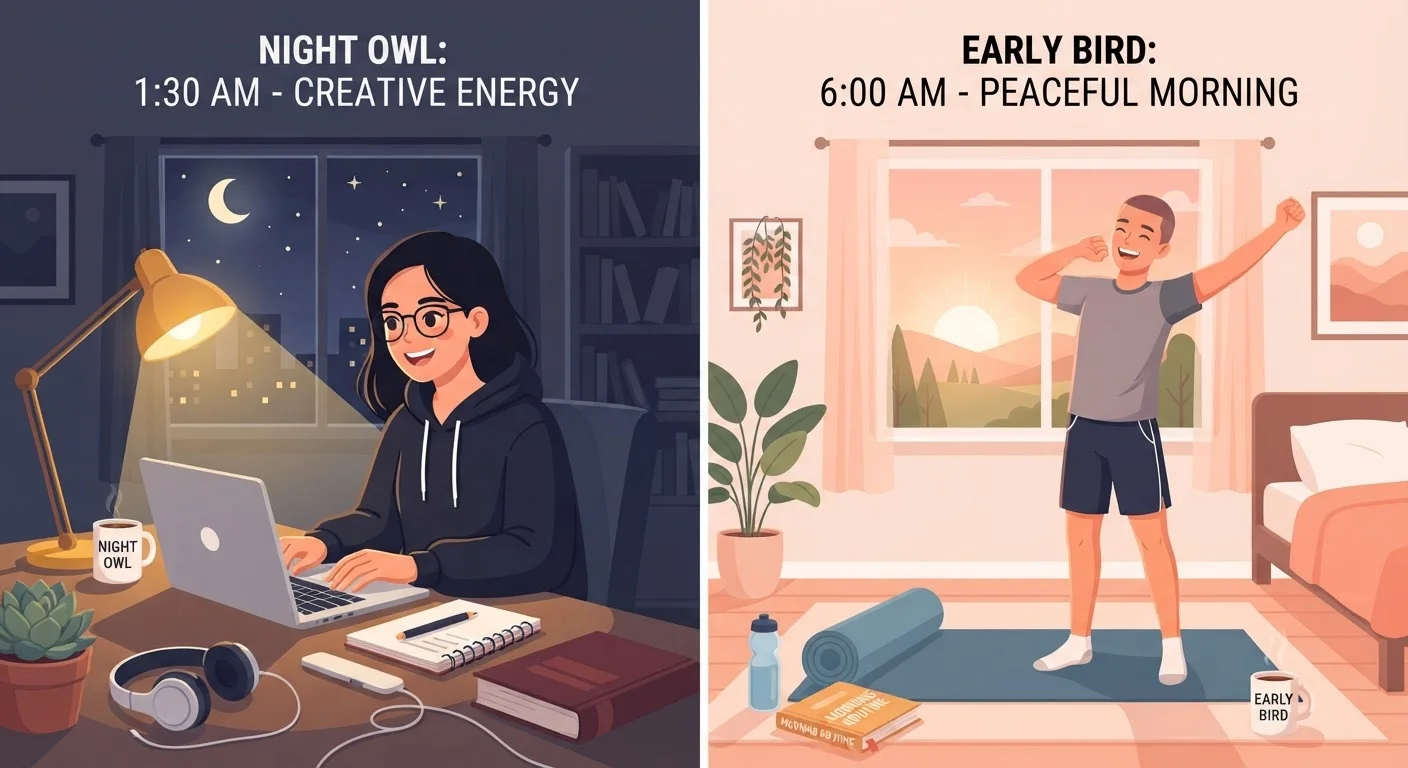
Popular culture frames chronotypes as a binary: night owls versus early birds. In reality, chronotype is a continuous spectrum. Researchers categorize it into roughly four zones — definite morning, moderate morning, moderate evening, and definite evening — but most people cluster in the moderate middle ranges. True extreme chronotypes at either end of the spectrum are relatively uncommon.
Your position on this spectrum also isn't fixed for life. It shifts predictably with age. Children and younger kids tend toward earlier sleep timing. A well-documented biological shift during puberty pushes adolescents toward later sleep and wake times — which is why a teenager sleeping until 10 a.m. on weekends is likely following their biology, not being lazy. This evening drift peaks in the early-to-mid twenties and then gradually reverses, with most adults trending toward earlier timing as they move through middle age and beyond.
For a closer look at how sleep needs and timing evolve across life stages, see Sleep Across a Lifetime.
~50%
Heritability of chronotype
Twin studies estimate that genetic factors account for roughly half of the variation in individual chronotype across populations.
2+ hours
Average social jetlag in evening types
Research published in sleep science journals has found that evening chronotypes commonly experience a gap of two or more hours between natural wake time and work-required wake time on weekdays.
Peak: early-to-mid 20s
Age of latest chronotype timing
Studies tracking circadian timing across the lifespan show the evening shift initiated at puberty reaches its maximum around age 19–21, then reverses gradually.
Social Jetlag: When Your Schedule Fights Your Biology
The real health concern linked to chronotypes isn't whether you're an owl or a lark — it's what happens when your required schedule persistently conflicts with your natural one. Researchers call this mismatch social jetlag.
If your body wants to fall asleep at 1 a.m. but your job demands a 6 a.m. wake-up, you're chronically accumulating a sleep debt and disrupting your hormone rhythms five days a week. Studies have associated chronic social jetlag with increased fatigue, reduced cognitive performance, lower mood, and — over time — poorer metabolic and cardiovascular health markers. The effects are functionally similar to repeatedly flying across multiple time zones without recovery time.
Evening chronotypes face a structural disadvantage in a world built around early-morning schedules. Recognizing this as a biological reality rather than a personal failing is the first step toward managing it constructively.
What You Can — and Can't — Change About Your Chronotype
Your core chronotype cannot be fundamentally overwritten. However, the timing of your circadian rhythm can be nudged — sometimes meaningfully — through consistent behavioral and environmental cues.
- Morning light exposure: Bright light in the first hour after waking is one of the most powerful signals to your circadian system. It anchors your body clock earlier.
- Consistent sleep and wake times: Keeping the same schedule seven days a week — including weekends — reduces drift and stabilizes your rhythm.
- Evening light management: Limiting bright and blue-spectrum light in the two hours before bed delays the suppression of melatonin less, making it easier to fall asleep at your target time.
- Temperature cues: A cooler sleep environment supports the natural core temperature drop your body initiates at sleep onset.
These habits form the basis of good sleep hygiene and can help moderate evening types shift their timing somewhat earlier. For practical guidance on using your environment to support better sleep, see how your bedroom environment shapes sleep quality. You can also explore how deliberate pre-bed habits act as biological cues in our guide to your evening routine as a sleep signal.
Start With Morning Light
If you want to shift your sleep timing earlier, morning bright light is your most reliable tool. Aim for at least 20–30 minutes of natural outdoor light within an hour of waking. On overcast days or during winter months, a high-lux light therapy lamp can serve a similar function. Consistency matters more than intensity — making it a daily habit anchors your clock more effectively than occasional longer sessions.
Working With Your Chronotype, Not Against It
Where possible, the most effective strategy isn't to fight your chronotype — it's to structure your life around it. If you're a moderate evening type, scheduling cognitively demanding work for late morning rather than 7 a.m. may yield noticeably better output. If you're a morning type, front-loading your most important tasks before midday and protecting sleep onset in the early evening aligns with how your brain and hormones are naturally cycling.
This also applies to exercise timing. Research suggests that physical performance, reaction time, and muscular output tend to peak in alignment with your circadian peak alertness — which differs between chronotypes.
Building a morning routine that suits your actual biology — rather than someone else's productivity template — is explored in depth in our guide to building a morning routine that works for your life. The goal is sustainable alignment, not performance of an idealized schedule that your biology actively resists.
This article is for general informational purposes only and does not constitute medical advice. Consult a qualified healthcare professional for concerns about sleep disorders or your personal health needs.