

Key Takeaways
No Equipment, No Excuses — But Also No Pressure
The biggest barrier to exercise isn't motivation — it's friction. A commute to the gym, the cost of a membership, the need for specific gear: each one is a genuine obstacle that can quietly derail even the most well-intentioned routine. Bodyweight training removes most of that friction in one move.
These exercises don't require a yoga mat, a pull-up bar, or a living room the size of a basketball court. They require a body and a small patch of floor. That's it. Whether you're in a hotel room, a studio apartment, or a narrow hallway on a cold morning, the movements below can meet you where you are.
If you've ever wondered whether home-based exercise can genuinely deliver results, the honest breakdown of home workouts is worth reading alongside this guide. And if you carry any persistent beliefs about what "real" exercise looks like, it may also be worth checking which common fitness myths are still shaping your thinking.
Below are seven bodyweight movements chosen for their effectiveness, accessibility, and adaptability — not their impressiveness on social media.
Bodyweight Squat
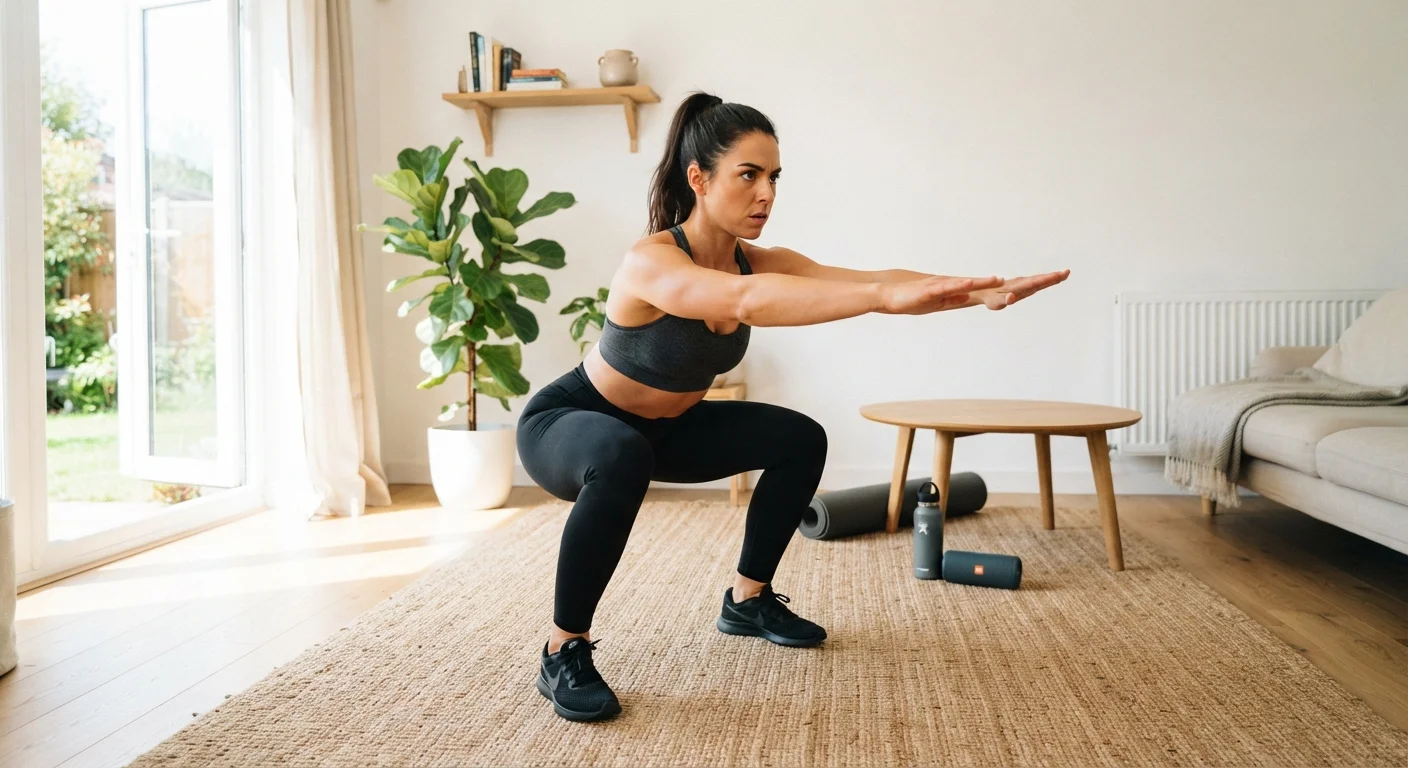
The squat is arguably the most functional movement a human body performs — it mirrors sitting, standing, climbing, and lifting from the ground. A standard bodyweight squat works the quadriceps, hamstrings, glutes, and core simultaneously.
Stand with feet roughly shoulder-width apart, toes turned out slightly. Lower your hips as if sitting back into a chair, keeping your chest tall and knees tracking over your toes. Drive through your heels to return to standing. Aim for your thighs to reach parallel with the floor, though depth should be earned gradually and never forced.
Easier variation: Squat to an actual chair, touching the seat lightly before standing. Harder variation: Pause for two to three seconds at the bottom before rising.
The squat mirrors nearly every fundamental movement pattern in daily life.
Push-Up
Push-ups are a full upper-body exercise that also engage the core, making them far more comprehensive than they're often given credit for. They train the chest, shoulders, triceps, and stabilising muscles of the trunk in a single movement.
Begin in a high plank position with hands slightly wider than shoulder-width. Lower your chest toward the floor in a controlled manner, keeping elbows at roughly a 45-degree angle from your torso — not flared wide. Push back up to the starting position without letting your hips sag or pike upward.
Easier variation: Perform from your knees, maintaining a straight line from knee to shoulder. Harder variation: Elevate your feet on a chair or low step to shift more load onto the upper chest and shoulders.
A proper push-up trains the chest, shoulders, triceps, and core simultaneously.
Reverse Lunge
The reverse lunge is gentler on the knees than a forward lunge while delivering the same lower-body benefits: quadricep, hamstring, and glute strengthening with an added balance challenge. Stepping backward also demands less floor space than a walking lunge.
Stand upright with feet together. Step one foot directly backward, lowering your back knee toward the floor without letting it slam down. Your front shin should remain roughly vertical. Drive through your front heel to return to standing, then repeat on the other side.
Easier variation: Use a wall or countertop for light balance support. Harder variation: Add a slow three-second descent to increase time under tension.
The reverse lunge builds single-leg strength while being kinder to the knee joint.
Glute Bridge
Extended sitting tightens hip flexors and underactivates the glutes — the largest muscle group in the body. The glute bridge directly counters both tendencies, making it especially valuable for people with desk-based routines.
Lie on your back with knees bent and feet flat on the floor, hip-width apart. Press your feet into the ground and squeeze your glutes as you lift your hips until your body forms a straight line from shoulders to knees. Hold briefly at the top, then lower with control.
Easier variation: Reduce the range of motion, lifting only partway. Harder variation: Perform single-leg bridges by extending one leg out straight while bridging on the other.
Glute bridges are a targeted antidote to the hip-tightening effects of prolonged sitting.
Plank
The plank is a deceptively demanding isometric hold — meaning the muscles contract without movement — that trains the entire core: deep abdominal muscles, obliques, lower back, and the stabilisers connecting them. It's also a useful diagnostic: most people discover quickly how much work their core actually does.
Place your forearms flat on the floor, elbows beneath your shoulders. Extend your legs behind you, balancing on your toes. Keep your body in a straight line from head to heels — resist letting your hips drop or your lower back arch. Breathe steadily throughout.
Easier variation: Hold from your knees rather than your toes. Harder variation: Lift one foot slightly off the floor for added instability, alternating sides.
The plank trains deep core stability that no crunch or sit-up can fully replicate.
Mountain Climber
Mountain climbers combine core stability with cardiovascular demand, making them one of the more efficient movements in a space-constrained toolkit. They raise heart rate while reinforcing the same high-plank position used in push-ups.
Begin in a high plank with arms straight and hands beneath shoulders. Drive one knee toward your chest, then quickly return it and switch legs, as if running horizontally. Keep your hips level and avoid letting them rise with each knee drive. Pace can be adjusted — slower for controlled core work, faster for cardio intensity.
Easier variation: Perform slowly, stepping one foot at a time rather than driving dynamically. Harder variation: Increase tempo while maintaining a stable, non-bouncing hip position.
Mountain climbers deliver cardiovascular effort and core training in one compact movement.
Standing Hip Hinge
The hip hinge is a foundational movement pattern — bending at the hips rather than the spine — that underpins deadlifts, kettlebell swings, and the act of picking something heavy off the floor safely. Practicing it without load builds the motor pattern before it's needed under stress.
Stand with feet hip-width apart, a slight bend in the knees. Push your hips backward as if trying to tap a wall behind you, keeping your back flat and chest up. Lower your torso until you feel a mild stretch in your hamstrings, then drive your hips forward to return to standing. The movement comes from the hips, not the lower back.
Easier variation: Stand near a wall and lightly tap it with your hips on each repetition for feedback. Harder variation: Add a brief pause at the bottom of each rep to increase hamstring engagement.
The hip hinge is the movement pattern that protects your lower back in everyday lifting.
Building a Routine That Actually Sticks
Knowing the exercises is only half the picture. The harder part — the part most fitness content glosses over — is stringing them together consistently over weeks and months. A few principles make that significantly easier.
Consistency Beats Intensity Every Time
Research consistently shows that frequency and regularity of movement produce better long-term outcomes than occasional intense sessions. Aim to move most days rather than exhausting yourself twice a week. Even ten to fifteen minutes of focused bodyweight work done consistently will compound into meaningful fitness gains over time.
Start with two or three movements from the list above, repeat them three to four times per week, and focus on form before volume. As the movements become familiar, you can add sets, adjust tempo, or layer in more challenging variations. Progression doesn't have to mean buying new equipment — it can mean slowing down a squat, narrowing your push-up stance, or holding the bottom of a lunge a beat longer.
For those who prefer movement woven into daily life rather than structured sessions, everyday movement habits can complement or even replace formal workouts for many people. And when you're ready to add resistance training to the mix, starting strength training from zero is a natural next step that builds directly on bodyweight foundations.
This article is for general informational and educational purposes only and does not constitute medical or fitness advice. Consult a qualified healthcare or fitness professional before beginning any new exercise program, particularly if you have existing health conditions or injuries.