

Key Takeaways
What time blocking actually is (and isn't)
Time blocking is a scheduling method where you assign specific chunks of time to specific types of work — in advance, on your calendar. Instead of working through a to-do list whenever you feel like it, each task or category of task has a designated slot. The block acts as a commitment: this is what I'm doing during this time, and nothing else.
That's different from simply having a busy calendar. Meetings and appointments already appear as blocks — time blocking extends that logic to your own work. It's also distinct from rigid micro-scheduling: a block for "deep work" doesn't mean you must accomplish a fixed outcome by the minute. It means that window is protected for focused, uninterrupted effort.
For a side-by-side look at how time blocking compares to other focus frameworks, The Pomodoro Technique vs. Time Blocking covers the tradeoffs clearly. And if your mornings set the tone for the rest of your day, pairing time blocking with a deliberate start to the day can sharpen results — building a morning routine that fits your life offers a grounded approach.
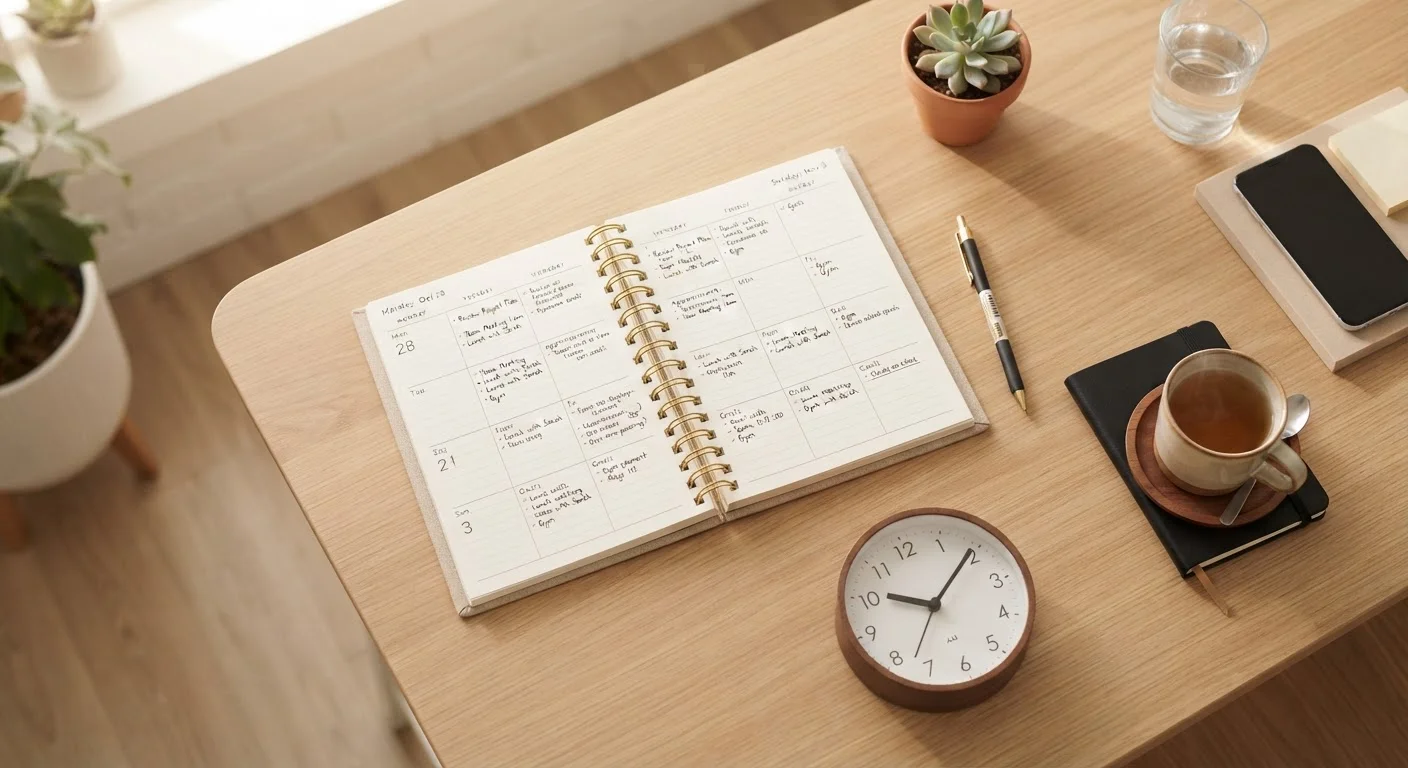
Calendar or Planner
The primary surface for mapping out your time blocks — digital or paper both work.
Task List or Backlog
A reference list of everything you need to schedule so nothing gets overlooked.
Timer or Clock
Helps you stay within a block and signals when it's time to transition.
Common pitfalls that derail time blocking systems
The most frequent reason time blocking fails isn't the method — it's unrealistic setup. Blocks that are too small, too crammed together, or misaligned with your actual energy levels create a schedule that looks productive on paper but falls apart by 10 a.m.
Overscheduling Is the Most Common Mistake
Filling every hour of your day leaves no margin for the inevitable: a task that runs long, an urgent message, or simply needing a break. Research on cognitive load consistently shows that unbroken task-switching degrades focus over time. Build in white space deliberately — it's not inefficiency, it's structural resilience.
A second common issue is treating the template as permanent. Life changes week to week, and a rigid system that can't flex will be abandoned rather than adapted. The goal is a living structure, not a perfect one. For more on understanding the real trade-offs of structured daily schedules, the honest trade-offs of rigid daily schedules is worth reading before you commit fully.
Finally, many people forget to block time for the unexpected — reactive tasks, quick questions, small fires. If every hour is assigned to something, there's no room to handle anything that wasn't planned. A daily "catch-all" block of 30–45 minutes gives you a designated place for the unpredictable without letting it derail everything else.
What you will need