
The Pomodoro Technique vs. Time Blocking: Which Structure Suits Your Work Style?

Key Takeaways
Our Verdict
Both the Pomodoro Technique and time blocking are evidence-informed frameworks for managing attention and workload — they just operate at different scales. Pomodoro controls how you work within a task; time blocking controls what you work on and when. Most people benefit from understanding both well enough to apply whichever fits the demands of a given day.
| Best for | Recommended |
|---|---|
| Those with task-heavy days and frequent distractions | Pomodoro Technique |
| Those managing complex, multi-project responsibilities | Time Blocking |
| Those who want maximum structure and calendar clarity | Time Blocking |
| Those who want a lightweight, low-setup focus system | Pomodoro Technique |
How Each Method Actually Works
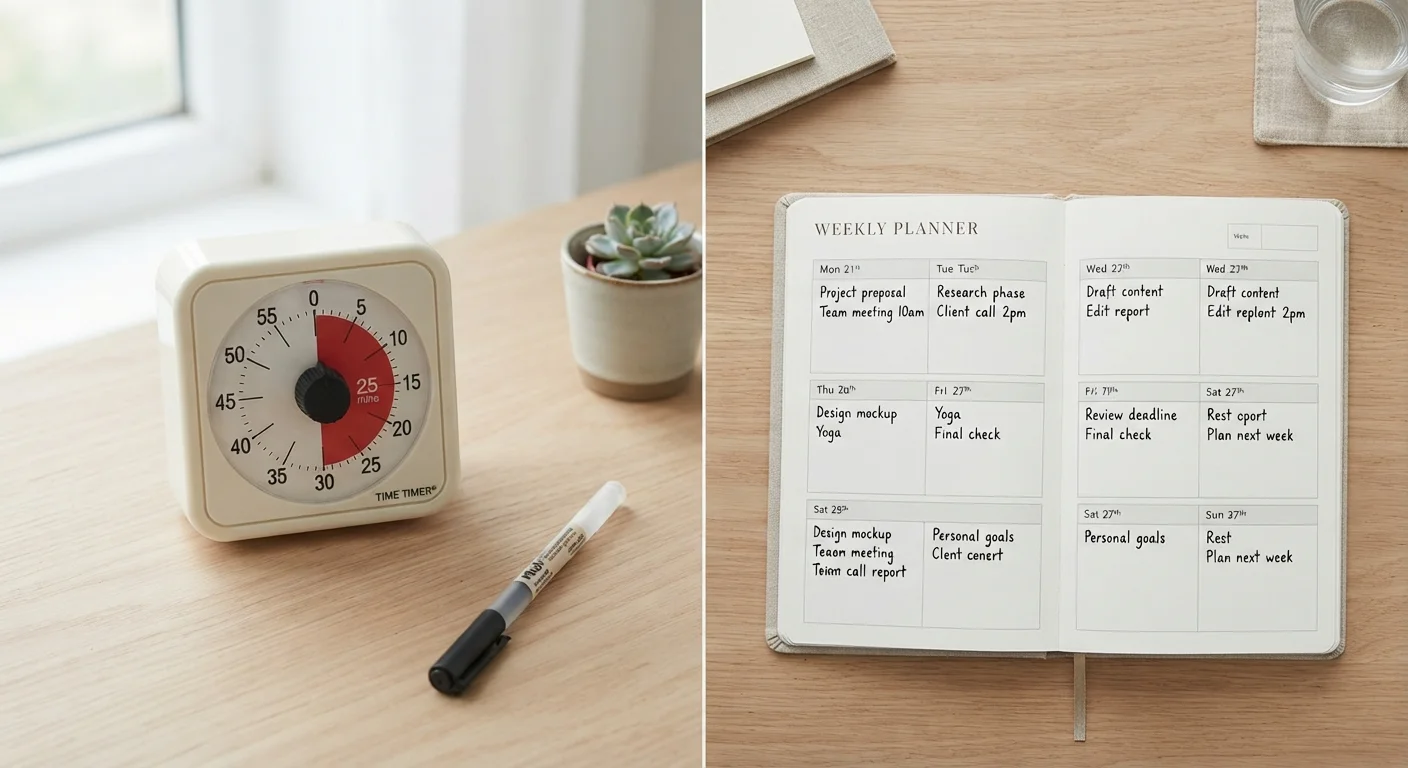
The Pomodoro Technique, developed by Francesco Cirillo in the late 1980s, is deceptively simple: work on a single task for 25 minutes, then take a 5-minute break. After four of these cycles (called "pomodoros"), you take a longer break of 15–30 minutes. The timer is non-negotiable — when it rings, you stop. The rhythm is designed to create urgency, protect attention from drift, and prevent the kind of low-grade exhaustion that builds when you grind without pause.
Time blocking takes a wider lens. Instead of managing minutes, you divide your day into named chunks of time — say, 9–11 a.m. for deep writing, 11–noon for email, 2–4 p.m. for meetings — and you commit to those assignments in advance. The goal is to eliminate the constant low-level decision of "what should I be doing right now?" and replace it with a pre-made plan. For a deeper dive into setting this up, see how time blocking works in practice.
Where Each Method Shines — and Struggles
Pomodoro's greatest strength is its low barrier to entry. You don't need a structured calendar or a carefully planned week — just a task, a timer, and the discipline to stay with it for 25 minutes. It's particularly effective when you're tackling something you've been avoiding, since committing to just 25 minutes feels far more manageable than an open-ended session. It also builds in rest automatically, which matters: research on cognitive fatigue consistently shows that brief, regular breaks help sustain attention over longer periods.
Where Pomodoro struggles is with tasks that don't fit neatly into 25-minute chunks. Deep creative work, complex problem-solving, or collaborative projects can take significant time just to get into — and being yanked out at the bell can break concentration rather than protect it. Some practitioners extend intervals to 50 or 90 minutes, but at that point, the method starts to blend into something closer to time blocking.
Time blocking shines when your day involves genuinely different kinds of work. Grouping similar tasks together reduces the mental cost of switching — something that task batching research supports as a real efficiency gain. Its weakness? Rigidity. An unexpected meeting or a task that runs long can cascade through your entire day. It also requires upfront planning that not everyone finds sustainable.
| Pomodoro Technique | Time Blocking | |
|---|---|---|
| Core unit | 25-min timed work sprint | Named calendar slot (varies) |
| Best for | Single tasks, focus building | Multi-project, varied workdays |
| Setup effort | Very low — just a timer | Moderate — requires planning |
| Flexibility | Adapts easily to any task list | Can break down if day shifts |
| Built-in rest | Yes — mandatory breaks | Only if you schedule breaks |
| Works with deep work | Less ideal for long flow states | Protects extended focus time |
| Calendar dependency | None required | Central to the method |
Matching the Method to Your Work Style
The honest answer is that neither technique is universally better — they suit different people and different kinds of work. Ask yourself a few practical questions:
- Do you struggle to start tasks or stay on them? Pomodoro's timed commitment is excellent for breaking inertia.
- Do you have a mix of deep work, admin, and meetings? Time blocking lets you protect space for each category before your calendar fills with defaults.
- Is your day largely unpredictable? Heavy Pomodoro reliance may frustrate you; loose time blocking with buffer slots tends to be more resilient.
- Do you work in long creative flows? Rigid 25-minute intervals may actually interrupt productive deep work — longer blocks serve these states better.
It's also worth being honest about whether you're actually productive during your busy stretches, or just active. Busyness and productivity are not the same thing, and the right framework is one that moves your actual priorities forward, not just one that fills your hours.
Try a Two-Week Experiment
Rather than committing to one method permanently, run a two-week trial of each. Use Pomodoro for the first week with no calendar planning, then switch to time blocking the next. Track which felt more natural and which produced better output on your actual priorities — not just on how busy you felt. Small adjustments based on real experience beat abstract preference every time.
Using Both Together — and Knowing When to Switch
Many people find the most traction using these approaches in combination. A common hybrid: use time blocking to structure your day at a high level, then apply Pomodoro intervals within your deep-work blocks to stay sharp and build in rest. This way, the calendar tells you what to work on, and the timer governs how you work through it.
Switching between methods is also valid. During a project-heavy sprint, you might lean heavily on time blocking to protect long stretches of focus. During a week of fragmented tasks or lower motivation, Pomodoro's short commitments can rebuild momentum.
If you're still building the underlying habits that make either method stick, it helps to start with your broader daily structure first — designing a daily routine that holds together is a useful foundation before layering in either focus framework. And if you're weighing how much rigidity your schedule can handle, the real trade-offs of rigid daily schedules is worth reading before you commit to either extreme.