
The Truth About Tailgating: Separating Road Myths from Stopping-Distance Science

Key Takeaways
Why Following Distance Is So Easy to Get Wrong
Most drivers consider themselves careful on the road — yet rear-end collisions consistently rank among the most common crash types in the United States. A major contributing factor is tailgating, and underneath that habit lies a cluster of deeply held misconceptions about how quickly a car can actually stop.
Stopping distance is not simply about how hard you press the brake pedal. It has two distinct phases: reaction distance — the distance your vehicle travels while your brain recognizes a hazard and your foot moves to the brake — and braking distance — the distance covered from the moment the brakes engage until the car reaches a full stop. At 60 mph, those two phases combined can consume well over 200 feet under normal conditions. That is roughly 18 car lengths.
Understanding where the myths creep in is the first step toward driving with a more accurate mental model of risk. See how tailgating connects to broader habits in our piece on habits that quietly make you a worse driver.
Myth
If I can stop quickly, I don't need to leave much space ahead of me.
Fact
Your ability to brake hard is only one part of stopping distance — reaction time alone adds significant distance before braking even begins.
Modern vehicles have capable braking systems, but no brake can act before your brain does. At 60 mph, the average driver covers roughly 132 feet during a 1.5-second reaction period — before the brake pedal is pressed at all. Add braking distance on top of that, and the total stopping distance far exceeds what most drivers intuitively estimate. Confidence in your brakes does not compress the laws of physics.
Myth
The two-second rule gives you a safe following distance in any situation.
Fact
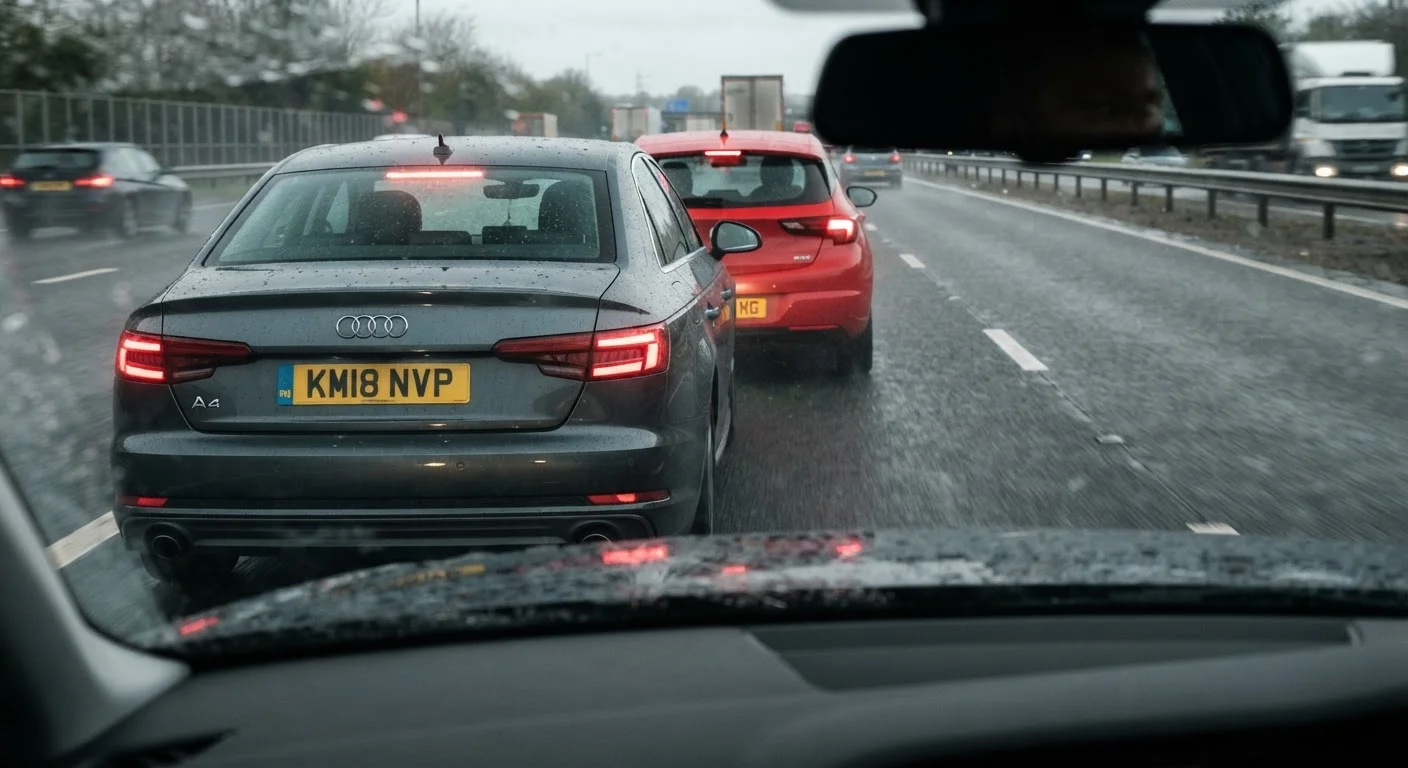
Two seconds is a minimum baseline for ideal conditions — dry roads, alert driver, light traffic. It should increase significantly when conditions deteriorate.
Many driving educators and safety guidelines recommend at least a two-second gap as a starting point, not a ceiling. On wet roads, increase that to four seconds. At highway speeds with a heavy vehicle load, or when fatigued, even more space is warranted. The rule's value is as a quick mental check, not a universal guarantee. Treating two seconds as universally sufficient is one of the most common and dangerous oversimplifications in everyday driving.
Myth
Tailgating is only dangerous at high speeds — at slow speeds it doesn't matter much.
Fact
Low-speed rear-end collisions cause a significant share of whiplash injuries and vehicle damage, and reaction time is equally relevant at any speed.
While high-speed tailgating carries catastrophic crash potential, slow-speed following too closely is far from harmless. Stop-and-go traffic creates repeated braking events that leave little margin for a distracted or slow-reacting driver. Whiplash injuries commonly occur at impacts under 15 mph. The cumulative effect of chronic close-following in city traffic is a significant source of fender-benders and injury claims.
Myth
Experienced drivers can compensate for a shorter following distance through skill.
Fact
Experience does not significantly reduce reaction time, and overconfidence in skill is itself a documented risk factor.
Veteran drivers may read traffic patterns more effectively, but neurological reaction time does not compress meaningfully with years of driving experience. Overconfidence — the belief that superior skill eliminates the need for safety margins — is a well-documented phenomenon in road safety research. Skilled drivers still benefit from ample following distance, and experienced drivers are not immune to distraction or fatigue. Skill complements safety margins; it does not replace them.
Myth
Leaving a large gap ahead just invites other drivers to cut in front of you.
Fact
Even when a vehicle merges into your gap, easing off slightly to re-establish distance costs almost nothing and restores your safety buffer.
This is one of the most frequently cited justifications for tailgating. While vehicles do occasionally merge into available space, the solution is simple: ease off the accelerator slightly to rebuild your cushion. The time cost is negligible — often under two seconds — and the safety benefit is restored immediately. Allowing a gap to feel like a threat rather than a resource reflects a misunderstanding of what that space is actually for.
What the Science of Stopping Actually Tells Us
Physics does not negotiate. Once you understand the forces involved in deceleration, the common instinct to follow closely starts to look far riskier than it feels in the moment.
~240 ft
Typical total stopping distance at 60 mph
According to U.S. driver education guidelines, a passenger car traveling at 60 mph requires approximately 240 feet of combined reaction and braking distance under normal conditions.
~40%
Of all crashes are rear-end collisions
National Highway Traffic Safety Administration (NHTSA) data consistently shows rear-end crashes represent a substantial share of all reported motor vehicle accidents in the U.S.
1.5 sec
Average driver reaction time
Transportation safety researchers generally cite 1.5 seconds as a baseline reaction time for an alert, unimpaired driver under normal conditions — longer when fatigued or distracted.
Reaction time for an alert driver averages around 1.5 seconds — but that figure assumes full attentiveness, no distraction, and no cognitive lag. Fatigue, for example, can push reaction time significantly higher. Our article on driving tired and reaction time explains exactly how sleep deprivation impairs judgment in ways that mirror alcohol impairment.
Road surface conditions add another variable entirely. Wet pavement can increase braking distances by 50% or more compared to dry asphalt. Drivers who rely on dry-road intuitions in the rain are operating with outdated mental math. For a deeper look, driving in heavy rain covers the physics of aquaplaning and wet-weather stopping.
The key takeaway from the science is this: safe following distance is not a fixed number of feet. It scales with speed, road conditions, vehicle load, tire condition, and driver alertness. A rigid memorized gap may feel safe but offer little real-world protection when any one of those variables shifts.
Worn Tires Multiply Your Stopping Distance
Even perfect braking technique cannot overcome inadequate tire tread. Tires with worn tread displace water less effectively and generate less friction on both wet and dry surfaces, extending stopping distances beyond published norms. Regularly checking tread depth — and replacing tires when they approach the 2/32-inch legal minimum — is a critical factor in real-world stopping performance that following-distance estimates often assume you have covered.
Adopting a defensive driving mindset means continuously adjusting your following distance rather than treating it as a set-and-forget habit.