

Key Takeaways
Night Driving Risk
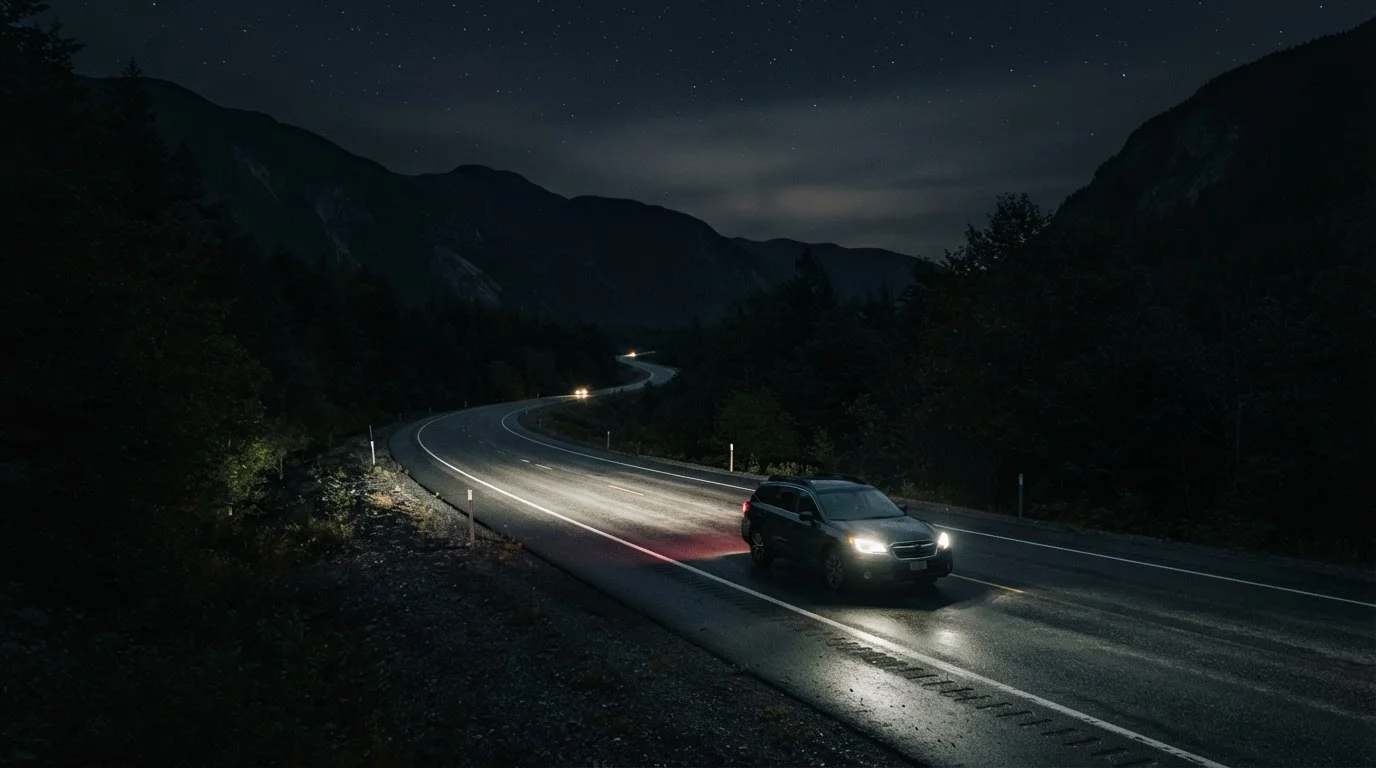
Night driving refers to operating a vehicle after dark, when reduced ambient light, glare from oncoming headlights, and driver fatigue combine to create conditions significantly more dangerous than daylight driving. Although fewer vehicles are on the road at night, crash fatality rates per mile traveled are substantially higher. The human eye is simply not optimized for high-speed navigation in low-light environments.
Scotopic vision — the eye's low-light mode — relies on rod photoreceptors that lack color resolution and fine detail, which is why peripheral hazards and depth perception both degrade after dark.
The Numbers Behind the Darkness
Night driving accounts for a disproportionate share of serious road fatalities. According to the National Safety Council, roughly half of all traffic deaths occur at night, despite nighttime hours carrying far less overall traffic volume. That imbalance reflects something important: darkness does not simply make driving inconvenient — it fundamentally changes the task.
The physics are unforgiving. Low-beam headlights typically illuminate about 160 feet of road ahead. At 60 mph, a vehicle covers that distance in under two seconds. Reaction time alone — before brakes are applied — consumes a substantial portion of that window. This gap between what headlights reveal and what stopping distances require is sometimes called overdriving your headlights, and it is a condition many drivers unknowingly operate in every night.
~50%
Of traffic deaths occurring at night
According to the National Safety Council, approximately half of all traffic fatalities occur during nighttime hours despite significantly lower traffic volume.
160 ft
Typical low-beam headlight range
Standard low-beam headlights illuminate roughly 160 feet of road — less than two seconds of distance at 60 mph before a vehicle arrives at that point.
3x
Higher fatal crash rate at night vs. daytime
The National Highway Traffic Safety Administration has documented that fatal crash rates per mile driven are substantially higher at night than during daylight hours.
What Actually Happens to Your Eyes After Dark
The eye shifts between two vision systems depending on available light. Photopic vision — used in daylight — relies on cone cells that deliver sharp detail and full color. After dark, the eye transitions toward scotopic vision, driven by rod cells. Rods are more light-sensitive but provide no color information and far less spatial resolution.
The practical consequences are significant. Depth perception degrades, making it harder to accurately judge the speed and distance of oncoming vehicles. Peripheral vision, while technically broader in low light, becomes less reliable for detecting fine detail. Contrast sensitivity — the ability to distinguish an object from its background — also falls, which is why a dark-clothed pedestrian on an unlit road can be nearly invisible until dangerously close.
Age compounds these effects. The pupil's ability to dilate in darkness diminishes with age, and the lens becomes less transparent, scattering more incoming light. Drivers over 50 generally require significantly more light to see as clearly as a younger driver — a factor worth accounting for when planning nighttime travel.
Glare: The Hidden Hazard
Oncoming headlights — particularly modern high-intensity LEDs and HID systems — can cause temporary visual impairment that lasts several seconds after the vehicle passes. During that recovery window, a driver is navigating on memory and instinct rather than real-time visual input.
Glare is not just an external problem. A dirty windshield scatters light dramatically, turning a manageable bright light into a wide starburst that obscures far more of the visual field. Dashboard brightness also matters: a bright infotainment screen reduces the eye's adaptation to darkness, narrowing effective night vision. Dimming interior screens and instruments to the lowest comfortable level is a straightforward adjustment with a measurable effect.
Clean Your Windshield Before Night Trips
Interior windshield film is nearly invisible in daylight but causes significant light scatter after dark, amplifying glare from every oncoming headlight and streetlight. Wipe the inside surface with a clean microfiber cloth before longer nighttime journeys. Replacing worn wiper blades also prevents streaking that worsens wet-road glare.
Wet roads introduce another glare dimension. Reflections from puddles and wet asphalt scatter headlight and streetlight beams in unpredictable directions, masking lane markings and road edges. The risks of wet road surfaces at night are explored further in our article on driving in heavy rain.
Fatigue, Circadian Rhythm, and Night Driving
The human body is governed by a circadian rhythm that promotes sleep between roughly midnight and 6 a.m. Driving during this window — regardless of how rested a driver feels — places them in a period of naturally elevated drowsiness. Fatigue slows reaction time, narrows attention, and can produce microsleep episodes lasting seconds without any awareness from the driver.
Night driving fatigue is not simply about being tired. It interacts with every other risk factor: a fatigued driver is slower to detect a pedestrian, slower to respond to a sudden stop ahead, and less capable of compensating for reduced visibility. The combination is more dangerous than either factor alone. Our companion piece on drowsy driving risks covers the physiological mechanics in depth.
It is also worth noting that some drivers carry habits that gradually erode their general safety — overconfidence, distraction, and complacency among them. Our article on habits that make you a worse driver examines how these patterns develop.
Practical Adjustments That Make a Real Difference
Awareness of the risks is only useful when paired with concrete changes. Several adjustments consistently improve night driving safety:
- Reduce speed on unlit roads. Slowing down closes the gap between headlight reach and stopping distance, providing more time to react to hazards in the illuminated zone.
- Clean the windshield — inside and out. Interior film accumulates over time and is frequently overlooked. Both surfaces should be clear before extended night driving.
- Dim dashboard and infotainment screens. Lower interior brightness supports better dark adaptation for the driver's eyes.
- Use high beams appropriately. On dark rural roads with no oncoming traffic, high beams extend visibility significantly. Switch to low beams promptly when approaching other vehicles.
- Increase following distance. Additional space provides more reaction time for hazards that appear suddenly within the headlight range.
- Have your eyes checked regularly. Uncorrected refractive errors and age-related changes significantly worsen night vision. A current prescription and clean lenses make a genuine difference.
Night driving is unavoidable for most drivers. Understanding why it is harder — and making consistent, evidence-based adjustments — is what separates risk awareness from risk reduction.