
New Orleans Neighborhood by Neighborhood: A Practical Orientation for First Visitors

Key Takeaways
Start here
Why Neighborhood Matters in New Orleans
Explore the icons
The French Quarter: Iconic but Misunderstood
Go deeper
Tremé, Marigny, and Bywater: The Creative Core
Find your vibe
Garden District and Uptown: Quiet Grandeur
Think local
Mid-City and Beyond: Local Life, Fewer Crowds
Make the call
Choosing Your Base: Practical Considerations
Why Neighborhood Matters in New Orleans
New Orleans doesn't work like most American cities. It isn't organized by a simple downtown grid — it's a mosaic of self-contained neighborhoods, each shaped by distinct histories, cultures, and rhythms. Choose the wrong one as your base and you might spend your whole trip fighting the city instead of enjoying it.
For first-timers, understanding this geography before you arrive makes a measurable difference. Your neighborhood determines walkability, noise levels, proximity to attractions, dining quality, and how "local" versus "tourist" your experience feels. If you're still building your itinerary from the ground up, the trip-planning framework for first-timers is a solid starting point before diving into neighborhood specifics.
Vieux Carré
The French name for the French Quarter, meaning "old square." It refers to the original colonial grid of New Orleans, established in the early 18th century.
Faubourg
A French term meaning "suburb" or "outlying neighborhood." In New Orleans, faubourgs are the historic neighborhoods that developed just outside the original French Quarter.
Second Line
A New Orleans tradition in which a brass band leads a parade through the streets, with community members following and dancing behind. Second lines are a living expression of the city's musical culture.
Streetcar
A rail-based urban transit vehicle that runs on fixed tracks along city streets. New Orleans has several historic streetcar lines that are both a practical transit option and a cultural landmark.
Creole Architecture
A style of building developed in colonial New Orleans, typically featuring ground-floor commerce, upper-floor living quarters, courtyards, and distinctive wrought-iron or cast-iron decorative elements.
The French Quarter: Iconic but Misunderstood
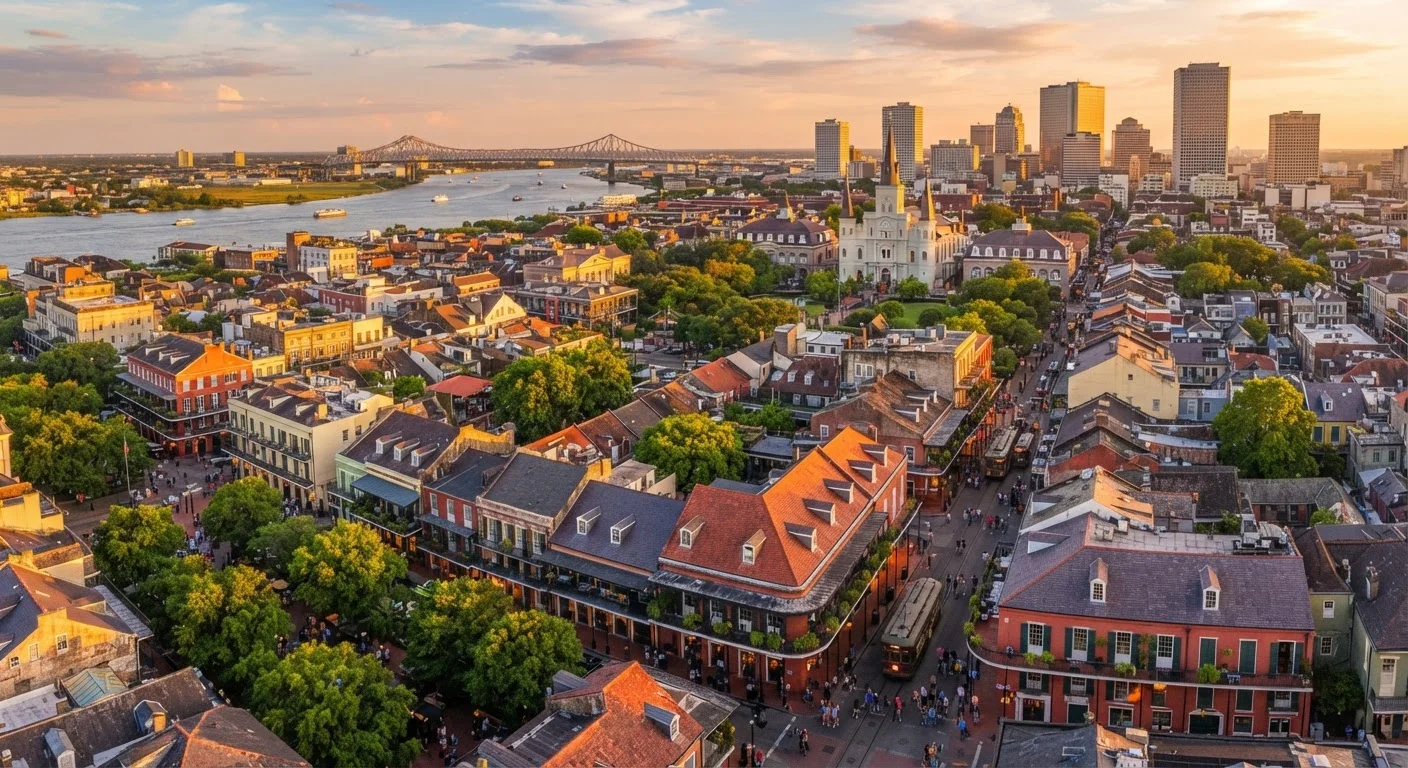
The French Quarter — locally called the Vieux Carré ("old square") — is the city's oldest neighborhood and its most-visited. Its iron-lace balconies, 18th-century Creole architecture, and landmark sites like Jackson Square and St. Louis Cathedral are genuinely worth seeing. The Quarter is also the most walkable, most centrally located option for lodging.
What guidebooks sometimes gloss over: Bourbon Street is only one street. Much of the Quarter — Royal Street, the quieter residential blocks, the French Market area — is a world apart from the party-heavy strip. First-time visitors who stay in the Quarter but sleep a few blocks from Bourbon enjoy the accessibility without the all-night noise. Daytime in the Quarter is colorful and cultural; weeknight evenings are lively; weekend nights can be genuinely overwhelming for travelers who didn't expect festival-level crowds.
Skip Bourbon, Explore the Quarter
Bourbon Street is a New Orleans experience unto itself, but it represents a small slice of the French Quarter. Spend at least one morning walking Royal Street, visiting the historic Cabildo and Presbytere buildings on Jackson Square, and wandering the quieter residential blocks toward Esplanade Avenue. You'll discover a much richer, more layered neighborhood than the nightlife strip suggests.
Tremé, Marigny, and Bywater: The Creative Core
Just outside the French Quarter's edges lie three neighborhoods that together form the city's creative and cultural engine. Tremé — widely recognized as the oldest African American neighborhood in the United States — is the birthplace of jazz and remains a living, breathing community with an extraordinary musical heritage. Visitors who spend time here experience New Orleans at its most historically significant.
The Faubourg Marigny, bordering the Quarter downriver, centers on Frenchmen Street — a strip of live music venues that locals genuinely frequent, not just tourists. It's walkable from the Quarter but feels markedly more neighborhood-like. Bywater, further downriver still, has evolved into an artsy enclave with independent restaurants, murals, and a relaxed creative energy that suits travelers who like to explore at their own pace.
Garden District and Uptown: Quiet Grandeur
Upriver from the French Quarter, the Garden District delivers a strikingly different New Orleans. Antebellum mansions set behind flowering gardens line streets like Prytania and Coliseum. The neighborhood is peaceful, photogenic, and well-suited to travelers who want a quieter base without sacrificing access to the city's core.
The St. Charles Avenue streetcar — one of the oldest continuously operating street railways in the world — runs through this corridor and makes reaching the French Quarter or Tulane University simple and scenic. Magazine Street, the Garden District's commercial spine, is lined with independent shops, cafés, and some of the city's most celebrated restaurants. Uptown, stretching further upriver, blends college-town energy with residential calm and is worth a half-day exploration on its own.
Heat and Humidity Are Serious Factors
New Orleans summers (roughly June through September) bring intense heat and high humidity that can make outdoor exploration genuinely uncomfortable and physically taxing. If you're visiting in summer, plan outdoor activities for the morning, keep afternoons indoors or in air-conditioned spaces, and stay well hydrated. Visitors with health conditions affected by heat should take extra precautions and consult a healthcare provider before traveling in peak summer months.
Mid-City and Beyond: Local Life, Fewer Crowds
Mid-City sits inland, between the French Quarter and the lakefront, and represents New Orleans in a more everyday register. City Park — one of the largest urban parks in the US — anchors the neighborhood with its art museum, botanical garden, and enormous canopy of live oaks draped in Spanish moss. The surrounding streets are full of neighborhood restaurants, po'boy shops, and coffee spots that rarely appear on tourist itineraries.
This area suits the kind of traveler who finds satisfaction in wandering without a plan and eating where locals actually eat. Getting around Mid-City without a rideshare or car is less convenient than in the Quarter or Garden District, so factor that into your decision if you're relying on walkability.
Choosing Your Base: Practical Considerations
Matching neighborhood to travel style is the most practical decision a first-time New Orleans visitor can make. Here's a quick-reference breakdown:
- French Quarter: Best for visitors who want landmark access, walkability, and central location. Expect noise, especially on weekends.
- Faubourg Marigny / Bywater: Best for live music lovers, independent travelers, and those who want local flavor within walking distance of the Quarter.
- Tremé: Best for culturally motivated travelers interested in jazz history and community authenticity. Research lodging options carefully as availability varies.
- Garden District / Uptown: Best for visitors who want quieter streets, distinctive architecture, and easy streetcar access.
- Mid-City: Best for repeat visitors or those willing to use rideshares to access a more residential, crowd-free experience.
Regardless of where you stay, New Orleans rewards curiosity and punishes rigid itineraries. Leave room to follow the music, linger over a meal, or get briefly lost — the city tends to show its best side when you're not rushing.