

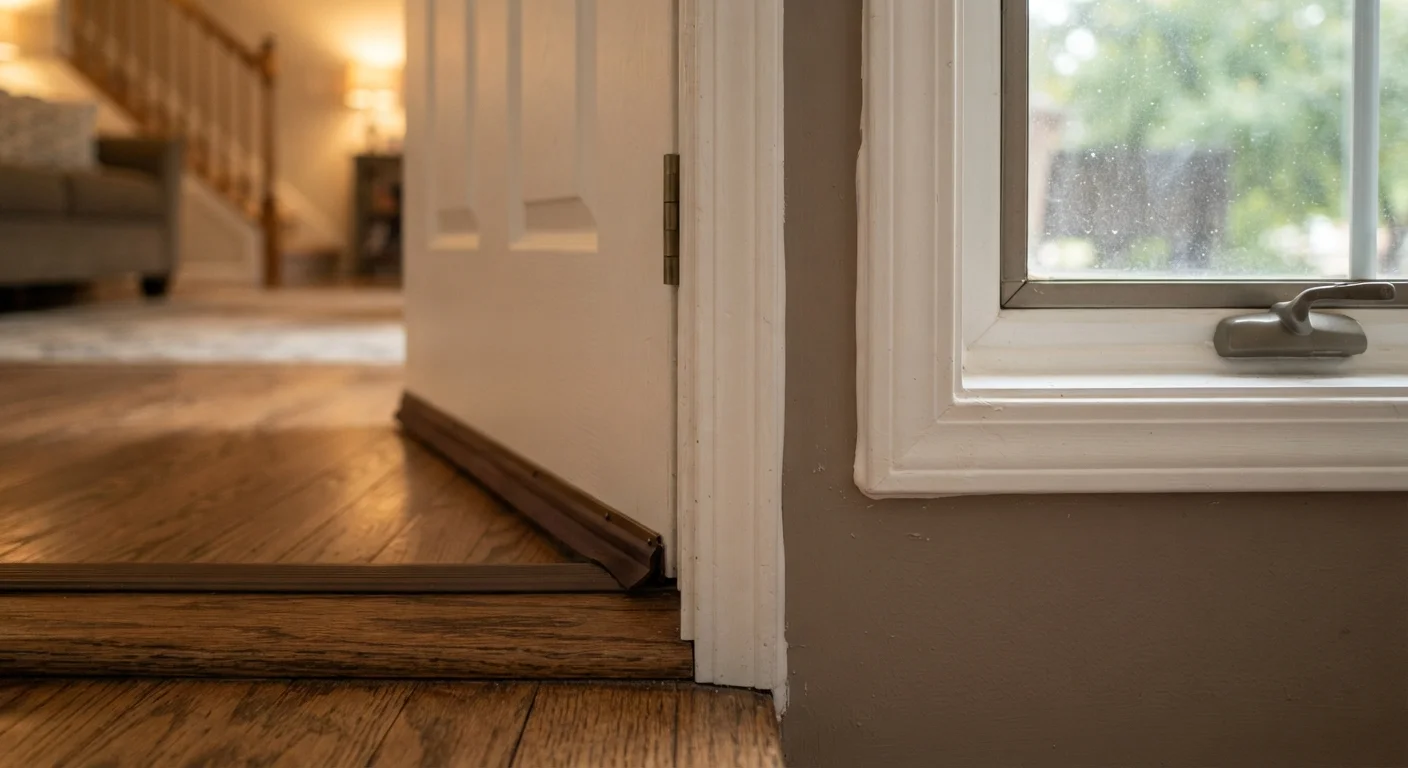
Key Takeaways
Option A
Weatherstripping
The flexible seal for moving parts.
Best for: Best for doors, operable windows, and any gap that opens and closes regularly.
Option B
Caulking
The rigid filler for fixed joints and seams.
Best for: Best for stationary gaps between window frames, walls, sills, and other non-moving surfaces.
If you need to seal an exterior door that swings open and closed daily
Weatherstripping
Door edges and thresholds need a seal that flexes with every use. Caulk applied here would crack within weeks.
If you need to seal the gap between a window frame and exterior wall
Caulking
This is a fixed, non-moving joint. Caulk bonds firmly and lasts years without the compression wear weatherstripping would suffer.
If you're sealing a casement or sliding window where the sash moves
Weatherstripping
The sash edge is a moving surface. Foam or V-strip weatherstripping accommodates the motion without breaking the seal.
If you're addressing gaps around a fixed skylight or attic hatch frame
Caulking
Stationary frames benefit from a rigid, waterproof bond that caulk provides — no movement means no risk of adhesive fatigue.
If you want a complete, energy-efficient draught-proofing job on a typical home
Both
Doors and operable windows need weatherstripping on their moving edges; their surrounding frames and sills need caulk. Both products are usually required together.
Why the Gap Type Determines Your Solution
Not all gaps behave the same way, and that distinction drives everything. A gap that opens and closes — like the edge of a door or the sash of a double-hung window — needs a seal that can compress, release, and spring back repeatedly without losing its shape. A gap that never moves — like the joint between a window frame and the surrounding wall — needs a material that bonds firmly and stays put for years.
Weatherstripping is designed for the first category. It comes in several forms: foam tape, V-strip (also called tension seal), door sweeps, and rubber or silicone gaskets. Each type compresses when a door or window closes and recovers when it opens. Caulking is designed for the second. It's a flexible sealant that cures in place, filling irregular joints and hardening into a durable bead that blocks air and moisture.
Applying caulk to a moving surface — say, along a door edge — will cause it to crack and peel quickly, because the constant movement pulls the cured bead apart. Equally, relying on weatherstripping to bridge a fixed gap between a frame and a wall won't work well either; it won't bond to the surface and leaves uneven coverage. Matching the material to the gap type is the fundamental rule.
| Criterion | Weatherstripping | Caulking |
|---|---|---|
| Best for | Moving gaps (doors, operable windows) | Fixed joints (frames, sills, penetrations) |
| Material forms | Foam tape, V-strip, door sweeps, gaskets | Silicone, latex, or polyurethane sealant |
| Application method | Press-and-stick or screw-fastened | Caulk gun, tooled smooth |
| Flexibility after curing | Remains compressible and resilient | Firms up; some flex but not for repeated motion |
| Typical lifespan | 2–5 years (high-traffic doors) | 5–10+ years (protected joints) |
| DIY difficulty | Low — measure, cut, stick or screw | Low-moderate — prep and technique matter |
| Risk if misapplied | Poor fit; air leakage remains | Cracking if applied to moving surfaces |
Where Each Product Belongs in a Typical Home
A useful way to approach draught-sealing is to walk through your home methodically and categorize every gap before reaching for any product.
Weatherstripping Locations
- Exterior door perimeters: The top and sides of a door (the doorstop area) need compressible foam or rubber strips. The bottom edge needs a door sweep or automatic door bottom.
- Garage doors: Bottom seals and side seals handle the movement of the door panel against the frame and floor.
- Operable window sashes: Where the sash meets the frame or another sash, V-strip or foam tape handles the sliding or swinging motion.
Caulking Locations
- Window frame perimeters: The joint where the window frame meets the interior or exterior wall surface is a fixed gap suited to caulk.
- Sill plates and baseboards: Gaps at the base of walls where they meet the floor, particularly in older homes, can let in significant cold air.
- Around pipes and wires: Penetrations through walls or floors where utility lines pass through are permanent gaps — caulk or an appropriate fire-rated sealant fills these.
For a broader look at protecting your home's exterior surfaces from the elements, including how sealants interact with render and paint, see our guide to external wall treatments.
Using Both Products Together
Most draught-proofing projects — especially around exterior doors and windows — require both weatherstripping and caulk. The weatherstripping seals the movable sash or door leaf, while caulk seals the stationary frame where it meets the wall. Thinking of them as a team rather than alternatives will give you the most complete result.
Installation Tips for Lasting Results
Both products are DIY-friendly, but surface preparation separates a seal that lasts several years from one that fails within months.
Before Applying Weatherstripping
Clean the contact surface thoroughly — adhesive-backed strips won't hold to dusty, painted, or oily frames. Remove any old weatherstripping completely and test the door or window closes firmly against the new strip without binding. Compression is essential; too little and cold air still passes through, too much and the door becomes hard to close and the strip wears out faster.
Before Applying Caulk
Remove all old caulk using a caulk remover tool or a utility knife, and clean the joint with a dry cloth. The joint must be dry — caulk applied over moisture or in temperatures below roughly 40°F (4°C) won't cure properly and may not bond. Apply the bead in a single continuous stroke and tool it smooth with a wet finger or a caulk-finishing tool before it skins over.
Up to 30%
Heating and cooling energy lost through gaps
The U.S. Department of Energy estimates that air leaks through cracks, gaps, and openings can account for up to 30% of a home's heating and cooling costs.
$0–$30
Typical cost for a single door weatherstripping kit
Foam and V-strip weatherstripping kits for a standard exterior door are widely available at hardware stores; installation requires no specialist tools.
Inspect all seals annually, ideally in early autumn before heating season begins. Weatherstripping typically lasts two to five years depending on traffic; caulk in protected interior joints can last a decade or more, while exterior caulk exposed to UV and temperature swings may need refreshing every five to seven years.