

Key Takeaways
Why Companion Planting Is Worth Taking Seriously
Companion planting — growing different plants in deliberate proximity for mutual benefit — has roots in Indigenous agricultural traditions and centuries of practical observation. While not every pairing holds up under controlled study, a meaningful number are supported by research into plant chemistry, soil ecology, and insect behavior.
The mechanisms vary. Some plants release compounds that confuse or repel pests. Others fix nitrogen from the air into the soil, reducing the need for added fertilizer. Tall plants can shade low-growing neighbors that prefer cooler conditions. And certain flowering plants draw in the beneficial insects that pollinate crops or prey on harmful bugs.
If you're planning your first vegetable garden, building companion pairings into your layout from the start is far easier than retrofitting them later. The combinations below are among the most reliably documented — practical choices for everyday gardeners who want results, not guesswork.
A Note on the Research
Companion planting research varies considerably in quality and scale. Many studies are conducted under controlled conditions that don't perfectly replicate a home garden, and results can differ based on climate, soil type, and local pest populations. The pairings listed here are among those with the most consistent supporting evidence, but treat them as informed starting points rather than guaranteed outcomes.
Companion Pairings That Have Earned Their Reputation
Tomatoes and Basil
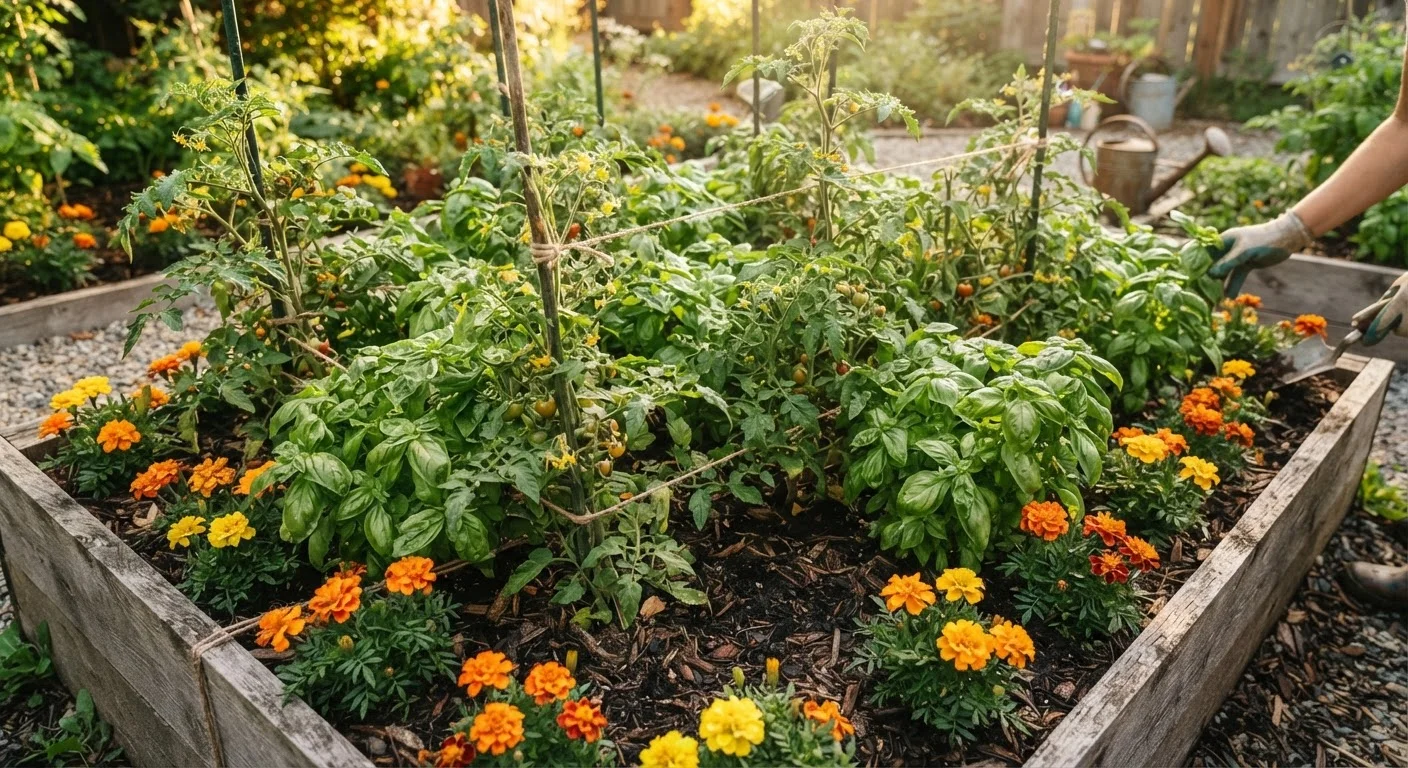
This classic pairing has anecdotal roots going back centuries, and there's credible support for it. Basil produces volatile aromatic compounds — particularly linalool and estragole — that are associated with repelling thrips and aphids in some studies. Planting basil at the base of tomato plants may help deter these common pests while making efficient use of ground-level space that tomatoes don't occupy.
Beyond potential pest benefits, basil and tomatoes share similar needs: full sun, warm temperatures, and consistent moisture. That compatibility makes them easy to manage together. Keep basil well-watered and pinch flower buds regularly to maintain leafy growth and strong aroma throughout the season.
Basil's aromatic compounds may help deter thrips and aphids that commonly trouble tomato plants.
The Three Sisters: Corn, Beans, and Squash
Developed by Indigenous peoples of North America over generations, the Three Sisters combination is one of the most ecologically sound companion systems known. Each plant plays a distinct role: corn provides a vertical structure for pole beans to climb; beans fix atmospheric nitrogen into the soil, benefiting the nitrogen-hungry corn and squash; and squash spreads along the ground, shading out weeds and retaining soil moisture with its large leaves.
This polyculture approach creates a self-supporting system that reduces the need for external inputs. It works best in a large-enough plot — at least a 10-by-10-foot area — and requires careful timing so the corn is tall enough to support beans before they begin to climb.
Each plant in the Three Sisters system contributes something — structure, nitrogen fixation, or weed suppression.
Carrots and Dill (With a Caveat)
Dill attracts beneficial insects — particularly parasitic wasps and hoverflies — that prey on common garden pests including aphids and caterpillars. Carrots benefit from this increased predatory insect activity. However, there's an important timing caveat: mature dill produces compounds that can inhibit carrot growth. Plant dill nearby while it's young and remove or relocate it before it fully flowers to avoid this interference.
Young dill also pairs well with brassicas like cabbage and broccoli for similar reasons, drawing in the same beneficial insects that help manage cabbage worms and whiteflies.
Young dill draws beneficial predatory insects, but mature dill may suppress nearby carrot growth — timing matters.
Marigolds and Virtually Any Vegetable
French marigolds (Tagetes patula) are among the most studied companion plants. Their roots release a compound called alpha-terthienyl, which has shown effectiveness against certain nematodes (microscopic soil worms that damage root systems) in multiple research contexts. Above ground, their scent may confuse or deter whiteflies and aphids.
Marigolds also attract pollinators and beneficial predatory insects throughout the season. Plant them as a border around vegetable beds or intersperse them among tomatoes, peppers, and squash. For nematode suppression, they need to be planted densely and allowed to grow through a full season — a single plant here and there won't achieve the same soil-level effect.
Marigold roots release compounds shown to suppress soil nematodes when planted densely over a full season.
Nasturtiums as Trap Crops
Nasturtiums work differently from most companion plants — they function as a trap crop. Aphids are strongly attracted to nasturtiums, often preferring them over neighboring vegetables. By planting nasturtiums at the garden's edge or between susceptible crops, you can concentrate aphid populations in one place where they're easier to monitor, hand-remove, or allow natural predators like ladybugs to manage.
This approach requires active monitoring. If aphid numbers on nasturtiums climb very high, remove heavily infested stems before the population spills onto vegetable plants. Nasturtiums also produce edible flowers and leaves, making them a practical and productive addition to any kitchen garden.
Nasturtiums lure aphids away from vegetables, concentrating pests where they're easier to manage.
Lettuce and Tall Crops
Lettuce is a cool-season crop that bolts (goes to seed and turns bitter) quickly in hot summer sun. Planting it in the partial shade of taller crops — corn, tomatoes, or trellised cucumbers — extends the lettuce season by buffering it from direct afternoon heat. The tall plants don't particularly benefit from lettuce in return, but they're not harmed either, and the ground-level space is put to productive use.
This is a straightforward spatial relationship rather than a chemical one, but it's highly reliable. Position lettuce on the north or east side of taller plants in the Northern Hemisphere so it receives morning light and afternoon shade during peak summer heat.
Lettuce planted in the shade of tall crops stays productive longer by avoiding the heat that triggers bolting.
Start With One or Two Pairings
If companion planting is new to you, resist the urge to redesign your whole garden at once. Pick one or two combinations that match what you're already growing and observe the results over a full season. Keeping a simple garden journal — noting what you planted where and what pest or growth patterns you observed — makes it much easier to refine your approach the following year.
Putting Companion Planting Into Practice
A few things are worth keeping in mind before rearranging your entire garden. Companion planting works best as one layer of a well-managed growing system — alongside good soil preparation, appropriate spacing, consistent watering, and a solid mulching routine. It rarely compensates for poor fundamentals on its own.
Also be cautious about pairings that circulate widely online but lack grounded evidence. Our article on common gardening myths covers several examples where popular advice doesn't match what research actually shows. When trying a new pairing, test it in one part of your garden before committing fully.
If space is limited, many of these combinations adapt well to raised beds or containers. See our guide to growing plants in containers for practical constraints to keep in mind. With thoughtful planning, companion planting can genuinely reduce pest pressure, improve soil health, and make your garden more productive over time.