

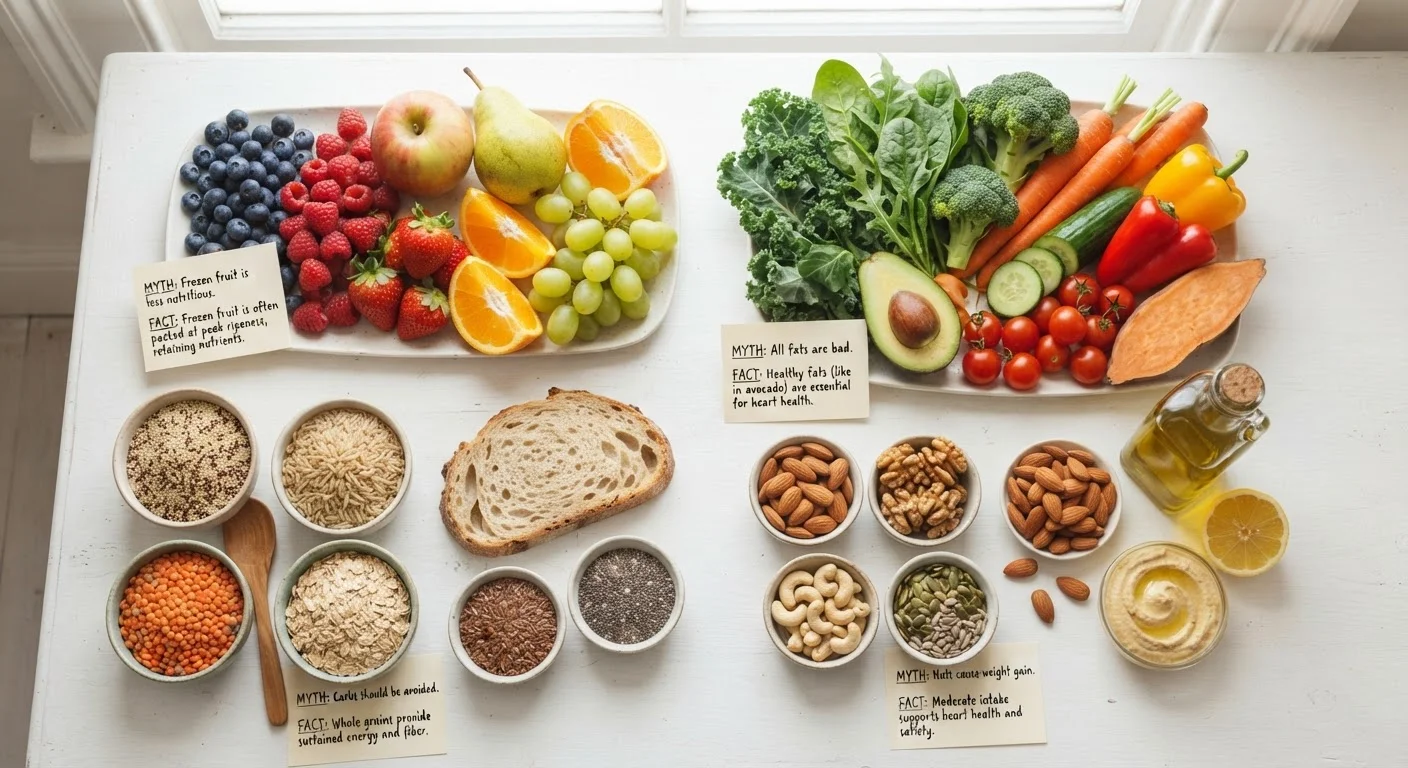
Key Takeaways
Why Nutrition Myths Are So Persistent
Nutrition advice travels fast. A headline, a social media post, or a friend's success story can harden into personal gospel within days. The problem is that many widely shared nutrition beliefs are either oversimplified, taken out of context, or rooted in outdated science. Understanding where these myths come from — and why they stick — is the first step toward eating with more confidence.
Much of the confusion stems from how nutrition research is reported. Small observational studies get amplified; nuance gets stripped away. Individual foods or macronutrients get labeled as universally good or bad, even when the evidence is far more complicated. The core principles of healthy eating are actually less dramatic than most headlines suggest.
Myth
Eating carbohydrates makes you gain weight, so cutting them out is the key to staying lean.
Fact
Carbohydrates alone do not cause weight gain. Overall calorie intake relative to expenditure, and the quality of carbohydrate sources, are what matter most.
The idea that carbs are inherently fattening gained traction alongside low-carb and ketogenic diets, but nutrition science tells a more nuanced story. Weight change is driven primarily by overall energy balance — how many calories you consume versus how many you expend. Carbohydrates provide four calories per gram, the same as protein, and the body uses them as its preferred fuel source. Refined, highly processed carbohydrates consumed in excess can contribute to weight gain, but the same is true of any macronutrient in excess. Whole-food carbohydrate sources like legumes, whole grains, and vegetables are associated with positive health outcomes in large-scale dietary research. For a deeper comparison of carbohydrate-restriction approaches, see how keto and low-carb diets actually differ.
Myth
Detox diets and juice cleanses remove toxins from your body and give your system a reset.
Fact
The human body has its own highly effective detoxification system — primarily the liver and kidneys — that operates continuously and does not require dietary cleanses.
The term "detox" is used loosely in wellness marketing but rarely defined in specific physiological terms. In clinical medicine, detoxification refers to treating poisoning or substance dependence — a very different context. For healthy individuals, the liver filters and processes waste products, and the kidneys excrete them via urine. There is no credible scientific evidence that juice cleanses, lemon-water fasts, or elimination protocols meaningfully enhance these processes or remove environmental toxins beyond what normal organ function already does. Some cleanse products may cause short-term digestive changes, but these are not evidence of toxin removal. Eating a diet rich in vegetables, fiber, and adequate water genuinely supports organ health — but that's not the same claim most cleanse products make.
Myth
Eating dietary fat makes you fat, so a low-fat diet is the healthiest approach.
Fact
Dietary fat is an essential macronutrient that does not directly convert to body fat. Low-fat diets are not universally superior and can displace beneficial nutrients.
The low-fat movement of the 1980s and 1990s was largely based on early research linking saturated fat to heart disease, but the public takeaway — that all fat is bad — went far beyond what the science supported. Dietary fat is essential for absorbing fat-soluble vitamins (A, D, E, and K), supporting cell membrane integrity, and producing hormones. Unsaturated fats, found in foods like olive oil, avocados, and nuts, are consistently associated with cardiovascular benefit in research. The issue is not fat as a category but rather the type and quantity of fat consumed, and what replaces it. Many commercial low-fat products substitute fat with added sugar or refined starches, which can be nutritionally counterproductive. The landscape of popular dietary approaches shows just how varied the evidence is across different fat-intake frameworks.
Myth
Skipping meals or eating less frequently boosts your metabolism and helps with weight management.
Fact
Meal timing has a modest effect on metabolism at best; total daily calorie and nutrient intake matter far more than the number of meals eaten.
The claim that skipping meals slows your metabolism — or conversely that eating many small meals speeds it up — has circulated for decades but lacks strong support in controlled research. The thermic effect of food (the energy cost of digestion) does mean the body burns some calories processing meals, but spreading the same total calories across more meals produces only a marginal metabolic difference. Some people find structured meal timing helpful for appetite regulation; others do well with fewer, larger meals. What research consistently supports is that total daily energy and nutrient intake drives outcomes more than meal frequency alone. Rigid rules about meal timing can also promote an unhealthy relationship with food — a topic explored in what mindful eating research actually shows.
Myth
Natural or organic foods are always healthier and safer than conventionally produced alternatives.
Fact
"Natural" and "organic" are labeling terms with specific regulatory meanings, but neither guarantees superior nutritional content or safety in all cases.
The appeal of natural and organic labeling is understandable, but these terms have precise — and limited — regulatory definitions that don't automatically translate to health superiority. Organic certification in the US, overseen by the USDA, refers to farming practices around pesticide and synthetic input use, not to nutritional profiles. Comparative studies of organic versus conventional produce have found mixed results on nutrient differences, with most showing modest or no meaningful variation. Similarly, "natural" on a food label has no strict nutritional standard under current FDA guidance. Some natural ingredients, such as certain plant compounds, can be harmful in high concentrations. Evaluating foods based on their full nutritional profile — rather than label claims alone — is the more evidence-grounded approach.
What the Evidence Actually Shows
Correcting a nutrition myth isn't just about being technically right — it matters because bad information leads to real dietary choices that can undermine health over time. Avoiding entire food groups, cycling through cleanses, or fearing whole categories of macronutrients can create unnecessary stress and nutritional gaps. As explored in why cutting out entire food groups usually backfires, elimination without guidance often creates new problems.
~80%
Adults who believe at least one nutrition myth
Surveys on nutrition literacy consistently find that a substantial majority of adults hold at least one inaccurate belief about diet, highlighting how widespread misinformation is.
4 kcal/g
Calories per gram in both carbs and protein
Both carbohydrates and protein provide the same caloric density, underscoring why labeling carbs as uniquely fattening oversimplifies the science of energy balance.
No proven benefit
Evidence for commercial detox diets
A review of available clinical evidence found no rigorous trials demonstrating that commercial detox or cleanse diets remove toxins or produce meaningful health benefits beyond dietary restriction itself.
Building a sustainable, evidence-based diet means holding these myths up to scrutiny — not replacing one rigid rule with another. If you've recently made sweeping dietary changes based on popular claims, it's worth reviewing them against what nutrition science consistently supports. See where people go wrong when trying to eat more healthily for a grounded look at well-intentioned changes that often backfire.
Extreme Dietary Restrictions Can Cause Harm
Eliminating entire food groups, following prolonged juice-only cleanses, or severely restricting calories based on popular myths can lead to nutritional deficiencies and other health consequences. Before making major changes to your diet, especially if you have a chronic health condition, speak with a registered dietitian or qualified healthcare provider. General nutrition information should never replace personalized professional guidance.
This article is for general informational and educational purposes only and is not a substitute for personalized medical or dietary advice. Consult a qualified healthcare professional or registered dietitian before making significant changes to your diet, especially if you have an existing health condition.