

Key Takeaways
Option A
Meditation
A dedicated, structured mental practice.
Best for: Anyone looking to build a consistent, intentional mental training routine with a defined start and end.
Option B
Mindfulness
An ongoing quality of present-moment awareness.
Best for: Anyone wanting to bring more awareness and intention into everyday activities without a formal practice.
If you want a defined daily mental training routine
Meditation
Formal meditation sessions give you a structured container for practice, making it easier to track consistency and deepen your skills over time.
If you want to feel more present without a scheduled practice
Mindfulness
Mindfulness as a quality can be applied to any moment — eating, commuting, or listening — without setting aside dedicated time.
If you're brand new and not sure where to start
Mindfulness
Starting with informal mindfulness in everyday moments has a low barrier to entry and builds the awareness that formal meditation later deepens.
If you want the most robust, research-supported mental wellness habit
Meditation
Structured meditation practices — particularly mindfulness-based programs — have the largest body of peer-reviewed research behind them.
Why the Confusion Exists
"Meditation" and "mindfulness" get swapped so often in everyday conversation that most people assume they're synonyms. They're not — though they are closely related, and that overlap is exactly where the confusion starts.
Think of it this way: mindfulness is a mental quality, and meditation is one of the most reliable ways to train it. That relationship is real, but it only runs one direction. You can be mindful without meditating, but you can't meditate mindfully without mindfulness. Understanding that distinction can help you decide which approach — or which combination — actually fits your life. For a broader look at how these ideas show up day-to-day, see what mindful living actually means.
What Meditation Actually Is
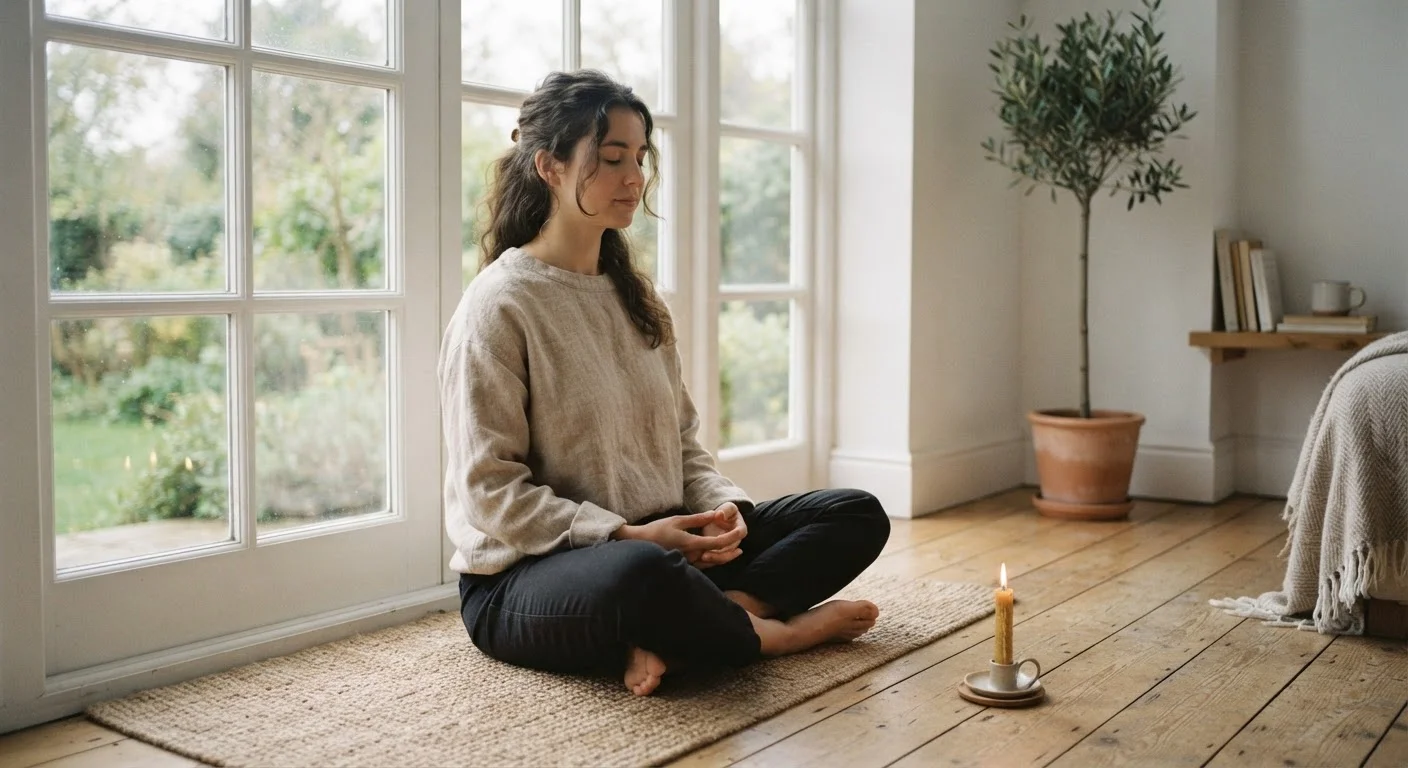
Meditation is a practice — something you sit down and do, with a beginning and an end. It involves deliberately directing your attention in a specific way, whether that's focusing on the breath, repeating a phrase (mantra), visualizing an image, or observing thoughts as they arise. It typically happens in a dedicated window of time, somewhere quiet, with the explicit intention to train the mind.
There are many styles of meditation. Some are rooted in Buddhist traditions; others are entirely secular. Mindfulness-based meditation — the kind most commonly studied in Western research settings — asks you to pay attention to present-moment experience, on purpose, without judging what you find. But loving-kindness meditation, body scan practices, and concentration-based techniques are all "meditation" too, even though they work differently.
| Criterion | Meditation | Mindfulness |
|---|---|---|
| What it is | A formal, timed practice | A quality of attention |
| When it happens | Dedicated sessions | Any moment, any activity |
| Requires stillness? | Usually yes | No |
| Can exist without the other? | Yes (other styles exist) | Yes — no meditation needed |
| Research support | Extensive, especially MBSR programs | Growing, including informal practice |
| Best entry point | Guided apps or classes | Present-moment awareness in daily tasks |
What Mindfulness Actually Is
Mindfulness is best understood as a quality of attention — a way of engaging with experience that is present-focused, intentional, and non-reactive. It isn't something you schedule; it's something you bring to whatever you're already doing.
Washing dishes, walking to the car, eating lunch: any of these can be done mindfully, meaning with full, non-judgmental awareness of what's happening in the moment, rather than on autopilot. That's mindfulness without any meditation required. Research supports the idea that this kind of informal practice still provides meaningful benefits — reduced stress reactivity and improved emotional regulation among them — though formal meditation tends to produce deeper, faster results for most people.
If you want to dig into which terms mean what in this space, a concise glossary of mindfulness terms is a helpful reference.
~14%
U.S. adults who meditate
According to a 2017 National Health Interview Survey, roughly 14% of U.S. adults reported meditating in the prior 12 months — triple the rate from a decade earlier.
8 weeks
Typical MBSR program length
Mindfulness-Based Stress Reduction (MBSR), one of the most studied structured programs, runs over eight weeks and has shown measurable effects on stress and anxiety in multiple clinical trials.
10 min
Minimum beneficial session length
Some research suggests even brief daily sessions of around 10 minutes can produce measurable improvements in focus and stress reactivity over several weeks.
Where They Overlap — and Where They Part Ways
The Venn diagram here is lopsided. Mindfulness meditation — the most common type people encounter — sits squarely in the overlap: it's a formal practice (meditation) that specifically trains present-moment awareness (mindfulness). That's why so many people treat the words as interchangeable.
But here's where they part ways:
- Meditation without mindfulness: A person could follow a guided visualization or mantra practice in a fairly mechanical, distracted way — technically meditating, but not cultivating much mindfulness.
- Mindfulness without meditation: A nurse fully present with a patient, a chef absorbed in the texture and smell of ingredients, a parent giving a child their complete, unhurried attention — all practicing mindfulness, none of them meditating.
This distinction matters practically. Some people find formal meditation inaccessible — too much stillness, too little time, or an underlying condition that makes it uncomfortable. For them, building mindfulness informally into daily habits may be the more sustainable path. Others thrive with structure and find that even 10 minutes of formal practice anchors everything else. A balanced look at structured practice can help you weigh that tradeoff honestly.
Choosing What Works for You
There's no rule that says you must pick one. Many people find that a short formal meditation session sharpens the mindfulness they carry into the rest of their day — the two genuinely reinforce each other. Others start with informal mindfulness and find it naturally leads them to want more structured practice over time.
What the research consistently suggests is that regularity matters more than the specific method. A mindfulness habit you actually maintain — whether that's five minutes of morning breathing or simply paying attention during your commute — outperforms a rigorous practice you abandon after two weeks. For a broader perspective on how these approaches connect to intentional living, slow living vs. mindful living is worth exploring.
Mindfulness Isn't One-Size-Fits-All
Some people find formal meditation uncomfortable or counterproductive, particularly those managing certain trauma histories or anxiety conditions. This is well-documented in the research. If sitting quietly with your thoughts feels distressing rather than calming, that's worth paying attention to — and discussing with a mental health professional. Informal mindfulness practices are often a gentler starting point.
This article is for general informational purposes only and is not a substitute for professional mental health advice. If you are experiencing significant stress, anxiety, or other mental health concerns, please consult a qualified healthcare professional.