

Key Takeaways
Why Rituals Work Better Than Willpower
Most of us have days that feel like they're happening to us rather than being shaped by us. Back-to-back tasks, constant notifications, and a to-do list that never quite empties — it's easy to arrive at 9 p.m. feeling like the day slipped through your fingers. That's exactly where everyday rituals come in.
Unlike resolutions or productivity systems that require sustained effort, rituals work because they're low-friction and repeatable. They become automatic anchors — brief pauses that signal to your brain: this is where we are, this is what we're doing now. Research in behavioral psychology consistently points to the power of cue-based habits, and rituals function in much the same way, except they carry an extra layer of intention.
If you're looking to design a daily routine that actually holds together, rituals are often the quiet scaffolding that keeps everything from collapsing under a busy week. And the good news? You probably already have a few without realizing it. The goal here is to make them more deliberate.
Rituals vs. Routines: A Subtle Difference
A routine is a sequence of actions done out of habit. A ritual is a routine you've made intentional — you're present for it, not just going through the motions. The same cup of coffee can be either one depending on how much attention you bring to it. The distinction matters because it explains why identical behaviors can feel meaningless for some people and grounding for others.
Below are seven everyday rituals worth trying — each one small enough to start today, meaningful enough to keep.
The Mindful First Drink
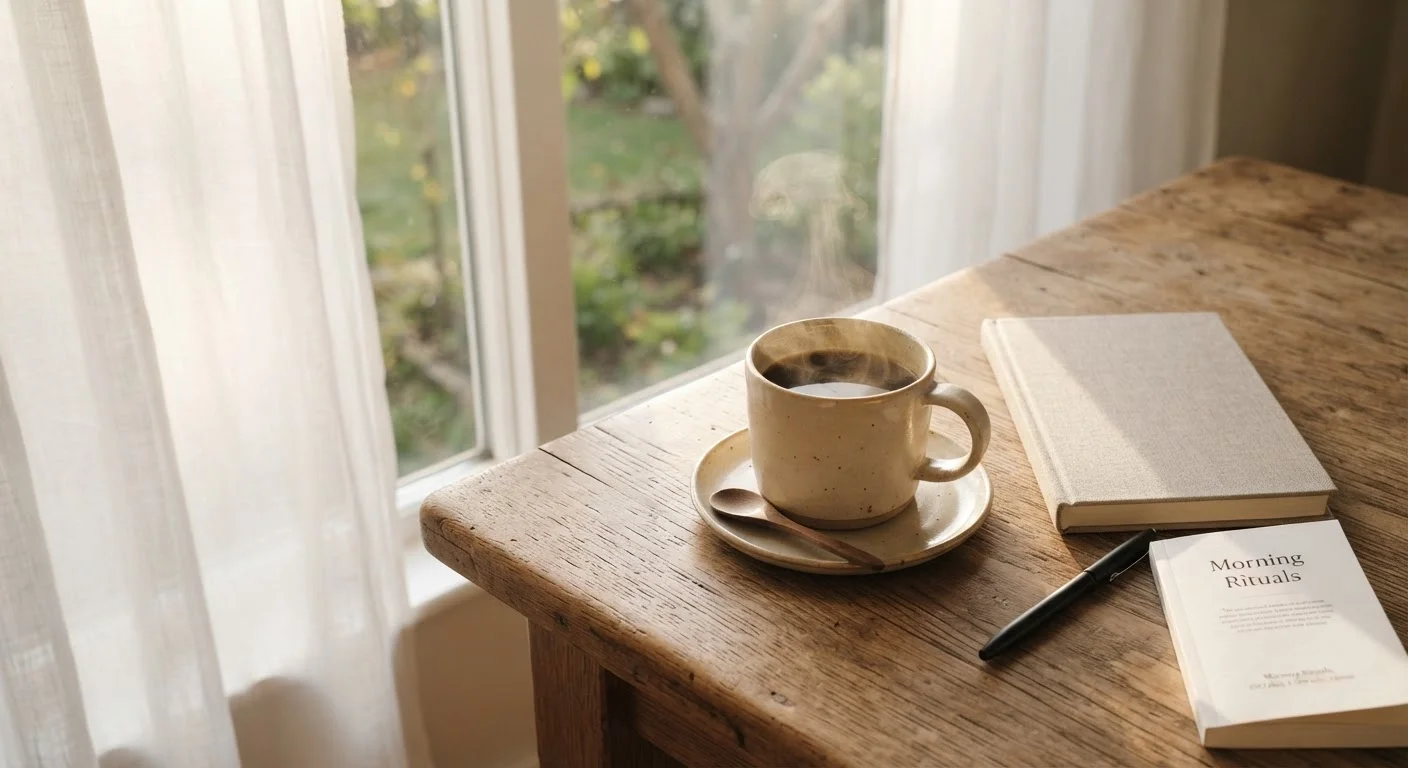
Before the phone, before the inbox — give yourself five minutes with your morning coffee, tea, or water. Sit with it. Notice the warmth of the cup, the smell, the quiet. This isn't about a formal meditation practice; it's about choosing one moment before the day pulls you in every direction.
This simple act signals a boundary between sleep and activity, and it sets a calmer tone for whatever follows. Think of it as a soft start rather than a running leap into the morning.
Five minutes of quiet before your phone is a small act of radical calm.
A Short Walk with No Destination
A ten-minute walk — ideally outside — done without a podcast or playlist creates a rare kind of unstructured thinking time. Your mind tends to organize itself when your body is in motion and your attention isn't being directed anywhere specific.
Whether it's after lunch or mid-afternoon when your focus starts to flag, a purposeless walk is one of the most underrated reset rituals there is. It's also a natural fit for the daily reset habits that help you bounce back from disrupted days.
An unscripted walk gives your mind room to quietly sort itself out.
Eating Without Distraction
At least one meal a day — lunch is often the most practical — eat without a screen in front of you. That's it. No multitasking, no scrolling, no catching up on the news.
Mindful eating has been associated with better digestion, reduced overeating, and a more satisfying relationship with food, according to general findings in nutrition and behavioral health research. Beyond the physical, it gives you a genuine mid-day pause. The Smart Meal Habits hub offers more practical guidance on eating more intentionally throughout the week.
One screen-free meal a day is a surprisingly effective act of mindfulness.
The Threshold Pause
This one is easy to overlook: before you walk through an important doorway — into your home after work, into a meeting room, into your child's school pickup — pause for just two or three breaths.
This micro-ritual creates a mental transition between contexts. It tells your nervous system that a shift is happening and gives you a moment to choose how you want to show up, rather than just reacting to whatever comes next.
A two-breath pause at a threshold is a conscious choice, not just a step.
An End-of-Work Closing Ritual
The boundary between work and personal time is increasingly blurry for many people. A closing ritual — even something as simple as writing down three things you completed today and closing your laptop deliberately — can help signal that work is genuinely done.
Without this kind of closure, the brain has a tendency to keep rehearsing unfinished tasks (a phenomenon psychologists sometimes call the Zeigarnik effect). Writing things down gives your mind permission to let go. Pair this with a strong evening anchor for a genuinely restorative end to the day.
Closing your workday deliberately is the ritual that protects your evening.
A Moment of Gratitude (Made Specific)
Generic gratitude lists can start to feel hollow pretty quickly. What tends to work better is being hyper-specific: not "I'm grateful for my friends" but "I'm grateful that my neighbor waved at me this morning and it made me feel less rushed."
The specificity is what makes it stick. It trains your attention toward the texture of ordinary life rather than its absence of problems. Even thirty seconds of this — done at the dinner table or just before sleep — is enough to shift your perspective meaningfully over time.
Specific gratitude trains your attention toward the texture of ordinary life.
A Wind-Down Sequence Before Sleep
The hour before bed is one of the most influential of the day, yet many people spend it in the most stimulating way possible — scrolling, streaming, or catching up on messages. A wind-down sequence doesn't have to be elaborate: dim the lights slightly, move away from screens, and pick one calming activity (reading, light stretching, journaling).
Consistency matters more than the specific activities you choose. When you repeat the same sequence each night, your brain begins to associate it with sleep — gradually making it easier to let the day go. For a calmer, less productivity-driven start to the following morning, see morning routines built around calm.
A consistent wind-down sequence teaches your brain to release the day on cue.
Building Your Personal Ritual Stack
You don't need to adopt all seven of these at once — that's a fast track to abandoning all of them. Instead, pick one or two that genuinely resonate with your current life and let them settle in for a couple of weeks before adding more.
A good starting point is to look at your natural transitions: when you wake up, when you sit down to eat, when you close your laptop for the day. These are moments already built into your schedule — you're just giving them a little more shape. For more ideas on where to start, our guide to morning vs. evening routines can help you identify which end of the day is the stronger anchor point for your personality and schedule.
Start With One Ritual, Not Seven
Trying to implement multiple rituals at once is one of the most common reasons routines fall apart within a week. Choose the single ritual that feels most natural to where you already are in your day, and let it become automatic before layering in anything new. Small consistency beats ambitious inconsistency every time.
It's also worth checking in honestly about what you're hoping to get from a ritual. Presence, calm, a sense of agency — these are all valid. But rituals are a supportive tool, not a cure-all. If you're dealing with significant stress, anxiety, or sleep difficulties, please reach out to a qualified healthcare professional. What rituals can do is make the ordinary moments of your day feel a little more yours.
This article is for informational purposes only and does not constitute medical or psychological advice. Always consult a qualified healthcare professional for concerns about your mental or physical health.