
The Science Behind Habit Formation: Why Some Changes Stick and Others Don't

Key Takeaways
Habit Formation
Habit formation is the process by which a repeated behaviour gradually becomes automatic — requiring less conscious thought and effort over time. It happens when the brain encodes a sequence of actions into a mental shortcut, triggered by a specific cue. Once a behaviour is habitual, it runs largely on autopilot, freeing up mental energy for other tasks.
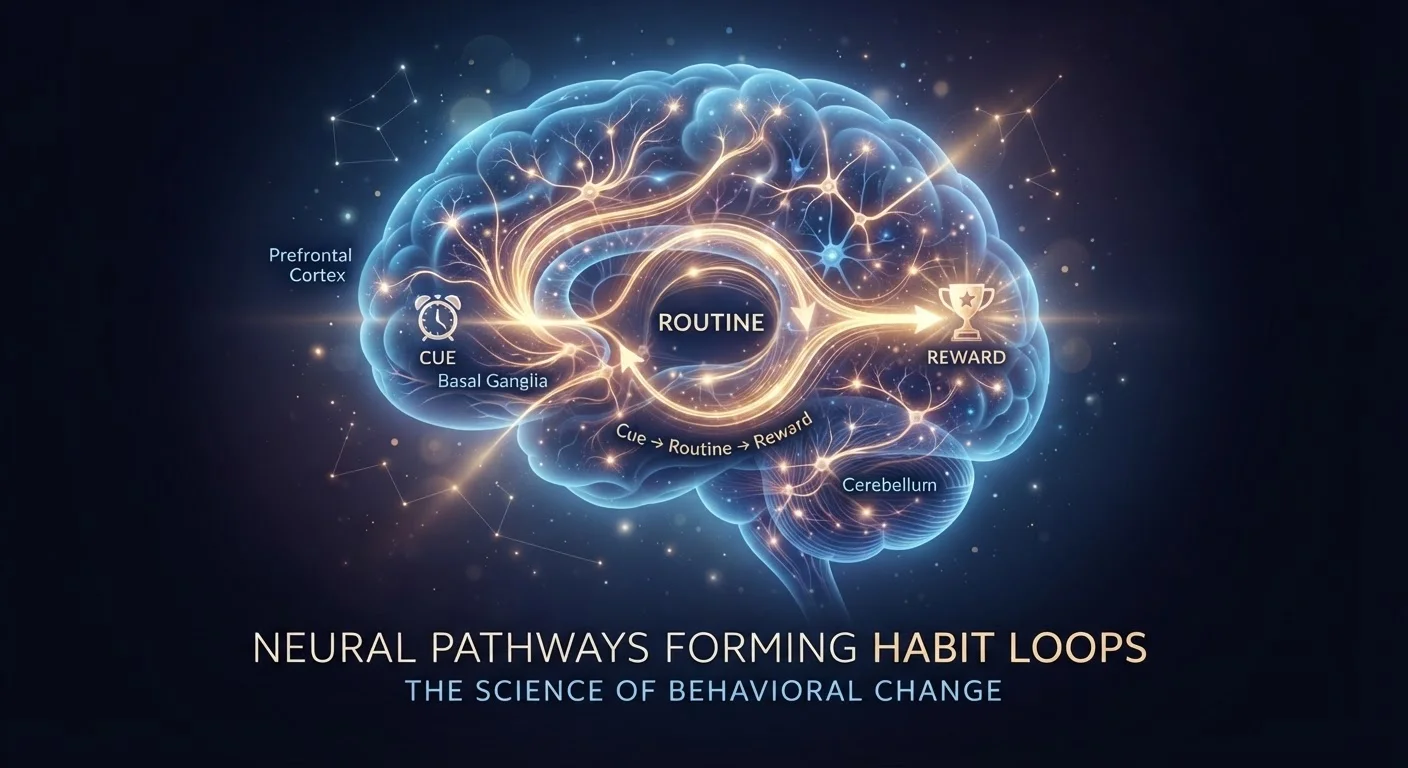
Neurologically, habit formation involves the basal ganglia, a brain region associated with procedural learning and routine. As repetition strengthens the neural pathway, the prefrontal cortex — responsible for deliberate decision-making — becomes less involved.
The Brain's Shortcut System
Your brain is a relentless efficiency machine. Every time you repeat a behaviour in a consistent context, your brain works to automate it — converting a deliberate action into a mental shortcut. This is the core of habit formation, and it happens whether you intend it or not.
The key brain structure involved is the basal ganglia, which handles procedural learning and routine execution. Early in learning a new behaviour, the prefrontal cortex — your planning and decision-making centre — is heavily engaged. With repetition, activity shifts toward the basal ganglia, and the action begins running on autopilot. The pathway becomes more efficient, like a trail worn into a field by repeated footsteps.
This is why experienced drivers can navigate a familiar route while holding a conversation. The driving routine has been transferred to automatic processing. The same mechanism governs far simpler behaviours: making coffee in the morning, reaching for your phone, or lacing up your shoes before a walk.
“Habits are the invisible architecture of everyday life. We make about 40 percent of our choices in the same situations, so our habits have an enormous influence on our existence.”
— Gretchen Rubin, Author and researcher focused on habits and human behaviour
The Habit Loop: Cue, Routine, Reward
Behavioural science describes habit formation through a three-part feedback loop. First, a cue — an environmental or internal trigger — signals the brain to initiate a behaviour. Second, the routine runs: the behaviour itself. Third, a reward tells the brain the loop was worth completing. Over time, this loop becomes encoded as a single unit of behaviour.
The reward is especially important. It's what causes the brain to "flag" the behaviour as worth repeating. Rewards don't have to be large — even a small sense of accomplishment or relief counts. What matters is that the brain registers a positive signal at the end of the routine.
Understanding this loop gives you real leverage. If you want to build a new habit, identify a reliable cue, define the routine clearly, and attach a genuine reward. If you want to change an existing habit, recognise what triggers it and what reward it's delivering — that's where the leverage lives.
66 days
Average time for a habit to become automatic
A study published in the European Journal of Social Psychology found the average automaticity plateau occurred at 66 days, with a range of 18 to 254 days.
40%
Daily behaviours estimated to be habitual
Research by habit scientists at Duke University estimated that roughly 40% of daily actions are habits rather than conscious decisions.
1 missed day
Impact on long-term habit formation
The same European Journal of Social Psychology study found that a single missed day had no significant effect on the long-term habit formation trajectory.
Why Context and Environment Matter More Than Motivation
One of the most consistent findings in habit research is that environment shapes behaviour more powerfully than motivation. We tend to overestimate how much our intentions drive our actions, and underestimate how much the physical context around us does.
If healthy snacks are at eye level in your kitchen, you'll eat them more often — not because you became more motivated, but because the cue is unavoidable. If your running shoes are by the door, you're more likely to use them. Behaviour researchers call this environment design, and it's one of the most evidence-backed approaches to sustainable habit change. See what researchers actually endorse for a deeper look at these strategies.
This is also why habits formed in one context often don't transfer automatically to another. A gym routine built during a stable period can fall apart during travel or a change in schedule. The cue has changed, and the loop breaks. Context stability is a quiet but powerful driver of habit durability.
Building Habits That Actually Last
The most common mistake people make is trying to build habits through motivation and discipline alone. Both are real, but both fluctuate. The goal of habit science is to make a behaviour require as little motivation as possible — to get it into the automatic zone.
A few principles hold up across the research:
- Start smaller than feels necessary. Tiny behaviours repeated consistently outperform ambitious behaviours attempted sporadically. A two-minute version of a habit is more useful than a one-hour version you never do.
- Anchor new behaviours to existing ones. This technique — sometimes called habit stacking — uses an established routine as a reliable cue, dramatically reducing the effort needed to remember or initiate the new behaviour.
- Focus on identity, not just outcomes. Research in behavioural science suggests that framing habits around who you are — rather than what you want to achieve — supports more durable change. Shifting how you see yourself shifts what behaviours feel natural.
The same logic applies to eating patterns. Eating habits that hold up over years follow these same neurological principles — small, consistent, context-supported choices rather than dramatic, short-term overhauls.
Make Your Environment Do the Work
Before relying on motivation, ask: can I redesign my space to make this behaviour easier? Move healthy snacks to the front of the fridge, leave your journal open on the desk, or set out workout clothes the night before. Small environmental nudges consistently outperform good intentions.