

| Framework origin | Behavioral science research; popularized in habit literature |
| Components | Cue → Routine → Reward |
| Types of cues | Time, location, emotion, people, preceding action |
| Average habit formation time | Roughly 18–254 days depending on complexity and consistency (Lally et al., European Journal of Social Psychology, 2010) |
| Key insight for change | Routines are interchangeable; cue and reward can stay the same |
| Applies to | Any repeated behavior — health, diet, productivity, skincare |
What the Habit Loop Actually Is
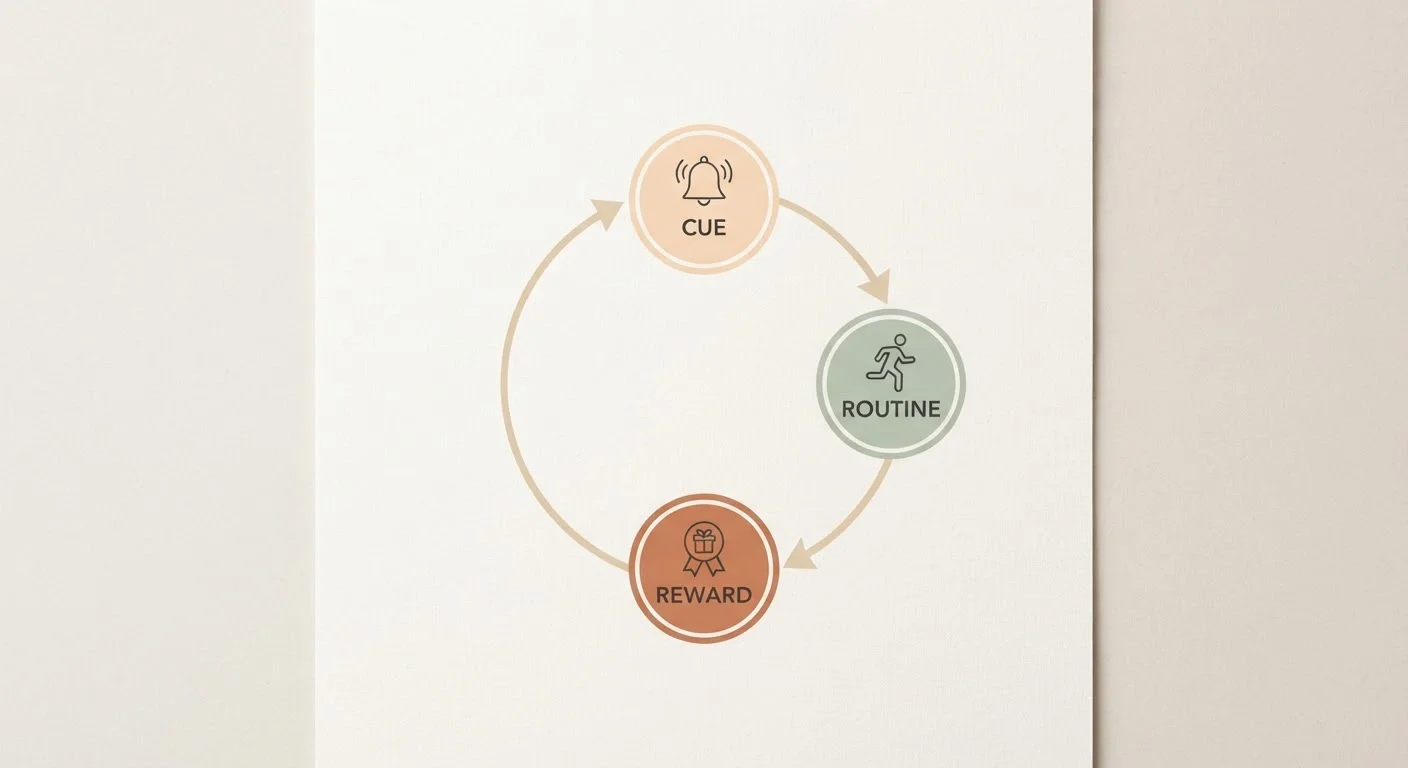
Behavioral researchers have long studied why certain actions become automatic while others never stick. The habit loop is one of the most widely cited frameworks for understanding this process. At its core, it describes a three-part cycle — cue, routine, reward — that the brain uses to encode and repeat behaviors with minimal conscious effort.
Think of it as your brain's efficiency shortcut. Once a behavior gets looped enough times, the brain stops deliberating and simply runs the pattern. That's great news when the habit is helpful — and a real challenge when it isn't.
Understanding each component gives you genuine leverage. You can redesign existing habits, troubleshoot ones that keep falling apart, or build new ones from scratch by engineering the loop intentionally. For a deeper dive into how this plays out in daily routines, see our guide to keystone habits.
| Framework origin | Behavioral science research; popularized in habit literature |
| Components | Cue → Routine → Reward |
| Types of cues | Time, location, emotion, people, preceding action |
| Average habit formation time | Roughly 18–254 days depending on complexity and consistency (Lally et al., European Journal of Social Psychology, 2010) |
| Key insight for change | Routines are interchangeable; cue and reward can stay the same |
| Applies to | Any repeated behavior — health, diet, productivity, skincare |
Breaking Down Each Component
The Cue
A cue is any trigger that initiates the habit loop. It signals to your brain: it's time for this behavior. Cues typically fall into five categories — time of day, location, emotional state, other people, or an immediately preceding action. For example, sitting down with your morning coffee might automatically cue you to check your phone. The cue doesn't have to be obvious; many operate just below conscious awareness.
When building a new habit, making your cue specific and consistent dramatically increases the chance the loop will form. Vague intentions like "exercise more" rarely produce reliable cues — whereas "lace up my shoes right after I brush my teeth" does. This is the foundation of habit stacking, a practical technique for anchoring new behaviors to existing ones.
The Routine
The routine is the behavior itself — the action you take in response to the cue. This is the most visible part of the loop and the component people most often try to change directly. But changing the routine in isolation, without addressing the cue that triggers it or the reward that sustains it, is one of the main reasons habits fail.
Routines can be physical (going for a walk), mental (running through a worry list), or emotional (seeking reassurance). The key insight is that the routine is interchangeable — the same cue and reward can support a different behavior, which is how habits can be reshaped rather than simply broken.
The Reward
The reward is what signals to your brain that the loop is worth repeating. It reinforces the connection between cue and routine, and over time creates a craving — an anticipation of the reward that actually drives the behavior. Rewards can be immediate (the pleasure of a snack) or cumulative (the calm you feel after a daily walk). Understanding what reward your current habits are actually delivering — which isn't always obvious — is often the most revealing step in changing them.
Habit loop
A three-part neurological cycle — cue, routine, reward — that the brain uses to encode and automate repeated behaviors over time.
Cue
A trigger (internal or external) that initiates a habitual behavior. Common cues include time of day, location, emotional state, social context, or a preceding action.
Routine
The behavior itself that occurs in response to a cue. It can be physical, mental, or emotional, and is the most commonly targeted component when people try to change habits.
Reward
The positive outcome or feeling that follows a routine and reinforces the habit loop. Over time, the anticipation of the reward — called a craving — begins to drive the behavior.
Craving
The motivational drive created by the brain's anticipation of a reward. Cravings make habits feel automatic and difficult to override without a substitute reward.
Habit stacking
A technique where a new behavior is linked directly to an existing habit, using the older routine's cue to trigger both actions in sequence.
Putting the Loop to Work
Knowing the framework is only useful if you apply it. Here's a practical starting point: pick one habit you want to build or change, then map its loop. Ask yourself — what consistently happens just before this behavior? What does the behavior feel like in the moment? And what do I get out of it, even if the payoff feels small or subtle?
For habits you want to build, design your cue first. Make it obvious, reliable, and tied to something you already do. Then keep the routine small enough to feel easy — the bar should be low enough that skipping feels stranger than doing it. Reward yourself immediately after, even briefly acknowledging that you followed through.
For habits you want to change, try keeping the cue and reward constant while substituting a different routine. The craving driving the loop often stays the same — what changes is how you respond to it. Pair this approach with a daily reset checklist to stay on track after disrupted days.
The habit loop also pairs naturally with identity-based thinking. When your self-image aligns with the behavior — rather than just the outcome — the loop tends to be far more durable. Explore that angle in our piece on identity-based habits. And if a habit keeps collapsing before it takes hold, understanding why habits break down can help you spot the pattern before it becomes permanent.