

Key Takeaways
Tyre Pressure
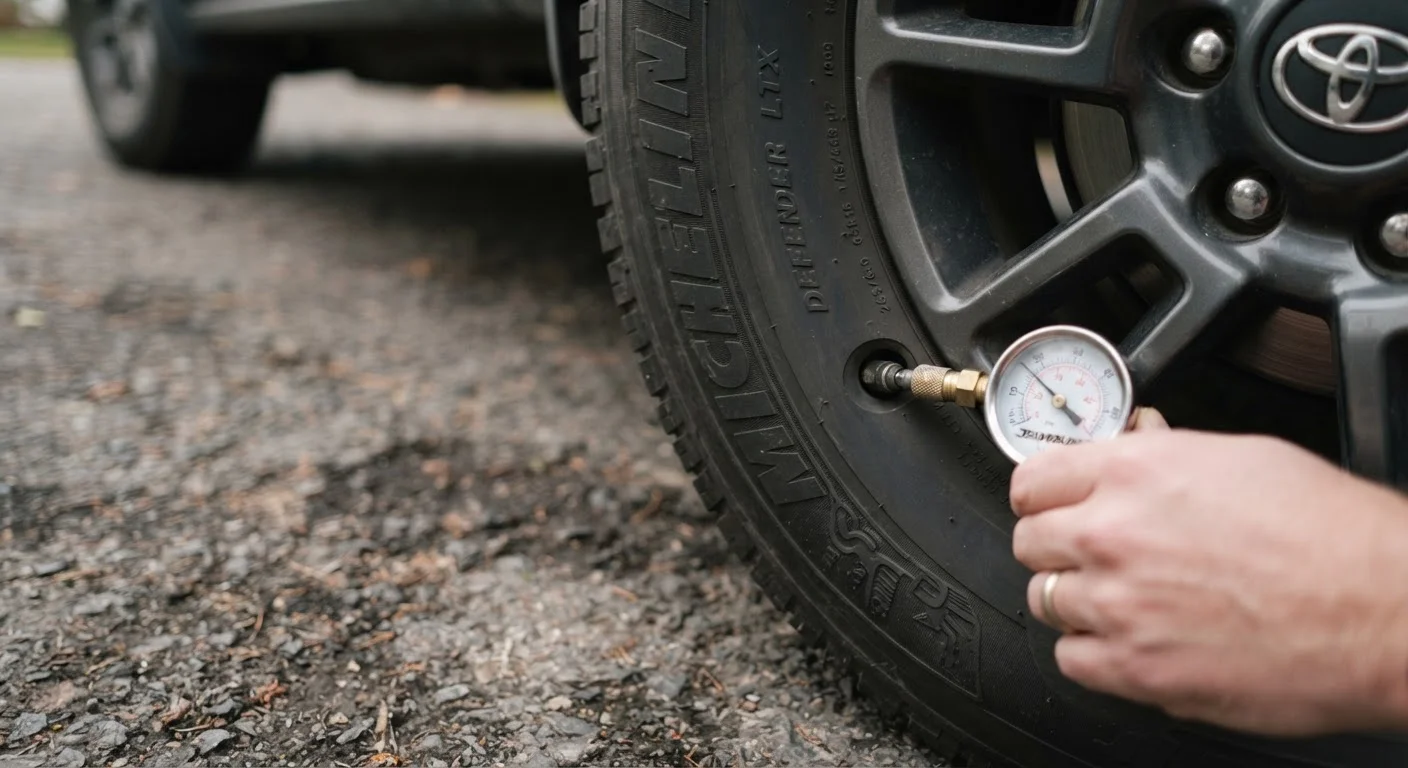
Tyre pressure refers to the amount of air inside a tyre, measured in pounds per square inch (PSI). Every vehicle has a manufacturer-recommended PSI range designed to balance safety, fuel efficiency, and tread wear. Running tyres outside that range — whether too high or too low — creates measurable problems that compound over time.
Recommended tyre pressure is set for the vehicle's load and suspension geometry, not the tyre itself; always check the placard inside the driver's door jamb rather than the maximum PSI printed on the tyre sidewall.
The Hidden Damage of Getting Pressure Wrong
Most drivers think about tyre pressure only when a warning light appears — by which point the damage is often already underway. Incorrect pressure works quietly, degrading safety margins and shortening tyre life over weeks and months before any visible symptom emerges.
Both underinflation and overinflation cause harm, but through different mechanisms. Underinflated tyres flex excessively with each revolution, building heat inside the tyre structure. That heat degrades the rubber compounds and internal cords, making blowouts more likely over time. It also increases the tyre's rolling resistance, meaning the engine must work harder — and burn more fuel — to maintain speed. As the lifetime cost of neglecting routine maintenance article explains, small oversights like this accumulate into significant expense.
Overinflated tyres present a different problem. A tyre pumped above its recommended pressure becomes rigid and sits on a smaller contact patch. Less rubber touching the road means reduced grip, longer stopping distances, and a harsher ride that transmits road shock more directly into the suspension. The centre of the tread also wears faster than the edges — the opposite pattern to underinflation.
~1 PSI
Pressure lost per 10°F temperature drop
A widely cited rule of thumb supported by the US Department of Transportation's tyre safety guidance.
Up to 0.3%
Fuel economy lost per 1 PSI underinflation
The US Department of Energy estimates fuel economy decreases by about 0.2%–0.3% for every 1 PSI drop below recommended pressure.
25% below
TPMS warning threshold (below recommended PSI)
Federal regulations require TPMS systems to alert drivers when pressure falls 25% below the recommended level — not at the first sign of underinflation.
What Correct Pressure Actually Means
The recommended pressure for your tyres is not a single universal number — it is specific to your vehicle's weight, suspension design, and intended load. Manufacturers specify this figure in PSI (pounds per square inch) and print it on a placard inside the driver's door jamb. It is also listed in the owner's manual. Front and rear axles often carry different recommended pressures, so check both.
A common mistake is inflating to the maximum PSI stamped on the tyre's sidewall. That figure is the tyre's structural limit, not the operating target for your car. Treating it as a guide almost always results in overinflation.
Check Pressure When Tyres Are Cold
Always measure tyre pressure before driving or after the car has been parked for at least three hours. Driving heats the air inside the tyre, raising pressure temporarily and giving a falsely high reading. Cold-inflation pressure is what your vehicle's placard specifies — matching that figure is what delivers the intended safety and efficiency balance.
Temperature is another variable most drivers underestimate. Tyre pressure is not static — it rises in warm conditions and falls in cold ones, approximately 1 PSI per 10°F of temperature change. A tyre correctly inflated in autumn may be noticeably underinflated by mid-winter without anyone touching the valve. This is why monthly checks with a calibrated gauge remain the reliable standard, even for vehicles equipped with a Tyre Pressure Monitoring System (TPMS).
The Real-World Cost of Ignoring Pressure
Tyre pressure is one of the cheapest maintenance tasks available to any driver — a quality gauge costs a few dollars and most gas stations offer free or low-cost air. Yet the financial consequences of ignoring it are disproportionately large.
Consistently underinflated tyres can reduce fuel economy by a measurable margin, a cost that accumulates with every tank. More significantly, improper pressure can shorten tyre life by thousands of miles, shifting the replacement cycle forward by a year or more on a set of tyres that already represent a substantial investment.
Beyond cost, there is a safety dimension. Wet-weather handling is particularly sensitive to tyre condition. Driving in heavy rain is already a demanding scenario — tyres operating outside their recommended pressure range make that scenario measurably more dangerous by compromising both grip and drainage performance.
Drivers looking to build broader habits around vehicle running costs will find tyre pressure fits naturally into a wider routine. See smart habits for keeping long-term running costs under control for a practical framework that goes beyond tyres alone.